A group of astronomers led by the National Astronomical Observatory of the Chinese Academy of Sciences
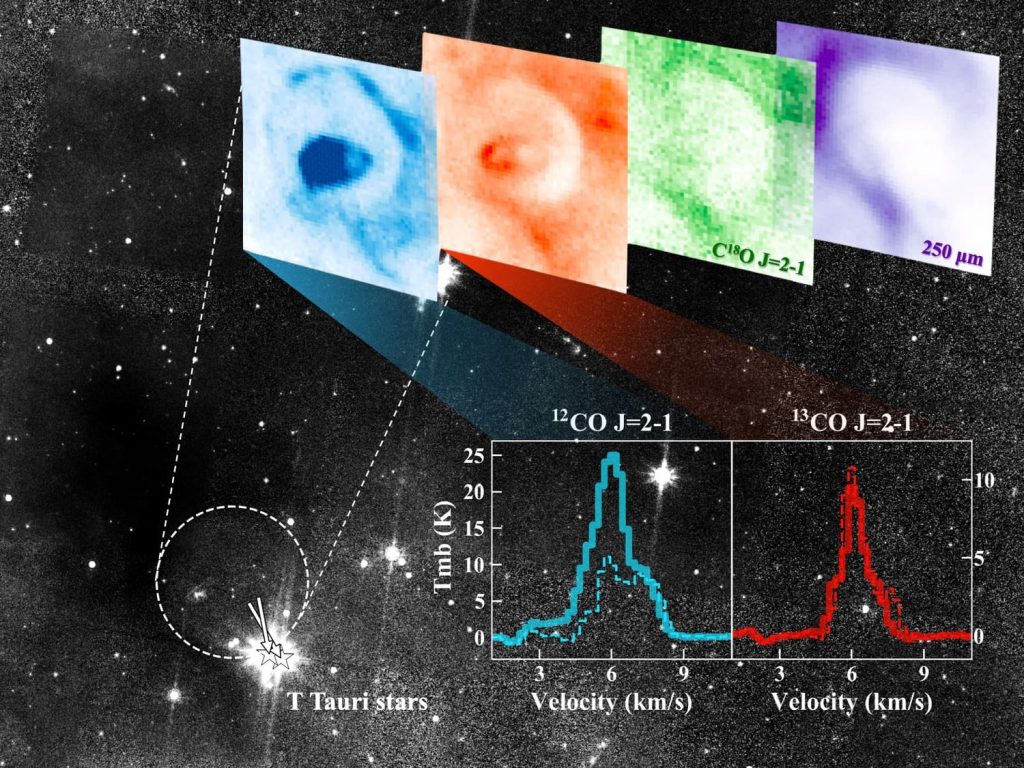 Multiwave images and spectra of a molecular bubble. Image: Duan Yan, Chinese Academy of Science
Researchers monitored carbon monoxide emissionsgas in the molecular clouds of Taurus using the 30-meter radio telescope of the Institute of Radio Astronomy in the Millimeter Wave (IRAM) in Spain and the James Clark Maxwell Infrared Telescope (JCMT) in the USA. An analysis of the data obtained in different ranges of electromagnetic radiation showed the presence of a gas outflow in the center of the molecular bubble.
The researchers analyzed the survey dataskies collected by the Gaia mission and concluded that the source of the unusual formation is a pair of binary stars. It was formed about 70 thousand years before observations. Previously, only one such bubble was known to leak gas.
 Three-color map of bubble structure and expiration.Blue corresponds to hydrogen, red to carbon monoxide, and green to 250 µm observations. Image: Yan Duan et al., The Astrophysical Journal
In the process of star formation, a protostarinteracts with the environment and causes observable dynamic phenomena, including molecular bubbles or gas outflow. In most cases, researchers observed only one of these phenomena. The new discovery testifies to the common nature of these two phenomena, the authors of the study say.
Read more:
An Earth-sized planet has been found not far from us. Perhaps there is an atmosphere
Look at the golden "braces" of the 17th century: they were installed by a socialite
Named the real reason for the disappearance of the Hittite Empire
On the cover: Taurus molecular cloud. Image: ESA/Herschel/NASA/JPL-Caltech; acknowledgment: R. Hurt (JPL-Caltech)