
In the last few days, Unity has managed to make a whole combo of scandals.Together, they add up to
Broken Promise
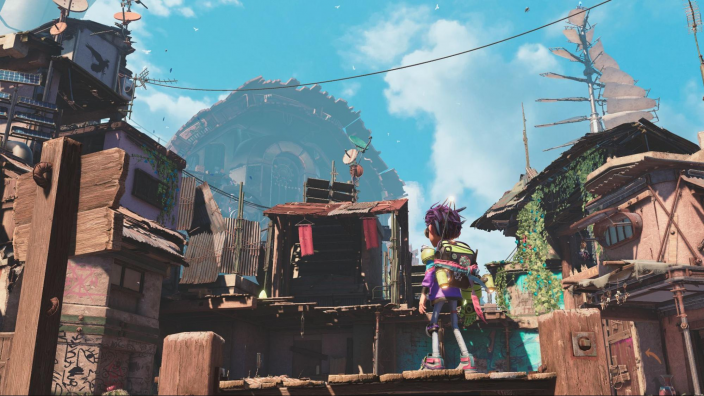
In March, Unity announced that it was going to shipto the release of Gigaya, an indie game from an in-house studio. The idea was to create a team in Unity that is close to the “field conditions” of indie creators: working with a relatively small staff, some of the employees contribute remotely, and the key goal is to release their game on Steam.
In addition, they were going to make a training tool out of Gigaya: they planned to publish the intricacies of production in the public domain for all Unity users.
But on July 4, a post appeared on the official forum,where Unity announced the suspension of the development of Gigaya The game will not be put on public display: for this, projects need to be cleaned of unnecessary software tails, but, according to the company, it is better to spend resources on some other areas.
Gigaya will remain only as an internal project. According to Unity, she gained a lot of useful experience in creating the game.
Developers often criticize Unity for beingdoes not understand the needs of its customers well enough: the company has never released full-fledged products on its own engine, which means that it misses various nuances of production and does not feel pain from them in its own skin. But the Unreal Engine team has the necessary experience: Fortnite is a real game, where Epic Games new technologies are often tested.
</ img>
Trojan manufacturers
On July 12, Unity announced that it was acquiring the companyironSource - it specializes in solutions for monetization, marketing, analytics and audience search. IronSource's tools seem to be particularly well suited to ever-evolving games and non-gaming applications.
What if we give the authors an engine for game services,which by default allows you to collect early indicators of success due to user engagement in their prototype? What if the engine gives a feedback system? based on interaction with real players at earlier stages?The combined offering of Unity and ironSource will create a unique company that provides a platform for both game development and growth.” -Unity in the official announcement
The piquant nuance is that ironSource came up withinstallCore is a wrapper for installers that can bring along a bunch of additional programs that are often unnecessary for the user. Inexperienced people searched for a program on the Web, got to the installer by installCore and naively invited a lot of garbage to their computer.

</ img>
installCore appeared in 2010 and somewhere sinceIn 2014, popular security software vendors began classifying this wrapper as unwanted or even harmful. For example, there was a case when, with the help of installCore, users were allegedly palmed off with a Windows version of the popular Snapchat chat. In fact, it was a disguised Android emulator, where they added applications with ads.
ironSource dropped installCore in 2015,when it teamed up with Supersonic, the developer of an in-app purchase platform. That is, ironSource seems to have tried to distance itself from the reputation of the manufacturer of malicious software, but the Internet does not forget - many began to criticize Unity for such a dubious neighborhood.
The press writes that the agreement between Unity and ironSource is estimated at $4.4 billion.

</ img>
"Stupid Idiots"
After the announcement of the agreement with ironSource, an interview was released with the head of Unity, John Richitello, and the general manager of Unity Create, Mark Witten. There is a provocative moment:
“Interviewer: The desire to introduce monetization earlier is clearly putting off some developers”.
Richitello:Ferrari and some other high-end car makers still use clay and finishing knives. A very small part of the gaming industry works this way, but some of them are my favorite people in the world, with whom I just love to discuss. They are beautiful and clean, shiny faces. But they are also the dumbest idiots in the world.
I've been in this industry longer than mostthe rest, even managed to become gray-haired. Previously, it was customary for developers to throw games at the wall at publicists and retailers without prior interaction. This model is embedded in the philosophy of many forms of art and media. And I respect her a lot. I know that people put their soul into their efforts.
But the industry divides the people of those who stilladheres to this philosophy, and those who seek to understand how to create a successful product. Also, I don't know of a single successful creator who doesn't care what the players think. This is where the feedback loop comes in handy [like the one offered by ironSource as part of Unity] and can be ignored. But choosing not to know the opinions of the players at all is the wrong step.
The quote is bright and scattered across social networks: they say, if you don’t think about monetization in advance, then Richitello considers you a “stupid idiot.” Such words did not sit well with some of the developers, especially among Indies.
i made Apple's iPhone Game of the Year2018 (Donut County) using unity, but consistent with its CEO and’m a ‘big fucking idiot’ for not producing Hole io, the f2p game that ripped it off ???? https://t.co/Gv1zqy0BjH
– Ben Esposito (@torahhorse) July 14, 2022
Someone started to say that before Richitelloheaded Electronic Arts (from 1997 to 2004 and from 2007 to 2013), a company that has long been famous for its dubious business practices. Others remembered either a joke or a snide expression by Japanese developer Goichi Suda (Goichi Suda) - in his game Travis Strikes Again: No More Heroes, a villain named Damon Richitello.
There is a version that the Japanese has personal accounts withformer EA boss. During Richitello's tenure, EA was working on Shadows of the Damned, the game Sud was working on. However, during production, EA intervened in the creative process to make Shadows of the Damned more appealing to Western audiences. The result was the game that Sudu dreamed of. A similar line can be traced in the story of Damon Richitello, who appeared in Travis Strikes Again a few years later.
</ p>On this adventure, Unity in the info field is notend: recently in the press there was information that hundreds of people were being laid off from the company. In a recent interview, Richitello clarifies that about half of the excited employees were redeployed to other Unity departments, so the scale of layoffs is exaggerated.
However, in combination with other Unity scandals that hit the company within a matter of days, such a clarification does not improve the company's image.
</ p>