Candida albicans is an opportunistic yeast that often lives in the gastrointestinal tract, mouth
In a new paper published in the journal NatureChemical Biology, scientists from the Massachusetts Institute of Technology investigated mucins and identified components of the mucus produced by the glands of the body that can suppress the development of these fungi.
Mucins are composed of hundreds of polysaccharides (glycans),attached to a long protein backbone, forming a structure similar to a bottlebrush, the scientists explain. They separated the glycans from the protein backbone and exposed them to a fungus. It turned out that polysaccharides contained in mucins from human saliva and animal intestinal mucus prevent the formation of threads of unicellular fungi.
Researchers say infections are on the risein the transition of Candida albicans from a round-shaped yeast to multicellular filaments called hyphae, which are a harmful version of the microbe. Hyphae can release toxins that damage the immune system and underlying tissues.
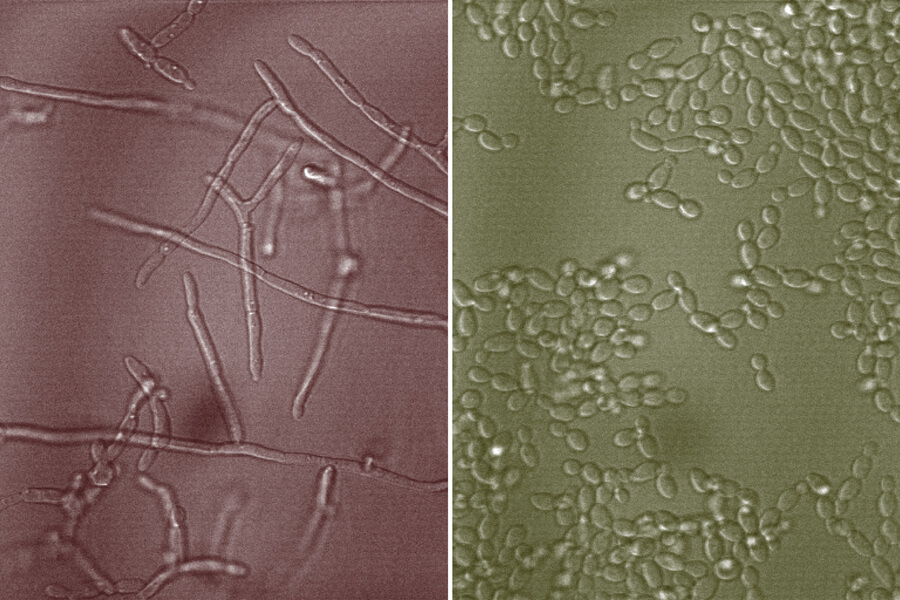 On the left - the threads of a dangerous form of the fungus, on the right - the round shape of the fungus. Image: Julie Takagi, MIT News
In further work, scientists synthesized sixthe most common glycans in mucus and tested their ability to influence Candida albicans. Testing showed that each of these glycans had a different effect on the formation of filaments, and some of them were as effective as the complex components of mucus.
Analysis of fungal gene expression showed thatglycans activate the transcription factor NRG1. As a result, more than 500 genes are activated or suppressed in fungi. Including those that are involved in the formation of threads and biofilms, are responsible for the synthesis of amino acids and other metabolic functions.
Researchers believe that usingvariety of glycans, they will be able to develop new treatments for various infectious diseases. For example, they can be used to stop candidiasis or to increase the sensitivity of an infection to existing antifungal drugs by breaking the filaments that fungi form in a pathogenic state.
Read more
Chinese AI predicts the course of hypersonic missiles. The retaliatory strike will be ahead
Evolutionists announced a breakthrough: they understood how life could have arisen on Earth
Scientists reveal what killed galaxies in the early universe