In the 1950s, in the Northern Hemisphere, four seasons followed each other in a predictable and fairly uniform manner.
“Summers are getting longer and hotter and winters are getting shorter and warmer due to global warming,” explains Yuping Guan, an oceanographer at the Institute of Oceanology of the Chinese Academy of Sciences. Study publishesGeophysical Research Letters.
The researchers used historicaldaily climate data from 1952 to 2011 to measure the duration and onset of four seasons in the Northern Hemisphere. Scientists then used established models of climate change to predict how the seasons would change in the future.
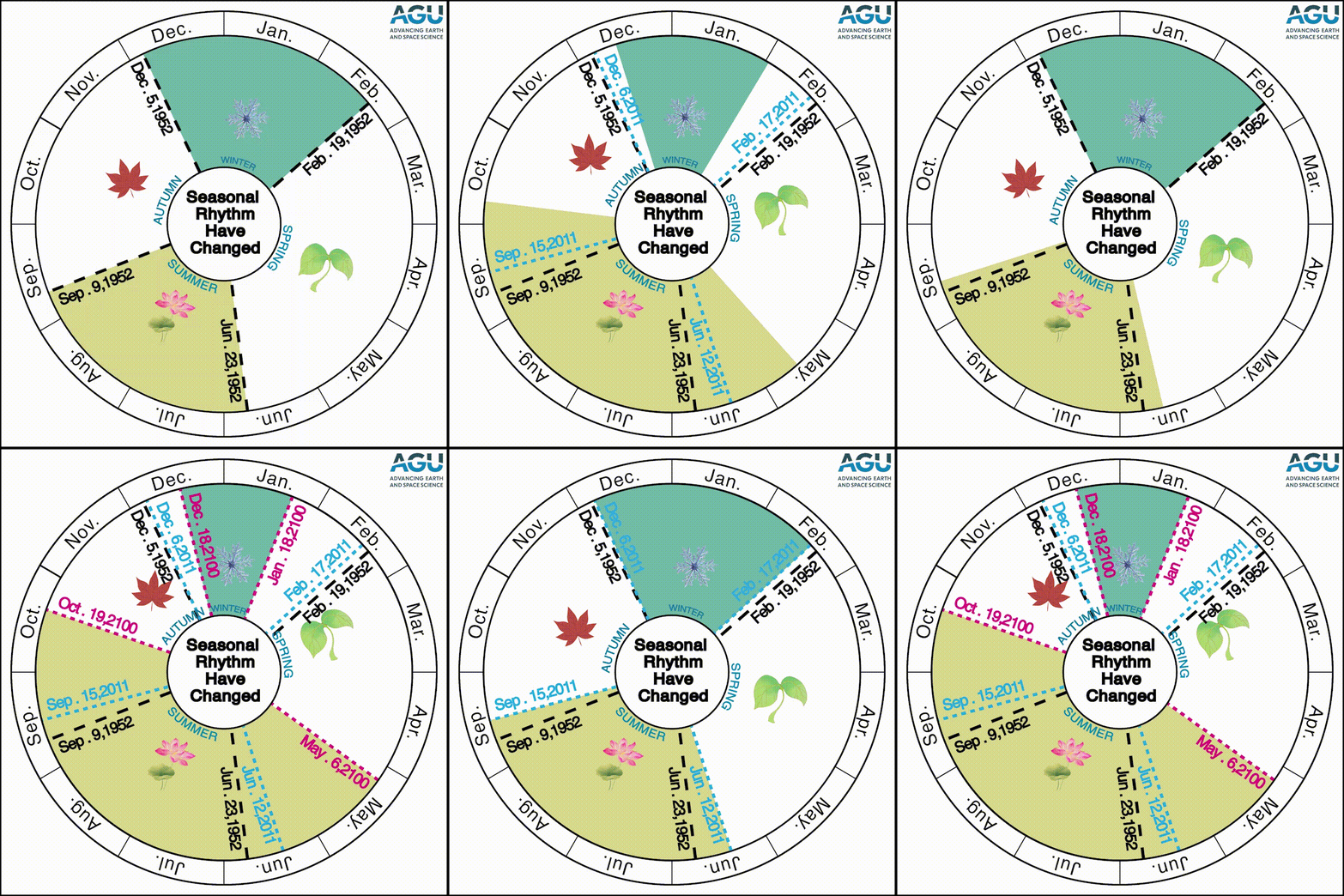 Changes in the average start dates and durations of the four seasons at the northern hemisphere mid-latitudes in 1952, 2011 and 2100. Photo: Wang et al., 2020 / Geophysical Research Letters / AGU.
The results showed that on average summerincreased from 78 to 95 days, and winter decreased from 76 to 73 days. Spring and autumn also fell from 124 to 115 days and from 87 to 82 days, respectively. Simply put, spring and summer started earlier, and autumn and winter later. The Mediterranean region and the Tibetan Plateau have experienced the biggest changes in their seasonal cycles.
If these trends continue without anyefforts to mitigate the effects of climate change, researchers predict that by 2100 winter will last less than two months, and the transitional spring and fall seasons will also be reduced.
Seasonal changes can also wreak havocagriculture. In addition, with a longer growing season, people will inhale more pollen that causes allergies, and mosquitoes that carry diseases will expand their range northward.
Read more
Physicists have created an analogue of a black hole and confirmed Hawking's theory. Where it leads?
Algorithm has discovered a new mysterious layer inside the Earth
Because of the Sun, the Earth's atmosphere will lose all free oxygen