An international team of astrophysicists has studied the super-Earth GJ 1252b, orbiting an M-class dwarf - the most
Scientists have measured the infrared radiation of the planet,when her light was hidden during the secondary eclipse. This event is associated with the passage of an object behind a star. The analysis showed that the daily temperature on GJ 1252b exceeds 1,200°C. This is enough to melt gold, silver, and copper on the surface.
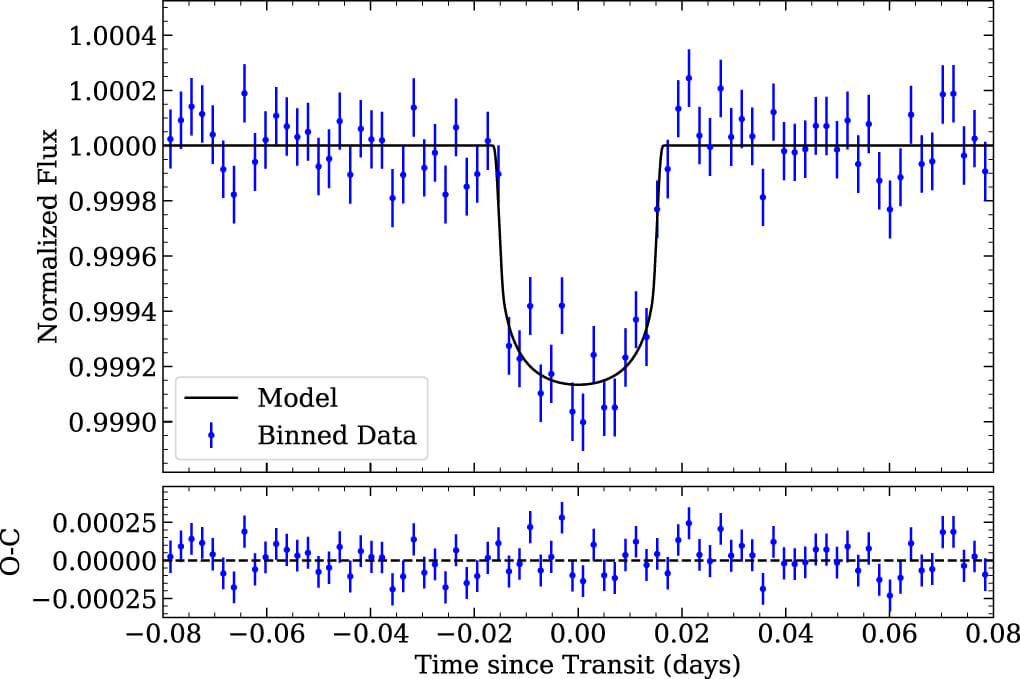 Secondary transit observation data. Image: Ian J. M. Crossfield et al., The Astrophysical Journal Letters
Planetologists have calculated that even with a hugethe amount of carbon dioxide that traps heat, such a planet would not be able to retain an atmosphere. At first, the gas will accumulate, but then narrow and collapse. In addition, stellar flares, which happen much more often in M-class dwarfs than in the Sun, will completely destroy the atmosphere, scientists say.
The authors note that this studyis important not only for a single planet, but also for understanding the development of exoplanets and the search for extraterrestrial life in general. There are about 5 thousand stars in the vicinity of the Sun, most of which are M-dwarfs. The results of the study show that the probability of such stars having habitable worlds is quite low.
 Artistic illustration of an atmosphere blown away by the pressure of a star's light. Image: NASA
Scientists believe that planets similar to Earth should be looked for primarily in stars resembling our Sun. Fortunately, in outer space there are also quite a few of them.
Read more:
A monster black hole was found in the "backyard" of the Earth: it is very close to our planet
NASA revealed the origin of Haumea - the most mysterious planet in the solar system
Webb photographed the Pillars of Creation. Compare how Hubble shot them before