Supercomputer simulation on the Texas Advanced Computing Center's (TACC) Frontera supercomputer
“It was during this era that we noticed extremeand the relatively rapid merger of three massive galaxies. Each of them has a mass 10 times greater than the mass of the Milky Way, and at the center of all there is a supermassive black hole. The simulations showed that these triplet quasar systems are the progenitors of supermassive black holes after they gravitationally interacted and merged with each other,” the scientists wrote.
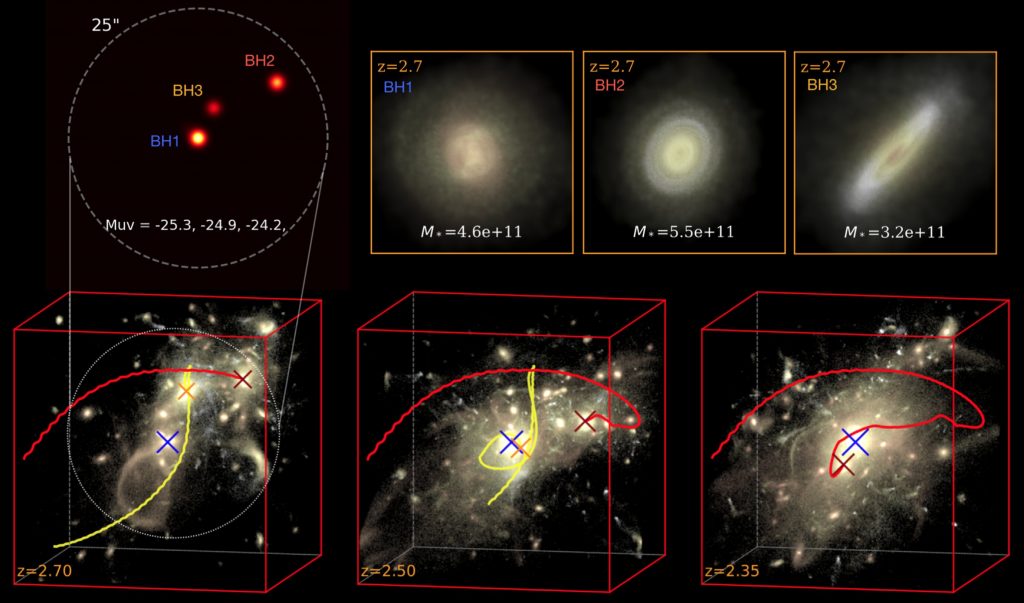 Shown here is a triplet system of quasars,centered around the most massive quasar (BH1) and its surrounding host galaxy in the simulation. The red and yellow lines mark the trajectories of the other two quasars (BH2 and BH3) in the BH1 frame as they swirl into each other and merge. Photo: DOI 10.3847/2041-8213/aca160
Computer modeling helps astrophysicistsfill in missing information about the origins of stars and exotic objects such as supermassive black holes. These are the most massive objects in the Universe. Their mass can reach millions and billions of solar masses. One of the largest cosmological simulations to date is called Astrid. This is the largest simulation in terms of particles or memory load in the field of galaxy formation simulations.
“Astrid’s scientific goal is to study the formationgalaxies, mergers of supermassive black holes and reionization in cosmic history,” explain the study authors. Astrid models large volumes of space, spanning hundreds of millions of light years, but can scale up to very high resolution.
Read more:
The mystery of the red stripes on the satellite of Jupiter is revealed
Found "impossible" planet. She defies modern science
Mysterious hexagonal "honeycombs" in salt deserts found an explanation