Physicists from the Massachusetts Institute of Technology have discovered an unusual property of graphene with a "magic
To create a "controlled superconductor"physicists placed graphene between two layers of boron nitride, a two-dimensional insulating material. The center of this "sandwich" is formed by two sheets of graphene, while the upper one is rotated with respect to the lower one by a "magic" angle of 1.1°. From above and below it is covered with layers of boron nitride. In this case, the first one is aligned with respect to the upper layer of graphene, and the second one is shifted by 30°.
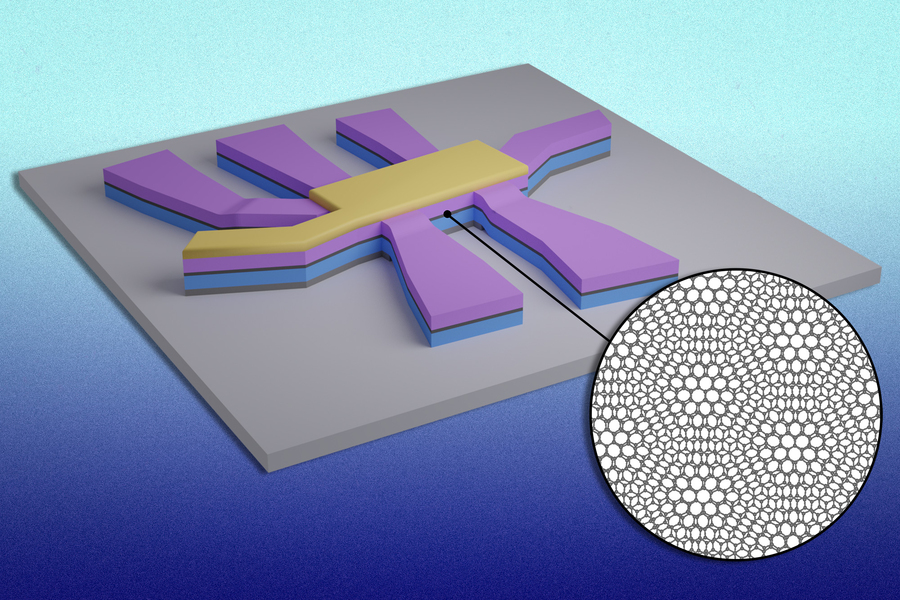 Device illustration:the dark gray graphene in the center is sandwiched between layers of boron nitride (blue and purple). The inset shows patterns formed by two-layer graphene folded at a “magic” angle. Image: Dahlia R. Klein et al., Nature Nanotechnology, MIT News
The researchers found that ifvoltage on such a layer of graphene, then the twisted two-layer graphene switched electronic states, passing between insulating, conducting and superconducting states at certain known voltages.
Researchers have obtained similar resultsearlier, but in a new study, physicists have also shown that the electronic state persists rather than disappears after the voltage is removed. They found that at a certain voltage, the graphene layers turned into a superconductor and remained so even after the voltage was turned off.
This bistable effect suggests that a "snap of fingers" - a short electrical pulse - is enough to activate superconductivity in twisted graphene.
For the vast majority of materials, ifremove the electric field, the electric state will disappear. For the first time, a superconducting material has been created that can be abruptly turned on and off using electricity. This will pave the way for a new generation of graphene-based twisted superconducting electronics.
Pablo Jarillo-Herrero, professor of physics at the Massachusetts Institute of Technology and study co-author
Read more:
Sword thought to be fake turns out to be a 3,000-year-old Bronze Age artifact
New passages from the Book of the Dead found in Egypt
Watch the hydrogen superyacht 'fly' over the water at 75 knots