The authors of the new work used crushed molecular spheres of carbon to create a new material,
Carbon is a universal tool, fromwhich can be made into many stable structures in various atomic configurations - from graphene to diamond. These can be repeating crystalline patterns or amorphous like glass. The atomic bonds themselves can form in two or three dimensions—this determines the hardness of the material. But there are some shapes, like diamond glass, that are more difficult to make than others.
We have long studied how to synthesize an amorphous carbon material with three-dimensional bonds. The trick is to find the correct source component.
Yingwei Fei, author of the new study
If graphite is placed under high pressure, thenyou get the crystal lattice of the diamond. It would be logical to use diamond to make diamond glass, but its melting point of 4.227 ° C is too high for practical use. Therefore, the authors were looking for a form of carbon that could become atomically disordered enough before being subjected to pressure.
This is how the researchers came to fullerene, orBuckyballu is a molecular compound that looks like convex closed polyhedrons. It is made up of 60 carbon atoms arranged in the shape of a hollow soccer ball.
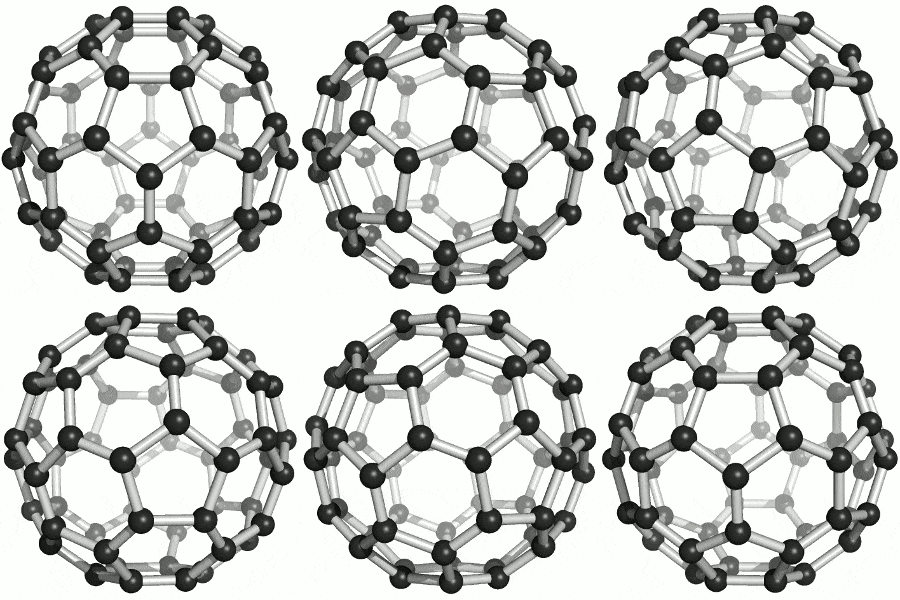
The team heated it up until the balloon wasturned into a chaotic set. Then the substance was placed under pressure. The result is a diamond-like glass. It was made in the form of pieces of millimeter size.
The resulting glass withstood 102 gigapascals. That's higher than natural diamond, but lower than AM-III, a form of glass recently synthesized in China that can withstand up to 113 gigapascals.
The team also claims that the new superhardglass has the highest thermal conductivity of all amorphous materials - k 26. It can also be synthesized at temperatures from 900 to 1000 ° C, this is within the reach of industrial production.
Read more
See what Saturn looks like from the Moon. Photo taken by NASA orbiter
Hubble completes a journey through the outer solar system: what he saw there
The fusion reactor KSTAR sets a record: it holds the plasma longer than ever