Modern comics as part of Western popular culture flourished in the United States in the 20th century.At first, it was
Science versus comics?
Psychiatrist Fredrik Wertham was studying crime youth in New York in the 1940s when he noticed that many of his patients were reading cheap comic books that were full of violence.
In his popular book Seduction of the Innocent(1954) Huertham argued that comics corrupted young, receptive readers. These comments lent scientific credibility to an already widespread anti-comic book bias. For example, Sterling North wrote in an editorial for the Chicago Daily News: “A poorly drawn, poorly written, and poorly printed comic strip is a tremendous strain on young eyes and young nervous systems. This paper-paper nightmare acts as a powerful stimulant. "
Psychiatrist Fredrik Wertham was studying crime youth in New York in the 1940s when he noticed that many of his patients were reading cheap comic books that were full of violence.
In his popular book Seduction of the Innocent(1954) Wertram argued that comics corrupted young, receptive readers. These comments lent scientific credibility to an already widespread anti-comic book bias. For example, Sterling North wrote in an editorial for the Chicago Daily News: “A poorly drawn, poorly written, and poorly printed comic strip is a tremendous strain on young eyes and young nervous systems. This paper-paper nightmare acts as a powerful stimulant. "
In the years that followed, a wave of worried parentsand educators teamed up to ban them altogether. This later led to hearings before the US Senate Subcommittee on Juvenile Delinquency and the establishment of the Comic Code Office, which halted the industry's growth and development for decades. These events, often referred to as the preamble to the birth of the 1960s and 1970s underground "comics", also thwarted the educational use of comics.

Wertham's mistake was that he gavetoo much emphasis on the content of the comics (yes, not the most instructive stories), rather than the widespread appeal of this media. Had he been careful, he would have noticed that in the 1940s and 1950s, they were read not only by "criminal youth", but also by almost all teenagers who could scrape together a few cents to buy. Instead of being afraid of comics and suppressing their distribution, scientists should try to understand what makes them so attractive to young readers and use this information to their advantage. Perhaps more people today would learn science through comics rather than through laboratory demonstrations.
Yet some teachers of that timesuch as W. D. Sones in The Journal of Educational Sociology, recognized the potential of comics and advocated their incorporation into the classroom. Similar ideas were promoted by educators Jean Young and Nick Susanis. However, they were never heard, and comics became synonymous with "superhero stories" and "children's entertainment." They were tolerated at best, but often disapproved by respectable adults - at least in the US (Japan has a long and rich tradition of educational manga). If scientists appeared in comics, they were supervillains or their crazy assistants. But later the situation changed.
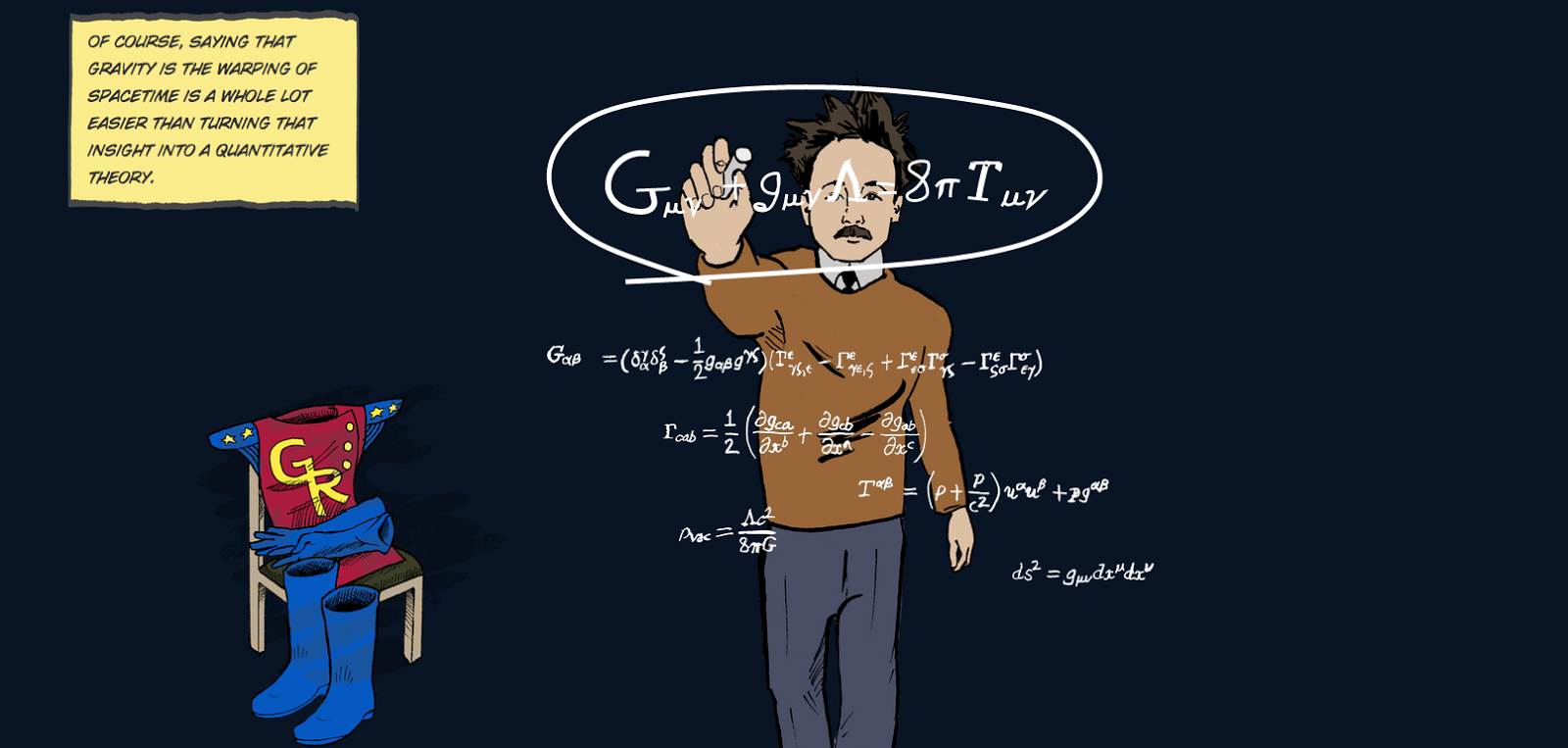
After graphic novels such as«Маус» Арта Шпигельмана, «Палестина» Джо Сакко и «Персеполис» Марджан Сатрапи, доказали миру, что полуисторические комиксы могут успешно решать сложные проблемы, такие как история и политика, начали появляться первые комиксы в научных журналах.
For example, Science and Nature have also startedexperimenting in the 2010s with a new format. This is how the comic strip "General Theory of Relativity" by Adrian Cho appeared in Science, as well as "The Fragile Frame" by Richard Monasterski and Nick Susanis in Nature.
The most interesting comics about science
Comics culture is also developing in Russia.For example, in December 2018, the comic book "That's for sure" was released with the participation of Skoltech. 13 illustrators took part in its creation. Each of the stories drawn in the collection is based on real research, an article about which has either already been published in one of the leading scientific journals, or is being prepared for publication. Comics clearly and with humor talk about experiments and developments in those areas to which the attention of people around the world is riveted today. Using examples of case studies, the book shows the connection between scientific knowledge and real life.

If you've ever searched for something you've been holding in your hands, or forgot the name of someone you're talking to as soon as you hear it, we recommend reading the comic strip "Where Are My Glasses and Other Stories About Our Memory."Psychophysiologist and science popularizer Polina Krivykh wrote the story of two friends who understand cognitive psychology.They study the work of the brain, get acquainted with the experiments of eminent scientists, and search forCauses of memory disorders and give specific tips for training the internal storage.Author's illustrations by artist Marina Evlanova.

One of the most famous scientist-artists inRussia - Olga Posukh. She works in the genomics laboratory of the Institute of Molecular and Cellular Biology in the Novosibirsk Akademgorodok, and also draws illustrations for her and other texts. One of Olga’s most famous comics is about “superhero animals” tardigrades, who can live at record high or low temperatures, pressure, radiation and recover after a ten-day stay in outer space.

In general, few "local" ones are produced in Russia.comics, but there are separate translated episodes, such as Educational Manga, which includes issues such as Linear Algebra, Differential Equations, Regression Analysis, and Entertaining Nutrition Science. Also, there are separate stories like "Neurocomix" and biographies of some famous scientists.

Some comics are created to popularizescience classes among children, showing the image of a tough scientist. In the USA there is a famous series about the super-tamed Max Axiom (Max Axiom, Super Scientist), released in 2007-2009.

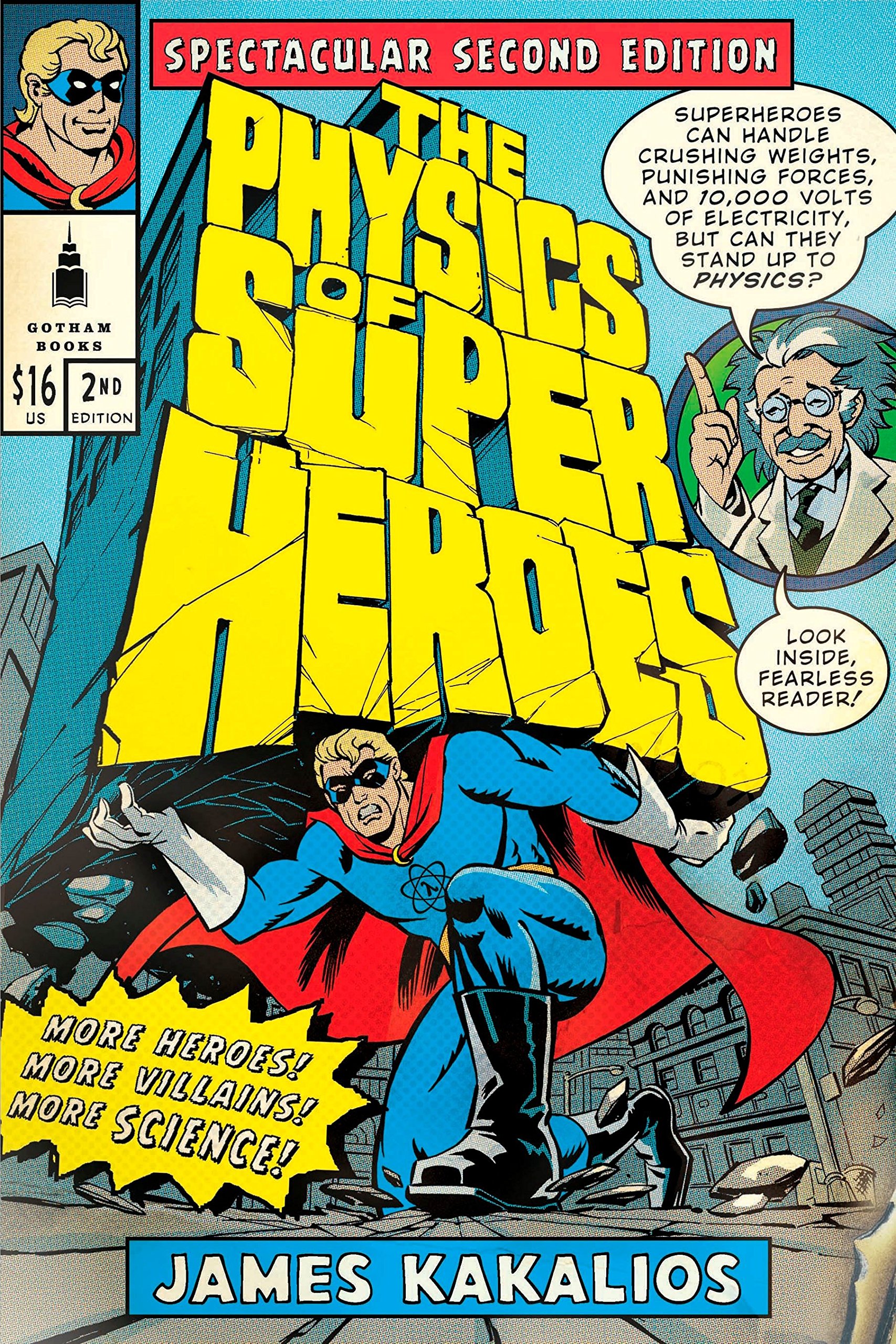
Science and superheroes do meet incomic books such as The Physics of Superheroes by physics professor and longtime comic book fan, James Kakalios. It explores the basic laws of physics through the prism of superhero forces.
Нередко комиксы начинают рисовать сами ученые.One example is the comic book series Dr. Scifun, which was invented by South Korean medical school graduate Min Suk Chang. In his free time teaching anatomy, he drew pictures to make this complex subject more understandable for students.
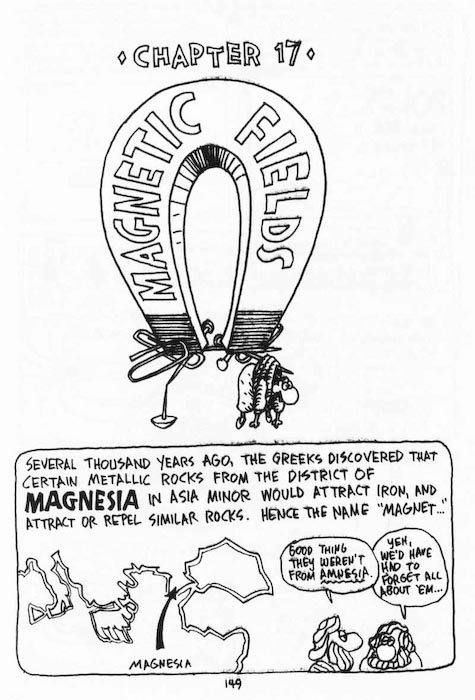
Harvard mathematician - Larry Gonick - became widespreadknown as a popular writer and comic book writer. He has a series, The Cartoon Guide, which covers physics, biology, statistics, chemistry and more. The collection about algebra can be read in Russian.
Another interesting series of scientific web comics isxkcd. In them, artist and programmer Randal Munroe explains the meaning of mathematics, data storage, life, love and everything else. Comics convey complex scientific ideas using key ideas and the simplest possible drawing.

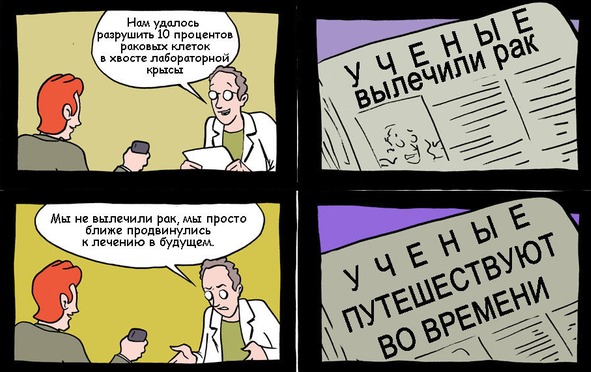
It is worth paying attention to Phd Comics -funny stories about the everyday life of a Stanford University student and his typical problems in school and not only. By the way, from the same series, there is a famous picture with a series of transformations that news about the discoveries of scientists passing through on the way from the scientific laboratory to the minds of readers.
Do the comics work?
There are many aspects that comics makea promising tool for scientific communication. Comics can combine engaging storytelling with diagrammatic structure, allow travel to distant worlds with fictional characters, and explain abstract concepts through metaphors. A more fundamental question remains to be answered: Do comics really improve learning or interaction with science?
Difficult to answer and empirical researchthe educational effect of comics is much less than the graphic novels about science themselves. A 2011 study by Jay Hosler found that Optical Illusions were as effective as a traditional textbook in teaching students the concepts of evolutionary biology. In addition, he attracted new students to the course. Similar effects have also been reported by Amy N. Spiegel and colleagues. In 2013, they tested comics as a way to engage students in virology. Teens who were given science comics were almost five times more likely to continue reading materials about viruses than teens who read a similar text essay. Again, these effects were more pronounced among students with a low scientific identity (that is, those who do not consider themselves to be a “scientific person”).
Read more
An airplane with articulated wings and a tail appeared. It can take off without a run
The development of AI has reached a critical point. Scientists are asking to take control of technology
The vampire fish uses an original way to move in water