The authors of the new work used living plants. They took regular beans and poured them with an aqueous solution containing
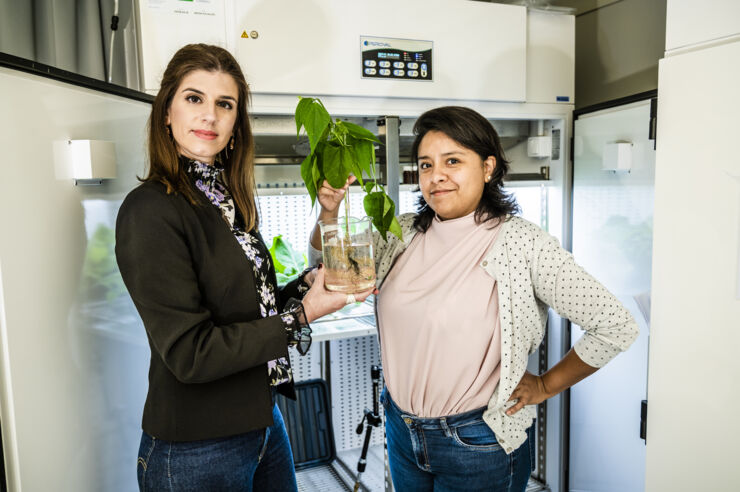 Photo: Thor Balkhed
Biologists continued to water the plant until itgrew, blossomed and began to bear fruit. While working, the beans lived through their natural cycle, but the above-ground parts and roots began to conduct electricity.
The roots of the plant remained electrically conductive for aboutmonths. The conductivity was 10 Siemens per centimeter. Scientists have investigated how efficient the roots will be at storing energy. To test this, they created a supercapacitor in which the roots functioned as electrodes during charging and discharging.
Earlier in 2015, such an experiment was carried out withroses. Compared to flowers, beans have increased the stored energy by 100 times. The researchers note that their method will help to efficiently store energy without harming the environment.
According to the authors, the beans had a developed fibrous root system, which perfectly suited the main task - the accumulation of charge.

The plant develops a more complex root system, but otherwise it does not affect it: it continues to grow and produce beans.
Eleni Stavrinidou, assistant professor and principal investigator of the electronic plants group in the laboratory
Read more
Impossible to imagine: what are the largest objects in the universe and where they are
Look at pictures of two merging galaxies, taken 9 years apart
Elon Musk: Starship can lift 1,000 times more cargo than other rockets