Scientists at Aalto University have developed light-based optical logic gates. Chiral
Logic gates are the basic elements of digitalscheme. Each such element performs one logical operation. Traditionally, they are electronic circuits that work due to the movement of the corresponding particles. In a paper published in the journal Science Advances, scientists at a Finnish university used crystalline materials to build light-based logic gates.
The new approach proposed by the researchers,uses light as an alternative to electrons. Crystalline materials are sensitive to the directionality of a circularly polarized light beam. In other words, the light emitted by the crystal depends on the direction of the input beams.
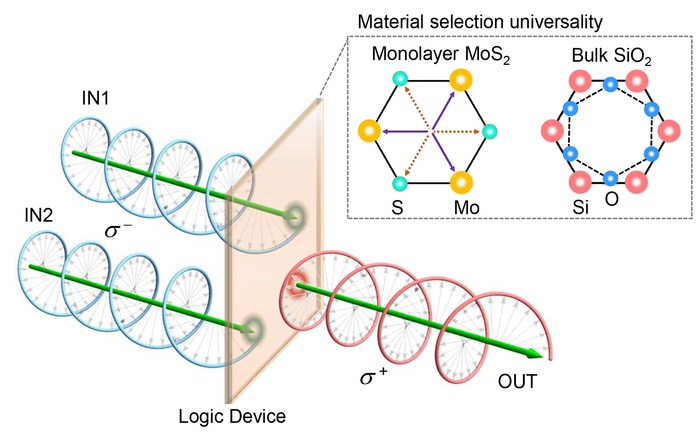 The logic optical gate is made of a material that emits light with different circular polarization depending on the chirality of the input beams. Image: Yi Zhang / Aalto University
Using this feature of crystals,researchers created the XNOR gate. This is a logical element that serves as the complement of the XOR gate. All other logic gates can be created using light filters or other optical components, the authors of the development say.
In a series of experiments, physicists have shown that onean optical device based on such chips may contain all logic elements that can operate in series or in parallel. At the same time, existing electronic valves can only work in sequential mode.
Simultaneous Parallel Gatescan be used to build complex multifunctional logic circuits, the authors say. In addition, the new approach significantly speeds up the calculation process. Scientists estimate that optical logic gates operate about a million times faster than traditional counterparts. The researchers believe that optical technologies based on the chirality (twisting) of light can become the basis for the next generation of computers.
Read more:
Does science exist in extreme conditions? We answer in numbers
"The Walking Dead" existed millions of years ago: scientists told how they appeared
Mysterious inscriptions found on an ancient manuscript: they were made without ink