This week, the Hubble telescope team presented an image of the bipolar planetary nebula M1-63 in the form
Bipolar Nebula (eng.bipolar nebula) is a nebula in the form of two lobes. Many, though not all, planetary nebulae have an observable bipolar structure. It is possible that the two types of nebulae are directly related and replace each other during the evolution of the nebula.
Although the exact reasons for the formation of such structuresunknown, perhaps they are associated with a physical process called bipolar outflow, in which a star throws out high-energy jets towards both poles. One of the theories states that such jets collide with the material surrounding the star (stardust, shells of matter thrown off during a supernova explosion), as a result of which dome-shaped structures are formed in the areas of collision.
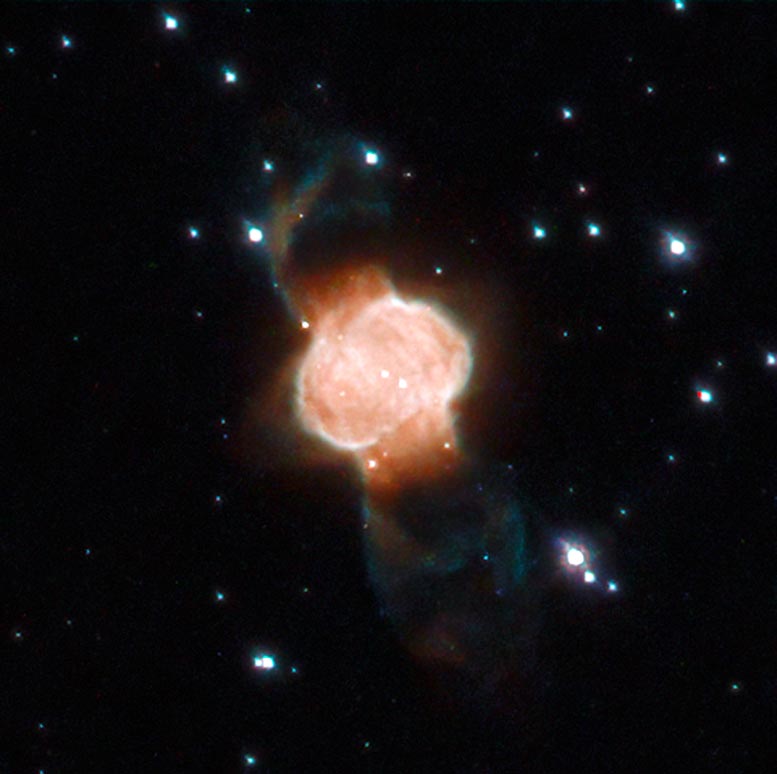 A portrait of M1-63, located in the constellation Shield. Credit: ESA / Hubble and NASA, L. Stangellini.
The binary star system at the center of the bipolar nebula is capable of creating hourglass or butterfly-like shapes.
M1-63 is located in the constellation Shield.It is located in the southern hemisphere of the sky near the celestial equator. It occupies an area of 109.1 square degrees in the sky, contains 28 stars visible to the naked eye.
Read more
Look at an 8 trillion pixel image of Mars
A nuclear rocket engine is being built for flights to Mars. How is it dangerous?
Abortion and science: what will happen to the children who will give birth