When it comes to telescopes, size matters. The larger the telescope, the more light it collects,
What if there was a way to doa telescope 10 or even 100 times larger than the Kelper, Spitzer, Hubble and the same Webb? Over time, the theoretical question turned into a series of experiments. The goal is to find out if liquids can be used to create lenses in microgravity. The next experiment will take place at the National Laboratory of the International Space Station by the astronauts of the Axiom-1 mission.
"Liquid" lenses
All liquids have an elastic force, whichcalled surface tension. It is she who allows some insects to glide through the water without drowning, and gives the drops of water their shape. On Earth, when water droplets are small enough (2 mm or less), surface tension overcomes gravity and they remain perfectly spherical. If the drop gets much larger, it contracts under its own weight.
Edward Balaban, the principal investigator of the FLUTE experiment, is looking to see if it is possible to make high-precision lenses and mirrors in space using liquids.
“We thought, why not take advantage of the fact thathow fluids naturally behave in microgravity. This property can be applied to the construction of large-scale telescopes or space-fabricated optical components,” Balaban explains in a NASA blog post. “In microgravity, liquids take on shapes useful for making lenses and mirrors. If we create them in space, they will be useful for creating telescopes so large that it was considered unrealistic.”
Ground tests
Before experimenting in space, scientists checkedtheir ideas here on Earth. “Fluids are useful not only for creating the lenses themselves, but also as a mechanism to eliminate the effects of gravity in experiments on Earth,” explains Moran Bercovici, assistant professor of mechanical engineering at the Technion.
By injecting a liquid that can solidify,in round frames immersed in water, scientists managed to create lenses. When creating them, scientists used widely used polymers that are used in nail salons to make acrylic nails.
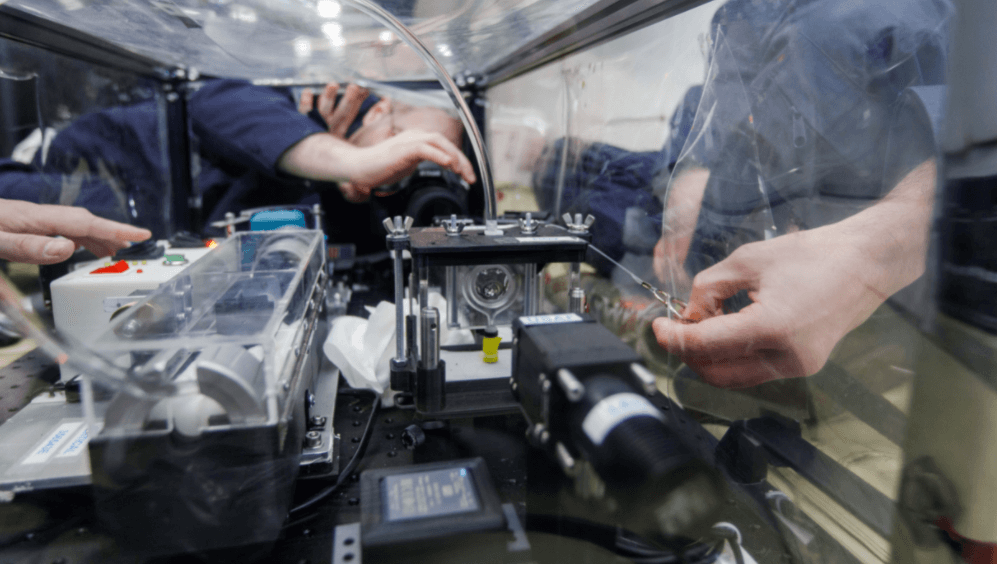 Experiment during ZeroG parabolic flight. Photo: Israel Institute of Technology
As the authors of the development note, the resulting lensesoutstanding surface quality. At the same time, it took quite a bit of time to make them. “This method allows us to completely dispense with any mechanical processes such as grinding or polishing. The natural physics of fluids just does all the work for us, ”the scientists say.
Microgravity Testing
In December 2021, the team tested their ideason two ZeroG parabolic flights. In total, the scientists found themselves in microgravity 50 times, each period lasting from 15 to 20 seconds. This was enough for the scientists to form liquid lenses and collect data to analyze whether they achieved their goals.
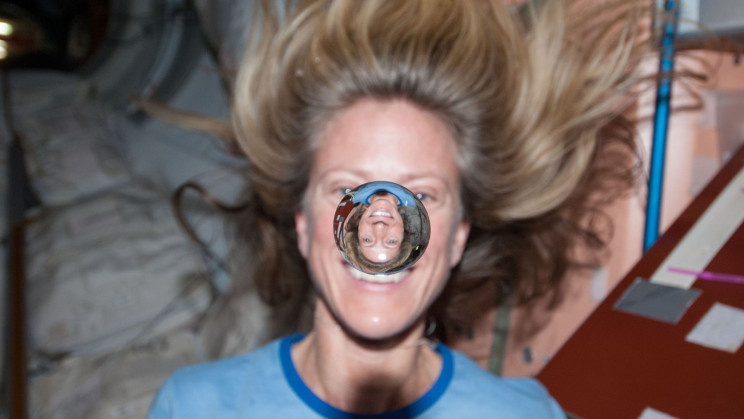 NASA astronaut Karen Nyberg looks through a floating spherical bubble of liquid in microgravity. Source: NASA.
During the flight, the researchers usedpumps to push the synthetic oil into a circular frame (about the size of a coin), allowing the liquid to fill the gap and instantly take the desired shape. Oils are similar to automotive oils, but with different levels of viscosity, or stickiness, so scientists can determine which option "works" best.
“In a matter of seconds, we were able to create separatelystanding liquid lens. She kept her shape until the plane rose again, gravity turned on and the oil leaked out, ”say the authors of the development. A new experiment on the space station will allow liquids to retain their shape for a long time. To see the moment when the liquid took the desired shape, scientists were helped by a laser for ultra-fast and ultra-precise measurements.
What's next?
After successful tests on ZeroG, scientists fromlooking forward to the experiment aboard the ISS Orbital Laboratory. Ax-1 crew member Eitan Stibbe will lead the experiment, and former NASA astronaut and Ax-1 commander Michael Lopez-Alegria will be his stand-in. The experiment will take place entirely in microgravity. Astronauts will use liquid polymers, ultraviolet light or temperature to harden them in microgravity. The lenses will then return to Earth, where they will be studied at the Ames Research Center (ARC).
“This approach will create smooth, perfectly shaped surfaces that are ideal for creating mirrors for telescopes,” explains Vivek Dwivedi, a participant in the FLUTE experiment.
“If the experiment on the ISS is successful, it will be the first experience of creating an optical component in space. This is a historic event,” the scientists conclude.
Read more:
There is another “planet” inside the Earth: how it saved nascent life
Nuclear fusion no longer needs millions of degrees: how the new method works
New study refutes light energy transfer theory
FLUTE is a technological experiment to create a telescope mirror in zero gravity using liquid gallium for polymer-based deposition (Fluidic Telescope Experiment).