Over the years of observations, planetary scientists and astrophysicists have developed many ways to search for distant exoplanets.
It is estimated that only in the Milky Way there should be noless than 100 billion worlds, of which almost 300 million must have conditions suitable for the emergence of life. But just over 5,200 confirmed exoplanets are currently known, and observations of another 9,000 candidate objects are still being tested.
How is the aurora formed?
Aurora - a colorful "light show"which can be observed in the night sky at subpolar and sometimes temperate latitudes. Auroras occur when charged particles (electrons and protons) collide with gases in the Earth's upper atmosphere.
These collisions produce tiny flasheswhich cover the sky with multi-colored "patterns". When billions of flashes occur in succession, the auroras appear to be moving or "dancing" in the sky.
Depending on which atomsparticles interact, it can be of different colors. For example, the most common, green, hue occurs when charged particles collide with oxygen molecules at an altitude of 100 to 300 km, and nitrogen atoms at an altitude of about 100 km give a pink and dark red glow.
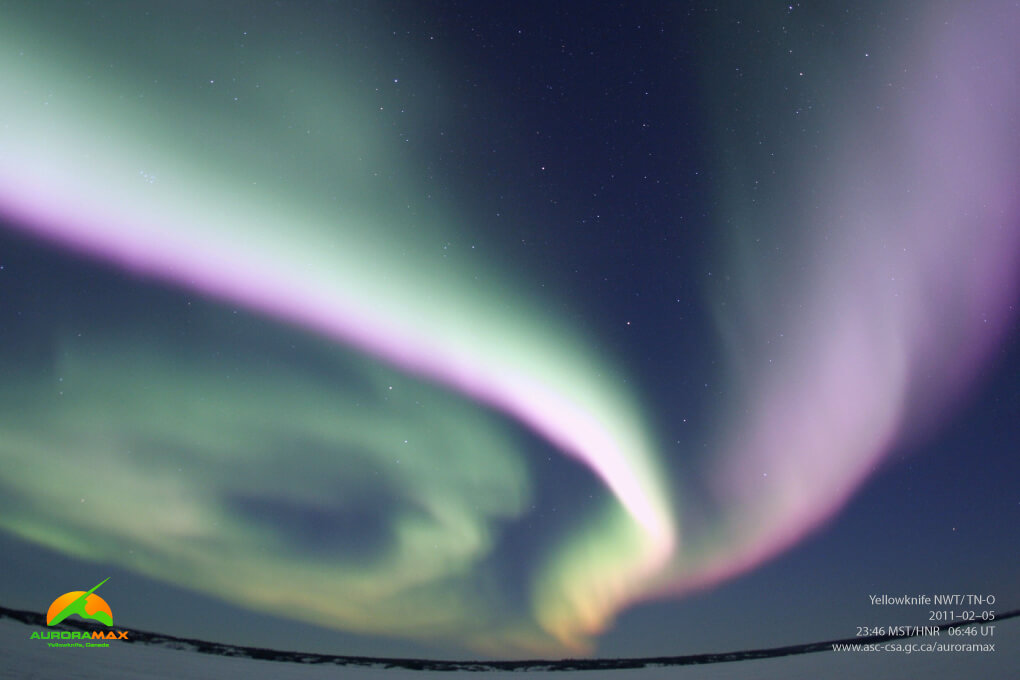 Multicolored polar lights. Image: Canadian Space Agency, University of Calgary, Astronomy North
Although the auroras are visible mainlyway at night, they are formed under the influence of the solar wind. This is a stream of ionized particles flowing from the corona of a star in all directions. It blows continuously, but under normal conditions, the Earth's magnetic field forms an invisible shield that protects us from the solar wind. From time to time, the solar wind intensifies and “breaks through” the protection. As a result, a stream of particles interacts with gases in a magnetic field (magnetosphere), giving rise to magnificent auroras.
Earth's magnetic field directs chargedparticles towards the poles. The shape of the Earth's magnetic field creates two aurora ovals above the north and south magnetic poles. Moreover, the more active the Sun, the “wider” this oval will be and the lower latitudes the aurora will be visible.
It reaches its greatest activity under the influence ofcoronal mass ejections. During this phenomenon, a huge “bubble” of charged plasma erupts from the solar corona, moving at an average speed of over 400 km / s.
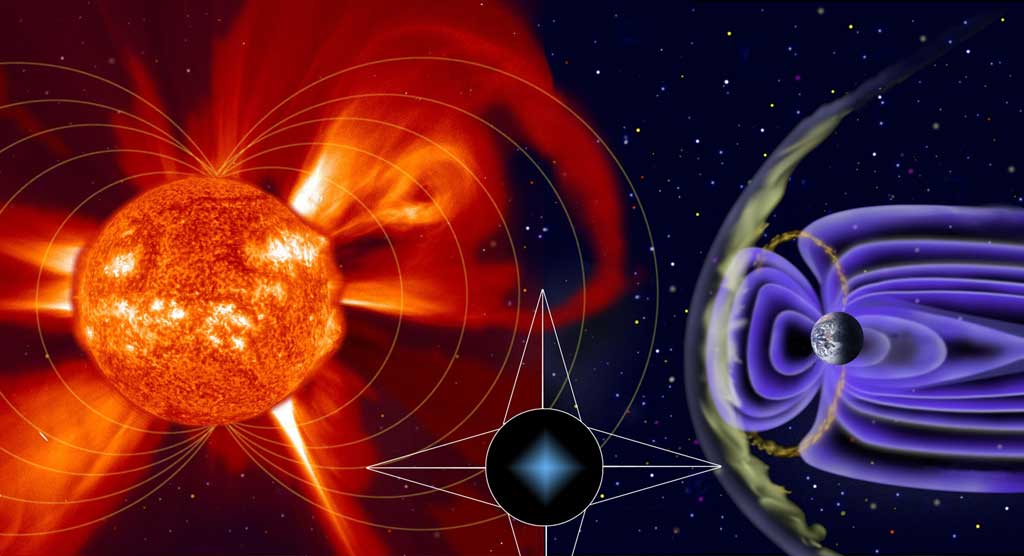 Artistic illustration of coronal mass ejections and magnetic field guard lines. Image: Canadian Space Agency
Are there auroras on other planets?
Auroras are not a unique terrestrialphenomenon. If a planet has an atmosphere and a magnetic field, it will most likely experience auroras. During astronomical observations, researchers have observed similar phenomena on many planets in the solar system.
The magnetic fields of Jupiter and Saturn are much strongerthan that of Earth (for example, Jupiter's equatorial field strength is 4.3 Gauss compared to 0.3 Gauss for Earth). Not surprisingly, large-scale auroras are observed on both gas giants.
Auroras on Saturn are similar to those on Earthare formed under the influence of solar wind. But on Jupiter this phenomenon is much more complicated. The main oval of Jupiter's auroras is associated with plasma that erupts from volcanoes on the moon Io and reaches the planet's magnetosphere. Another type of auroras on the planet is associated with the solar wind.
Additionally, the moons, especially Io, are alsopowerful sources of the aurora. It arises due to magnetic dynamo - the effect of self-generation of a field when moving due to the relative motion between the rotating planet and the moving moon. This effect generates electric currents moving along lines of force and "charging" particles in the atmosphere.
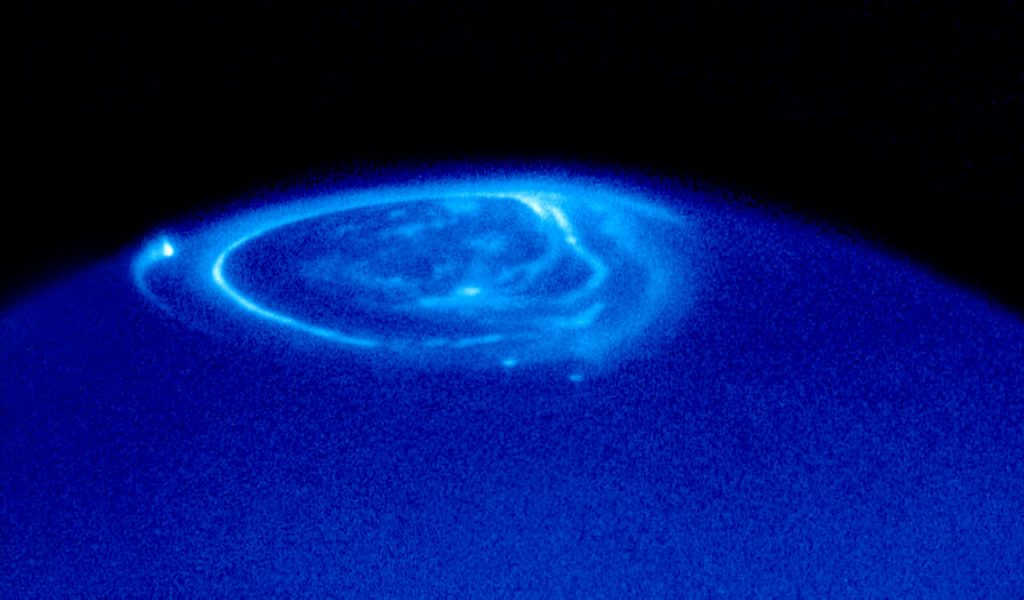 Aurora on Jupiter. Image: NASA, ESA & John T. Clarke (Univ. of Michigan)
Auroras have also been observed on Venus andMars. Venus does not have a magnetic field, so the auroras on this planet look like bright and scattered spots of various shapes and intensities, sometimes distributed throughout the planet's disk. And on the Red Planet, several types of similar phenomena were discovered at once, which are explained in different ways.
Moreover, in 2014–2016, researchThe Rosetta ship observed auroras even on the comet Churyumov-Gerasimenko. It could be seen in the far ultraviolet wavelength range. Researchers believe that it occurs when accelerated electrons from the solar wind interact with gas particles in the coma, a cloud surrounding the planet's core.
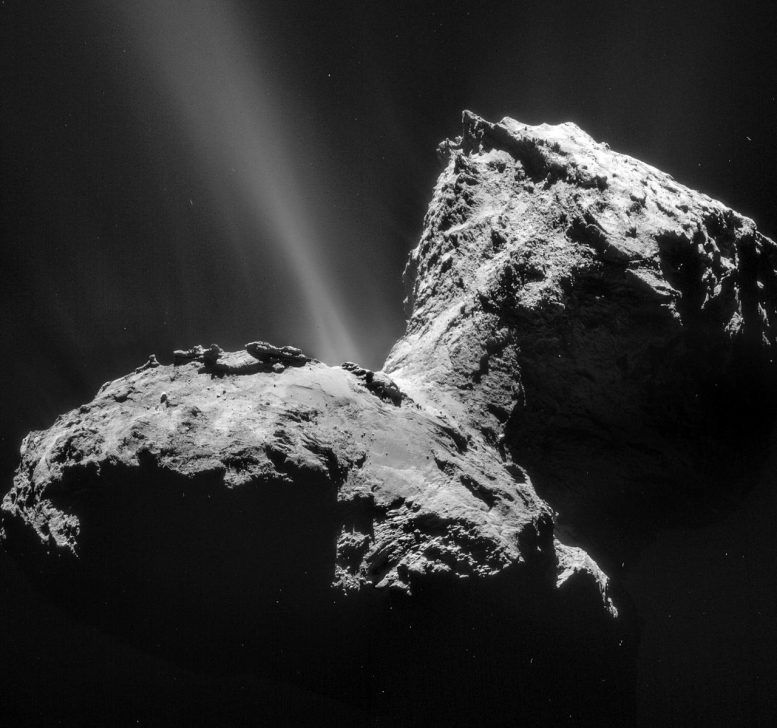 Auroras in ultraviolet light on a comet. Image: ESA/Rosetta/NAVCAM
Star winds of distant worlds and the search for life
In 2021, hints of the presence of suchinteractions occurring in other star systems were first detected using the LOFAR (Low-Frequency Array) radio telescope in the Netherlands. Researchers have discovered about 20 dwarf stars emitting specific radio emission. Although these planets do not yet have discovered exoplanets, this effect resembles the interaction of stellar winds with the magnetic fields of other objects.
In their study, the scientists focused onred dwarfs, the most common type of star in the Universe, making up more than 70% of the “population” of the Milky Way. These stars are small and cool: their mass is no more than a third of the Sun's and they are usually up to 50 times fainter.
The planets of the solar system emit powerfulradio waves when their magnetic fields interact with the solar wind, but radio signals from planets in other star systems could not be detected until 2021.
During the study, planetary scientists discovered 19stellar systems from which radio emission comes. The data is reminiscent of the interaction of the magnetic fields of Jupiter and Io. Although exoplanets themselves have not yet been found, the interaction between the planet and the star is the best explanation for the observed phenomena.
In 2022, a researcher from LeydonUniversity Rob Kavanagh went even further. He developed mathematical models that describe how the stellar winds and magnetic fields of different planets interact. Kavanagh's models are useful for more than just discovering new exoplanets.
The data collected by the radio telescope can also beuse to explore the star system. For example, based on models and a fixed signal, one can determine the size of the planet and its orbit. In addition, the strength of the radiation could also provide insight into the properties of the stellar winds themselves and the size of the magnetic field around the exoplanet.
This is important information because it is quiteIt is likely that the Earth's magnetic field provided us with an atmosphere. This means that the presence and size of the magnetic field gives astronomers an indication of the potential habitability of the planet.
Rob Kavanagh, modeler
Researchers will continue to develop modelsinteractions between stars and planets to create a technique for large-scale searches for exoplanets using radio astronomy observations. Perhaps it is this method that will make it possible to find another habitable world in our Galaxy.
Read more:
Why the Moon and not Mars: the main thing about the Artemis-1 mission and why it is needed
An ancient amulet rewrote the history of Europe's most mysterious language
The main theory of the origin of man was refuted: where did we come from