Experts from the European Earth remote sensing program Copernicus spoke about the results
 Temperature anomalies in March 2023. Image: Copernicus Climate Change Service/ECMWF
The average temperature worldwide was at 0.51 °Chigher than the average for 1991-2020. (base period). Only in March 2016 did the average monthly temperature rise even higher: 0.62°C above the baseline. While in most of the continents and above the surface of the oceans the temperature was above the norm, the researchers recorded a relative cooling in the western and central parts of North America, over Scandinavia and northwestern Russia.
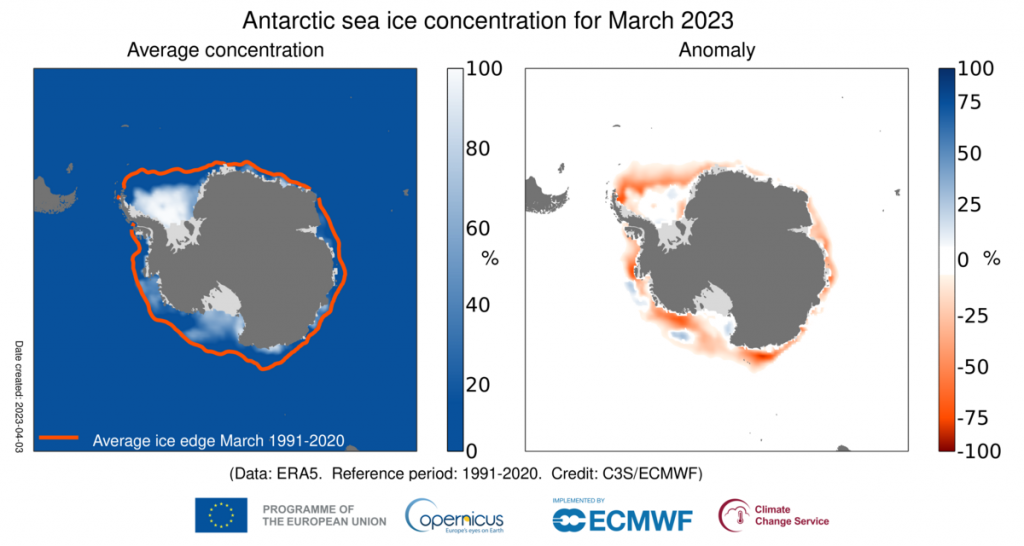 Change in ice extent in Antarctica in March 2023 from average values for 1991–2020. Image: Copernicus Climate Change Service/ECMWF
The researchers also note the low extentsea ice in the Arctic and Antarctica. In the area of the South Pole, after the February anti-record, the area of sea ice increased slightly and reached an average of 3.2 million km². This is 28% less than the March average for 1991-2020.
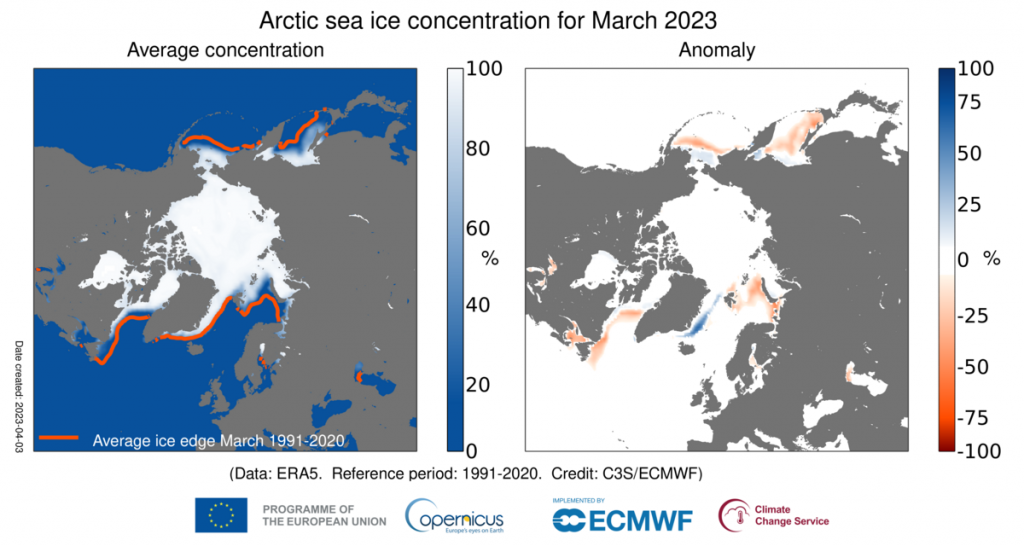 Change in Arctic ice extent in March 2023 from average values for 1991–2020. Image: Copernicus Climate Change Service/ECMWF
Mean monthly Arctic sea ice extentin March 2023 reached 14.5 million km². This value ranks as the 4th lowest value for March in a satellite record that begins in 1979. It is only slightly above the three lowest values (in 2015, 2017 and 2018). Daily sea ice extent reached its annual maximum in early March and has since begun to decrease with the onset of the melting season.
Read more:
A red halo flared up over Italy. Now its nature has been explained
Named a way to reduce appetite without surgery
Chia seed experiment confirms Alan Turing's famous mathematical model