The Big Bang could have been accompanied by a shadowy, "dark" Big Bang that "flooded" space with a mysterious
Basic theory
Most cosmologists believe that afterDuring the Big Bang, in the first moments of its existence, the Universe experienced a period of rapid and noticeable expansion—inflation. Nobody knows what caused it, but finding out is necessary to explain many observations, such as the geometric plane of the Universe on a large scale.
Presumably, inflation was caused by somean exotic quantum field that is a fundamental entity that permeates all spacetime. At the end of inflation, this field decayed into a stream of particles and radiation, causing the “Hot Big Bang” that physicists usually associate with the beginning of the Universe. These particles continued to coalesce into the first atoms when the cosmos was about 12 minutes old, and—hundreds of millions of years later—began to assemble into stars and galaxies.
Missing Ingredient
But there is one more ingredient in the cosmological mixture:dark matter. In astronomy and cosmology, as well as in theoretical physics, a form of matter is not involved in electromagnetic interaction and is therefore inaccessible to direct observation. It makes up about a quarter of the mass-energy of the Universe and manifests itself only in gravitational interaction.
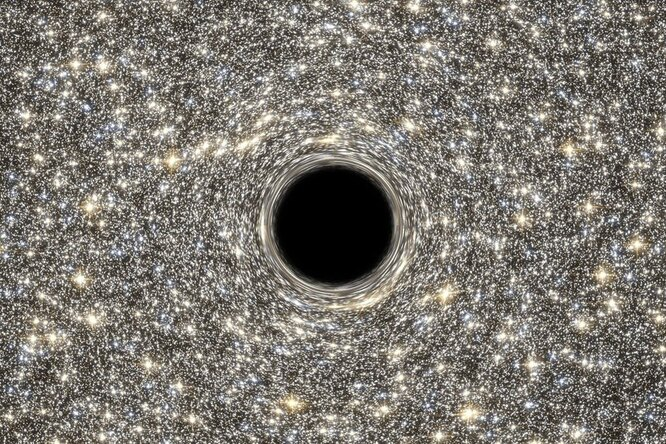 Black hole. Photo: NASA/Flickr, CC BY-SA
In the simplest models, the end of inflationand the Hot Big Bang that followed also flooded the Universe with dark matter, which evolved along an independent path. But this assumption was made “just for simplicity” and to at least somehow explain its appearance and existence, say the authors of the new study. Additionally, since dark matter does not interact with normal matter, it could have had its own “dark” Big Bang, the researchers say.
Dark Big Bang
In their work, the researchers examined how couldlook like the Dark Big Bang. They hypothesized the existence of a new quantum field—the so-called “dark field”—necessary for dark matter to form completely independently.
In this new Dark Big Bang scenariostarted only after inflation had disappeared and the universe had expanded and cooled enough to cause the dark field to make its own phase transition, where it morphs into dark matter particles.
 The merger of black holes in the representation of the artist. Credit: ©LIGO/A. Simonnet
The researchers concluded that the Dark Bigthe explosion must be subject to certain restrictions; if it's too early, there will be too much dark matter today, and if it's too late, there will be too little. But if another explosion occurred when the Universe was less than a month old, it is consistent with all known observations.
What are the advantages of the theory?
The Dark Big Bang Theory has severalbenefits. First, it fits with what scientists know about dark matter: if it doesn't interact with ordinary matter, then there's no reason for them to have a common origin. Second, it allows researchers to create models of dark matter without worrying about how they will affect the behavior of normal matter in the earliest times. This gives scientists much more flexibility when creating models. And most importantly, the new theory of physicists provides an answer to the main question of the Universe - how and where did such an amount of invisible dark matter come from?
Can the theory be tested?
In addition, the researchers discovered that the DarkThe Big Bang creates a special signature in gravitational waves, which are ripples in space-time that are still spreading throughout the Universe. This means that one day the theory can be tested.
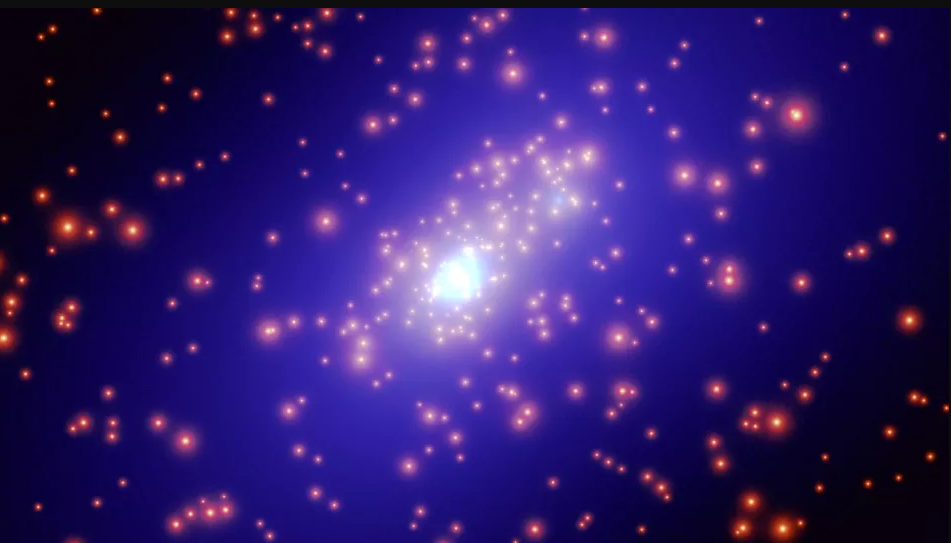 New research suggests that darkThe matter seen as blue light in this Hubble image of the galaxy cluster Cl0024+1654 may have appeared in the universe a month after the Big Bang. Image courtesy of the European Space Agency, NASA and Jean-Paul Kneib (Mid-Pyrénées Observatory, France/Caltech, USA)
The researchers acknowledge that current experimentswith gravitational waves are not sensitive enough to find signs of the Dark Big Bang. But another gravitational wave probe using a pulsar time array, such as the NANOGrav experiment, could do the job.
Read more:
"Sea" of quarks inside one proton: what does an elementary particle consist of
Look at the highest resolution map of Mars: 110,000 frames and 5.7 trillion pixels
Scientists have studied an ultra-bright object that violates the law of physics
</ p>