On October 9, 2022, the orbiting Swift Observatory recorded the unusually bright gamma-ray burst GRB 221009A for the first time.
Over the following months, researchers around the world analyzed the source of the gamma rays to recover details of the unusual astronomical event and find its source.
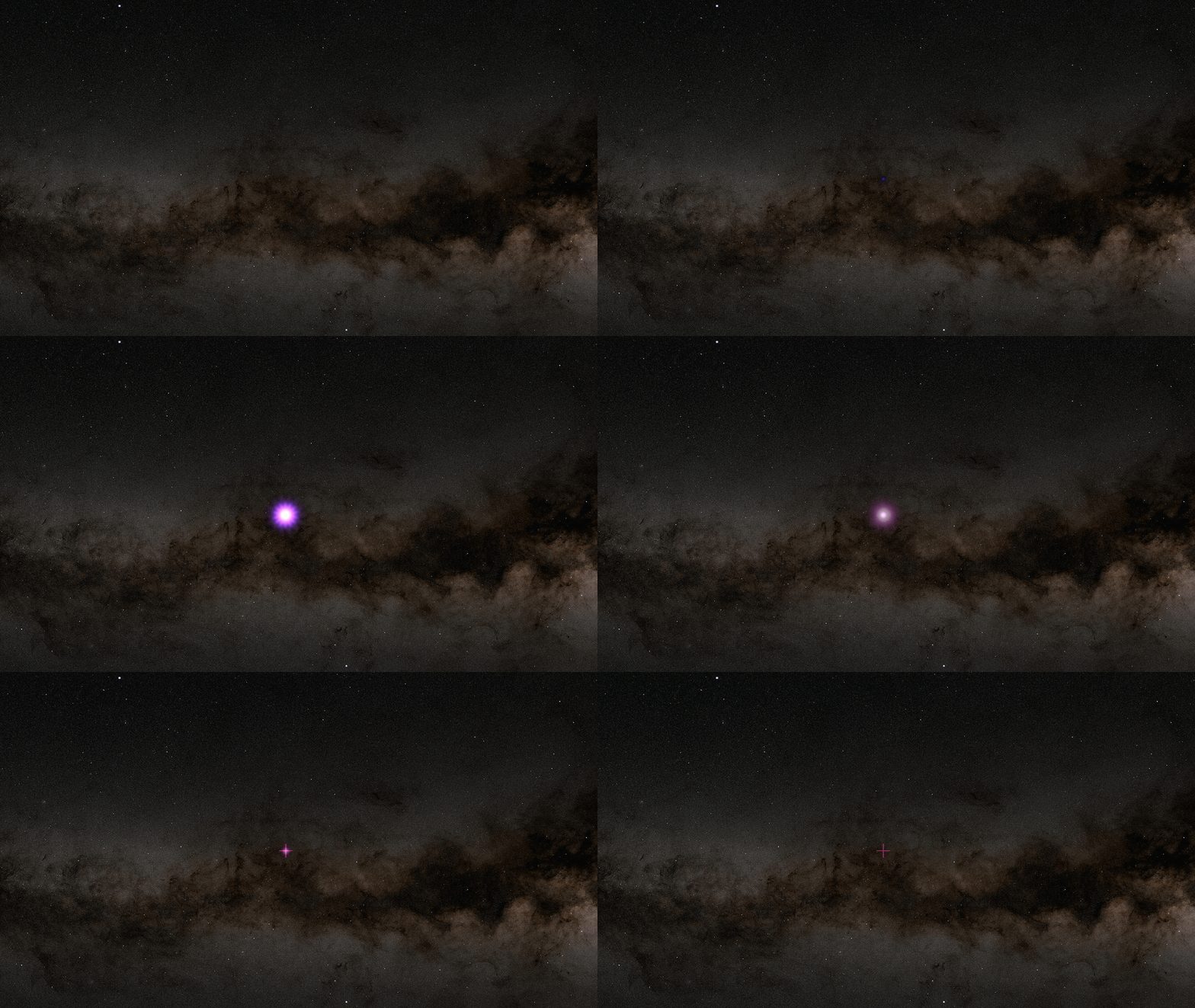 The location of the gamma-ray burst GRB 221009A against the background of the Milky Way. Image: NASA's Goddard Space Flight Center
What is a gamma ray burst?
Gamma-ray burst (GRB)astrophysicists call a short-term burst of gamma radiation, a stream of photons with an extremely short wavelength (less than 2⋅10−10 m) and high energy. Such astronomical events represent the release of huge amounts of energy and, as a rule, are recorded in distant galaxies. A gamma-ray burst is one of the brightest events in the Universe.
Researchers have discovered gamma-ray bursts relativelyrecently: in the 60s of the last century. In 1963, NASA sent into orbit the military satellite Vela, equipped with neutron, X-ray and gamma ray detectors. He was supposed to monitor compliance by the USSR and other countries with the Nuclear Test Ban Treaty. The satellite's instruments did not detect nuclear tests, but accidentally discovered bursts of gamma radiation emanating from deep space.
Researchers distinguish two types of gamma-ray bursts,which differ in duration: short and long. The first category includes flashes that last from a few milliseconds to two seconds. It is believed that the source of such an event is the merger of two neutron stars with the formation of a kilonova or the absorption of a neutron star by a black hole.
The second type is long gamma-ray bursts.They can last from a few seconds to several minutes. The main hypothesis suggests that long bursts of gamma rays are associated with a supernova explosion: the final stage in the evolution of stars, the mass of which is 10 or more times greater than the sun. But in 2022, astrophysicists from the Gemini observatory reported the discovery of a kilonova, formed after the merger of neutron stars, at the site of the long gamma-ray burst GRB 211211A recorded a year earlier.
Animated image of a long gamma-ray burst associated with the collapse of a massive star. Animation: NASA's Goddard Space Flight Center
What is unusual about the gamma-ray burst GRB 221009A?
GRB 221009A's gamma-ray burst lasted more thanfive minutes. This means that it belongs to long bursts and is most likely associated with the collapse of the core of a massive star into a black hole and a supernova explosion. Surprisingly, in the time that has elapsed since the first observation of a gamma-ray burst, researchers have not been able to confirm the formation of a supernova at the site of the explosion or find an alternative source of radiation.
In addition, the splash was so bright thatblinded most cosmic gamma-ray detectors, so they could not directly capture the actual intensity of the radiation. The researchers used data collected by the Fermi Telescope and the Cone Gamma Ray Spectrometer to reconstruct this information. The analysis showed that GRB 221009A was 70 times brighter than any other observed gamma ray burst.
 Comparison of GRB 221009A and the four previously recorded most powerful gamma-ray bursts. Image: NASA's Goddard Space Flight Center and Adam Goldstein (USRA)
Calculations carried out by the astrophysicists of the project"Integral" of the European Space Agency (ESA), show that while the explosion lasted, about one gigawatt of power fell into the upper layers of the Earth's atmosphere. This is equivalent to the power of a ground power plant. The event was so bright that even today the longer wavelength afterglow, the afterglow, is still visible.
Analysis of a sample of 7,000GRBs recorded by Fermi and Cone shows that such large-scale GRBs should occur more often than once every 10,000 years. "GRB 221009A was probably the brightest burst of X-rays and gamma rays since the dawn of human civilization," said Eric Burns, a researcher at Louisiana State University at Baton Rouge.
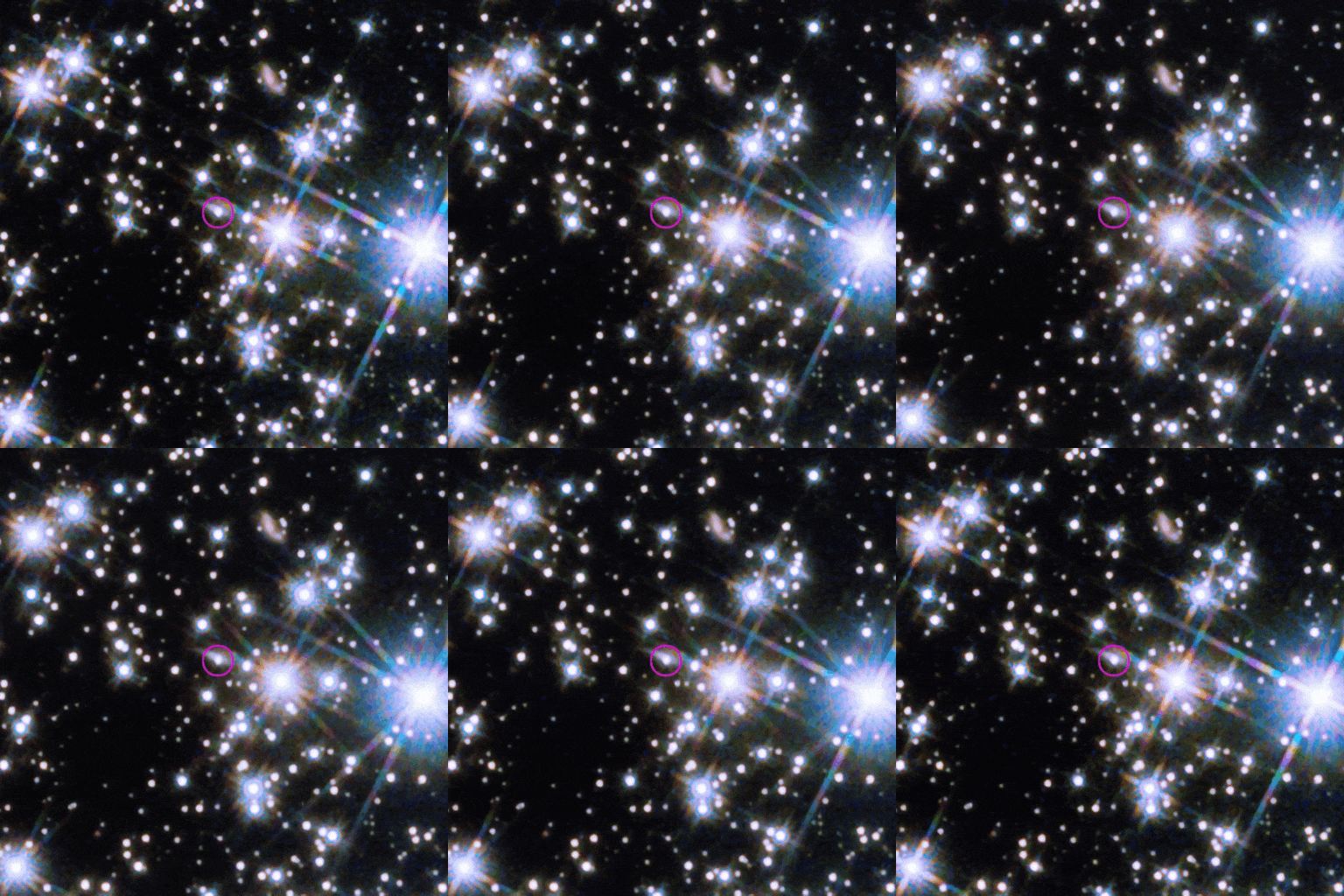 The afterglow of GRB 221009A, captured by the Hubble telescope. Image: NASA, ESA, CSA, STScI, A. Levan (Radboud University); Image Processing: Gladys Kober
What have astrophysicists learned?
To better reconstruct the history of the gamma-ray burst, researchers used instruments that detect electromagnetic radiation at a variety of wavelengths, from radio waves to gamma rays.
The first scientific results show howX-rays illuminated dust clouds in the Milky Way as they spread. The researchers calculated that the radiation traveled through intergalactic space for about 1.9 billion years before entering our galaxy. It collided with the first cloud of dust on the "outskirts" of the Milky Way about 60 thousand years ago, and with the last - about a thousand.
Every time the x-rays collidedwith the dust cloud, they scattered some of the radiation, creating concentric rings that seemed to expand outward. The ESA XMM-Newton Space X-ray Telescope observed these rings for several days after the gamma-ray burst. Nearby clouds formed the largest rings simply because they appear larger in perspective, the scientists explain.
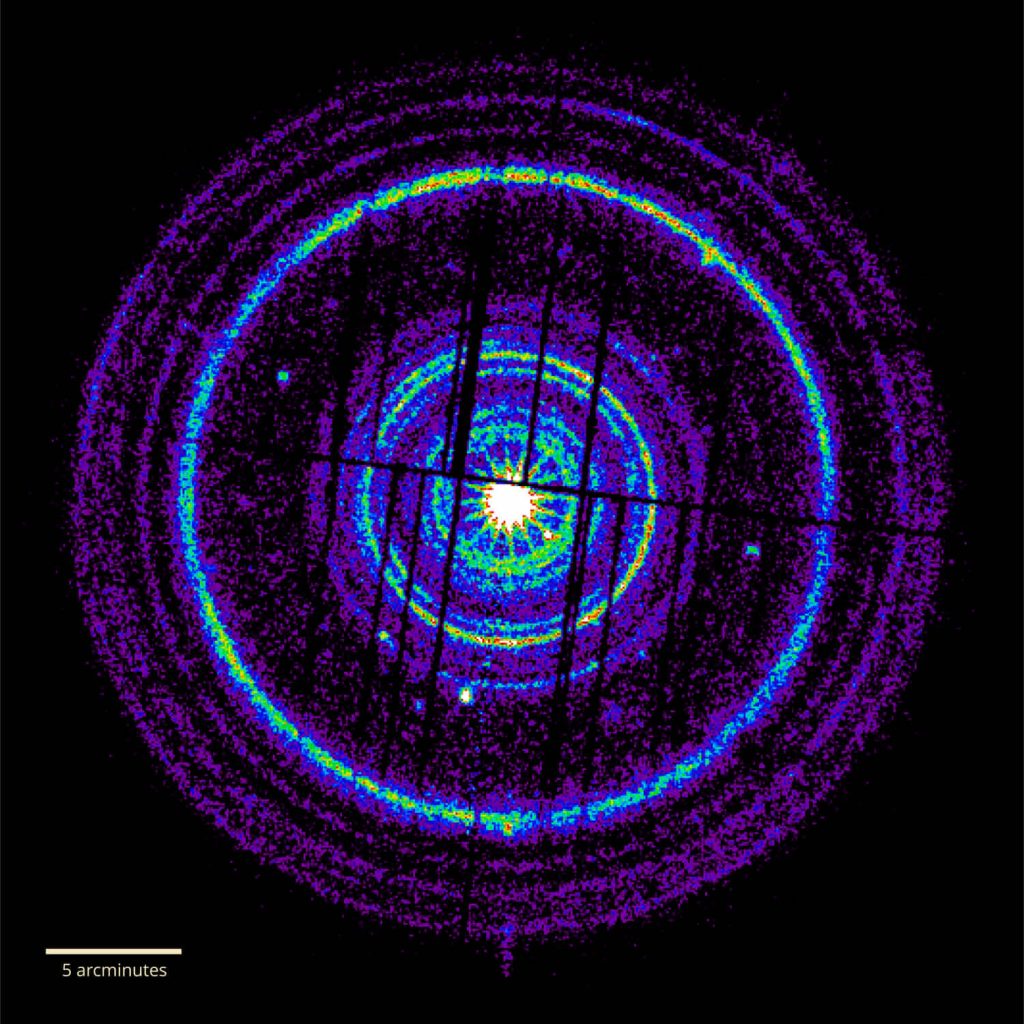
Dust rings from GRB 221009A observed by an X-ray telescope. Image: ESA/XMM-Newton/M. Rigoselli (INAF)
Traveling through the Milky Way, X-rayssequentially illuminated 20 dust clouds of our galaxy. Radiation analysis helped calculate the distance to them and analyze the properties of their constituent particles.
Over the years, researchers have proposed a number ofvarious theories describing the properties of dust grains. The researchers overlaid these patterns on the collected data. They found that a model that suggests the particles are made up primarily of graphite, a crystalline form of carbon, best fits the observations.
Mysterious source
Despite the large amount of data collectedit remains a mystery what exactly caused such a bright gamma-ray burst. Since the main version links long gamma-ray bursts to a supernova explosion, the researchers used the James Webb and Hubble space telescopes to search for the beginnings of a future nebula. But none of the telescopes found anything at the site of the alleged explosion.
One possible reason is thatThe GRB appeared in a part of the sky that is only a few degrees above the plane of the Milky Way, where thick dust clouds can greatly cloud the incident light. If so, perhaps further observations will help find the remnants of the supernova.
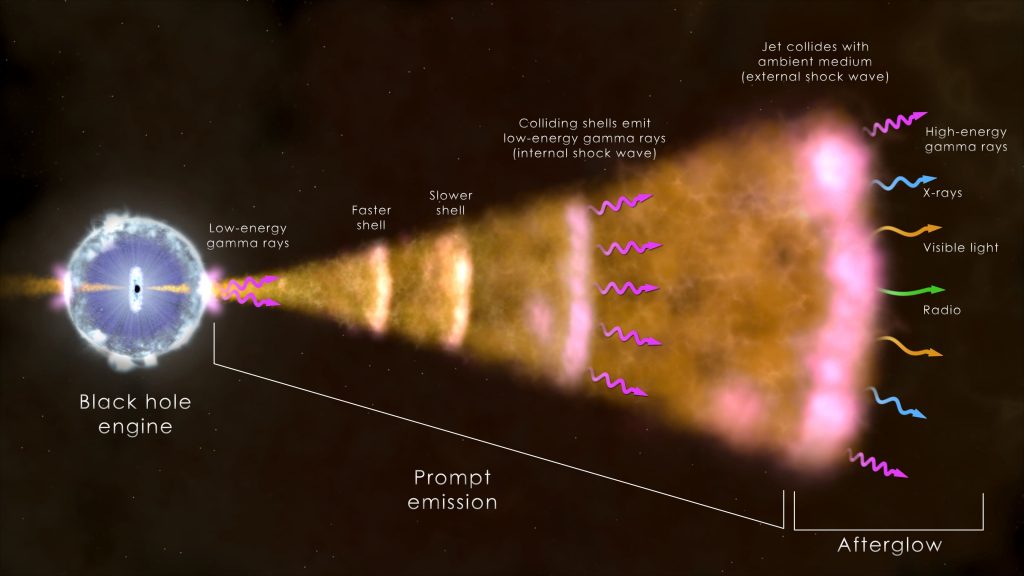 Illustration of the main components of a longgamma-ray burst, the most common type. The core of a massive star (left) has collapsed, forming a black hole that sends a stream of particles moving through the star's material into space at almost the speed of light. Emissions across the entire spectrum arise from hot ionized gas near the newborn black hole, collisions between shells of fast-moving gas within the jet (internal shock waves), and from the leading edge of the jet as it sweeps away and interacts with its surroundings (external shock). Image: NASA's Goddard Space Flight Center
An alternative hypothesis suggests that the starwas so massive that after the initial explosion, it immediately formed a black hole, which swallowed up all the material that would otherwise form a gas cloud.
Astrophysicists continue to search for remainsexploding star. Researchers are now looking for traces of heavy elements such as gold, which are believed to be formed in powerful explosions associated with the collapse of the core of a massive star.
The researchers also note that it is likely thatThe unusual power of the gamma-ray burst is due to the fact that the jet of energy (jet) ejected during the formation of the black hole was directed directly to the Earth. Analyzing the afterglow and polarization of light from such an explosion will help to learn more about how jets are formed.
Read more:
Biologists discover how cancer cells elude the immune system
The key theory of quantum physics has finally been proven. Main
Named products that protect the brain from dementia, and when to use them
On the cover: artistic illustration of a gamma-ray burst. Image: NASA/Swift/Cruz deWilde