Starry sky in September
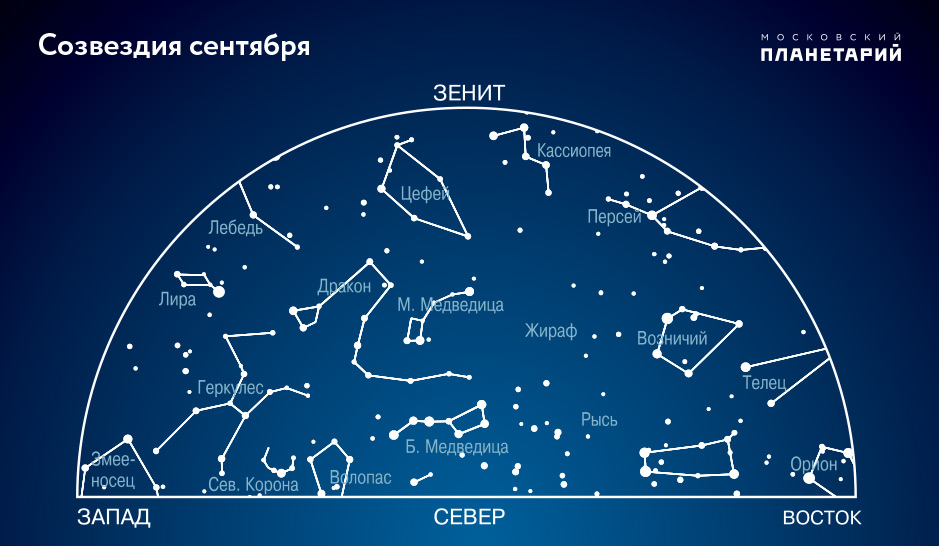
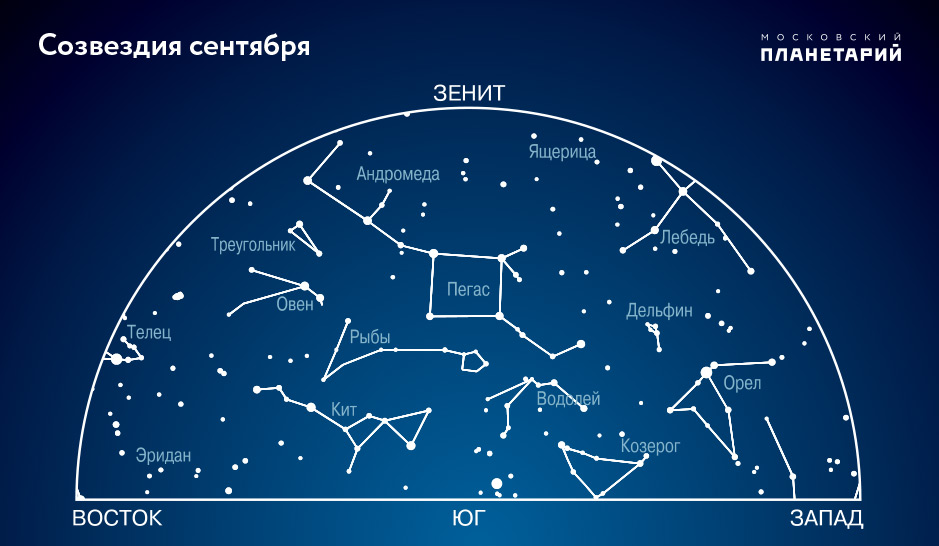
In September, three stars can be observed in the western and southwestern regions of the sky.
 Source: Moscow Planetarium
To the left of Altair is the constellation Delphinus, which looks like a small rhombus with a "handle" pointing downward.
To the right of Vega are the constellations Hercules and the Northern Crown.Below the constellations Ophiuchus and Serpent. A small trapezoid of four stars stands out above Hercules, this is the Head of the Dragon, since it serves as the beginning of the constellation Dragon.
 Source: Moscow Planetarium
Almost overhead, near the zenith, is the constellation Cepheus. Next to him is Cassiopeia.
On the north side, not high above the horizon, is the constellation Ursa Major, and above it is the constellation Ursa Minor. In North-west.
In the northeast and east, the stars of the constellation Auriga have already risen above the horizon.A little higher up is a tiny dipper of six stars, visible to the naked eye.It is an open star cluster of the Pleiades.
Near the northeastern part of the horizon is the constellation Gemini with the bright stars Castor and Pollux.
 Source: Moscow Planetarium
In the late evening, the constellation Pegasus is visible high in the southeast.
September is a very convenient month for observers of the northern hemisphere.The Milky Way is especially easy to see : it passes throughthrough the constellations Sagittarius, Scutum, Eagle, Cygnus, Lizard, Cepheus, Cassiopeia, Perseus, Auriga, and Taurus.
Position of the planets in September
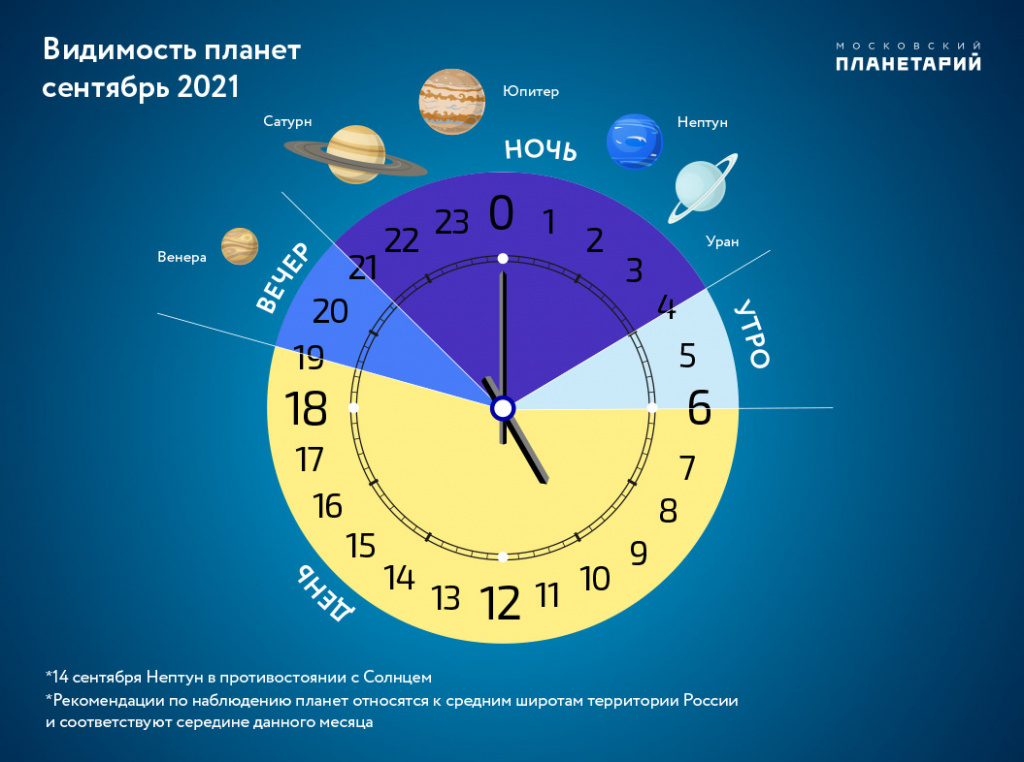
September is the best time for observing Jupiter, Saturn and Neptune. The first two planets passed the point of confrontation only in August and are perfectly visible all night.
- Neptune
September 14, the planet at the point of opposition and inSeptember is the best time for observation. Around midnight, Neptune will be at its highest point above the horizon. Until 2024, in every confrontation, conditions for observing Neptune will improve.
- Mercury
Mercury will be visible in the evening sky in September.From the beginning of the month, it will move away from the Sun until September 14 reaches the greatest elongation - the maximum distance of the lower planets, Mercury and Venus, from the Sun from the point of view of an earthly observer.
- Venus
The planet will also be observed in the evening sky, in the constellation Virgo, and from September 18 it will move to the constellation Libra.
- Jupiter
It is the brightest star in September in the southern sky, in the constellation Capricornus.On August 20, the giant passed the point of confrontation and in September there are excellent conditions for its observation.Visible from evening to morning, satellites can be easily seen even with binoculars.
 Source: Moscow Planetarium
Confrontation of Neptune
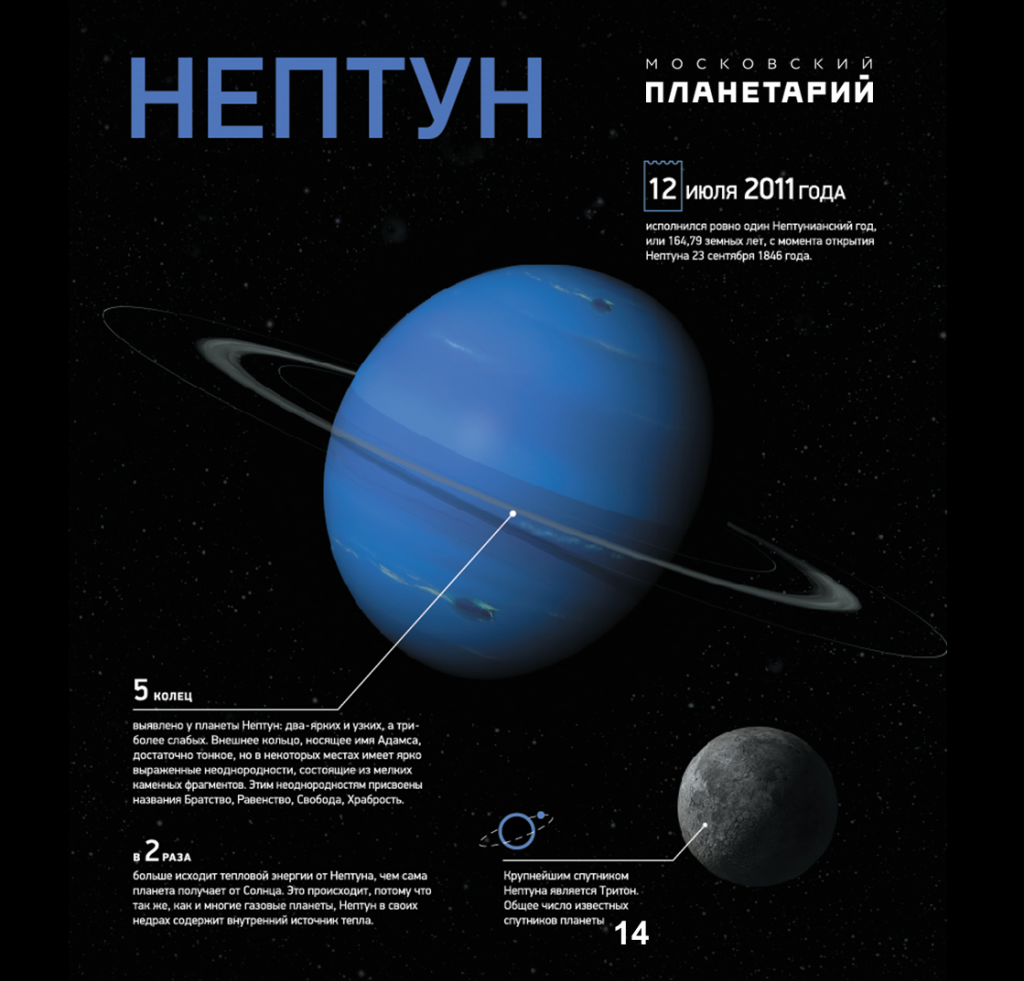
On September 14, 2021 at 12:12 Moscow time, Neptune enters opposition to the Sun.This means that there are the best possible conditions for the planet's visibility, since the distance from theThe Earth is getting smaller, so the apparent size of Neptune in the sky will bethe largest of the year.
The distance from Earth to Neptune at the moment of opposition will be 4.32 billion km, which is almost 29 times farther from the distance from the Earth to the Sun.
The most favorable period for observing Neptune will be the month before and after the day of opposition - from mid-August to mid-October 2021.
From Moscow on the night of the confrontation from 14 to 15September 2021, Neptune will be visible from dusk until dawn (from 7 pm to 6 am), gradually rising by midnight to a height of almost 30 ° above the southern horizon.
At 6 o'clock in the morning, Neptune will disappear below the horizon.Look at Neptune only through a telescope and in clear weather.
To read Further:
See a heavy attack drone that carries a ton of weapons
Scientists have updated the forecast for the collision with the Earth asteroid Bennu
Complete invulnerability: why some people never get COVID-19