CHEOPS Mission
CHEOPS stands for CHaracterisingExOPlanetSAtellite (a satellite characterizing exoplanets
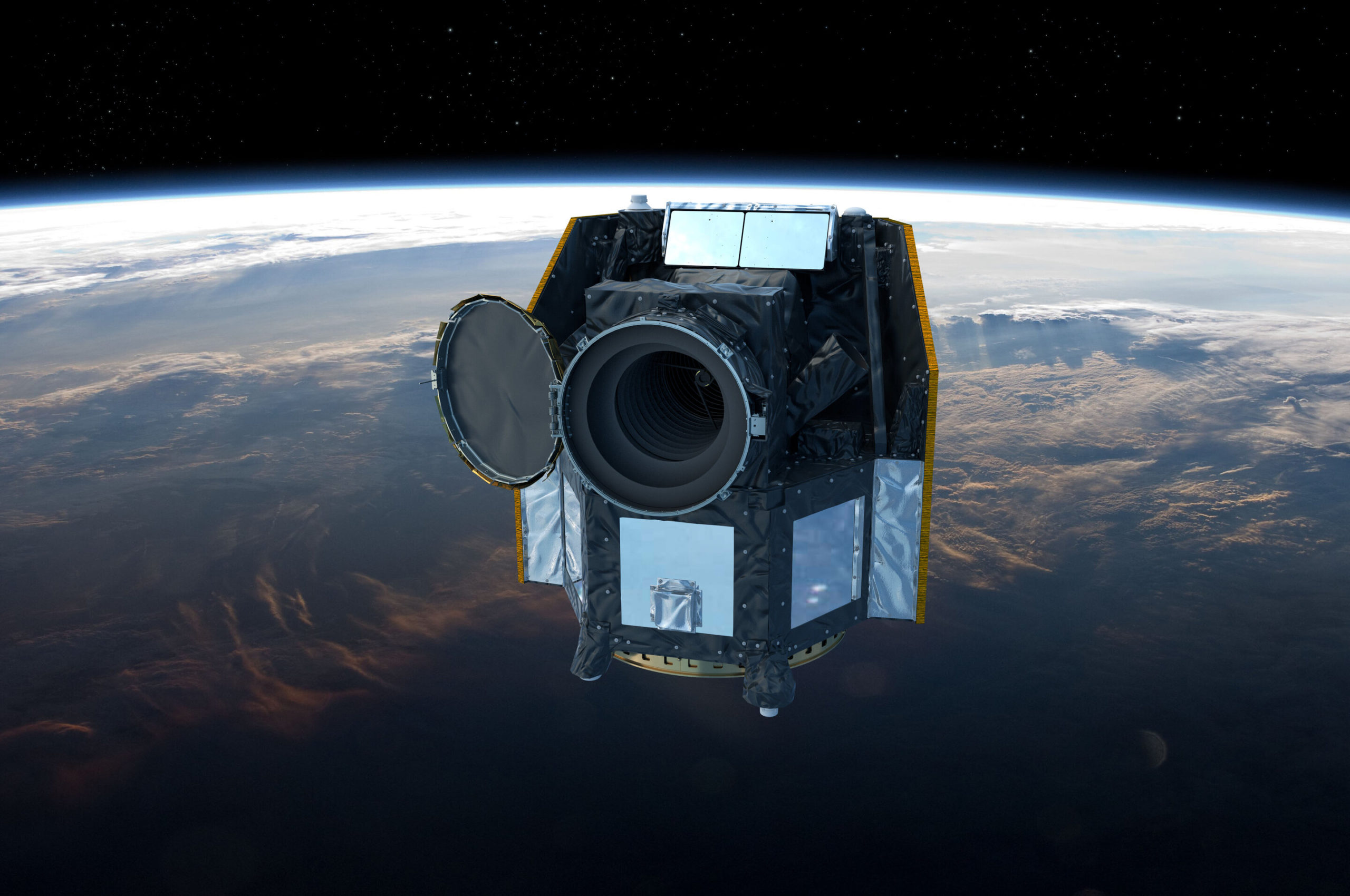 Artist's impression of CHEOPS. Credit: © ESA / ATG medialab
What is the Exoplanet Transit Method?
Exoplanets were first discovered in 1995two Swiss astronomers, Michel Mayor and Didier Kelos, who were awarded the Nobel Prize last year for this discovery. The transit method allows the discovery and study of exoplanets. Telescopes measure the radiance of stars to confirm the presence of planets around the star. The fact is that with each passage of the planet in front of the star, its darkening occurs. Cyclical changes in brightness show the passage of a planet between the Earth and the star.
NASA has its own satellite, which was createdfor detecting exoplanets using the transit method - TESS. This is a space telescope designed for the discovery of exoplanets by the transit method, developed by the Massachusetts Institute of Technology as part of NASA's Minor Exploration Program. Launched on April 18, 2018. In August 2020, TESS successfully completed its mission.
The CHEOPS mission from ESA, in turn, isthe first mission to study bright nearby stars already known to host exoplanets, with the goal of making high-precision observations of the planet's size as it passes in front of its star. CHEOPS will focus on planets ranging in size from super-Earths to Neptune, and its data will allow the bulk density of the planets to be determined. This will be the first step towards understanding these alien worlds.
First mission indicators
After launching into orbit, the satellite immediatelyreceived promising observations of known stars with exoplanets. Already in January, CHEOPS made the first deliberately blurred images of stars. Deliberate defocusing is at the heart of the mission's observation strategy, which improves measurement accuracy by distributing light from distant stars across multiple pixels of its detector.
Accuracy is the key to today's researchexoplanets. More than 4,000 discovered planets are known to orbit stars other than the Sun. A key continuation of the study of these worlds is to determine the characteristics of the planets, indicating the restrictions on their structure, formation and evolution.
The mission of Cheops is precisely to determinecharacteristics of exoplanets by accurately measuring their size. However, before announcing its readiness for this mission, the small satellite 1.5 meters in size had to go through a large number of tests.
Important tests "Cheops"
With the first series of flight tests carried out inFrom January to February, the mission's experts began to analyze the response of the satellite, in particular the telescope and detector, in real space conditions. Starting in March, CHEOPS has focused on well-studied stars.
To measure how well CHEOPS works,We first needed to observe stars whose properties were well known, stars with “good behavior” selected by hand, they had to be stable and with no signs of activity.
Keith Isaac, Cheops Project Scientist at ESA
This approach has allowed the teams of ESA, the consortiummission and Airbus Spain - the general contractor - to ensure that the satellite is as accurate and stable as necessary to achieve its ambitious goals.
Within two weeks of launch into orbitCHEOPS observed two exoplanet stars as they "passed" in front of their host star and blocked some of the starlight. The mission was created to observe the transits of known exoplanets - to measure the size of planets with unprecedented accuracy, as well as to determine their density by combining these results with independent measurements of their masses.
One of the targets was HD 93396, a subgiantThe yellow star, located 320 light years away, is slightly colder and three times the size of our Sun. The focus of the observations was KELT-11b, a plump gas planet about 30% larger than Jupiter in orbit much closer to the star than Mercury is to the Sun.
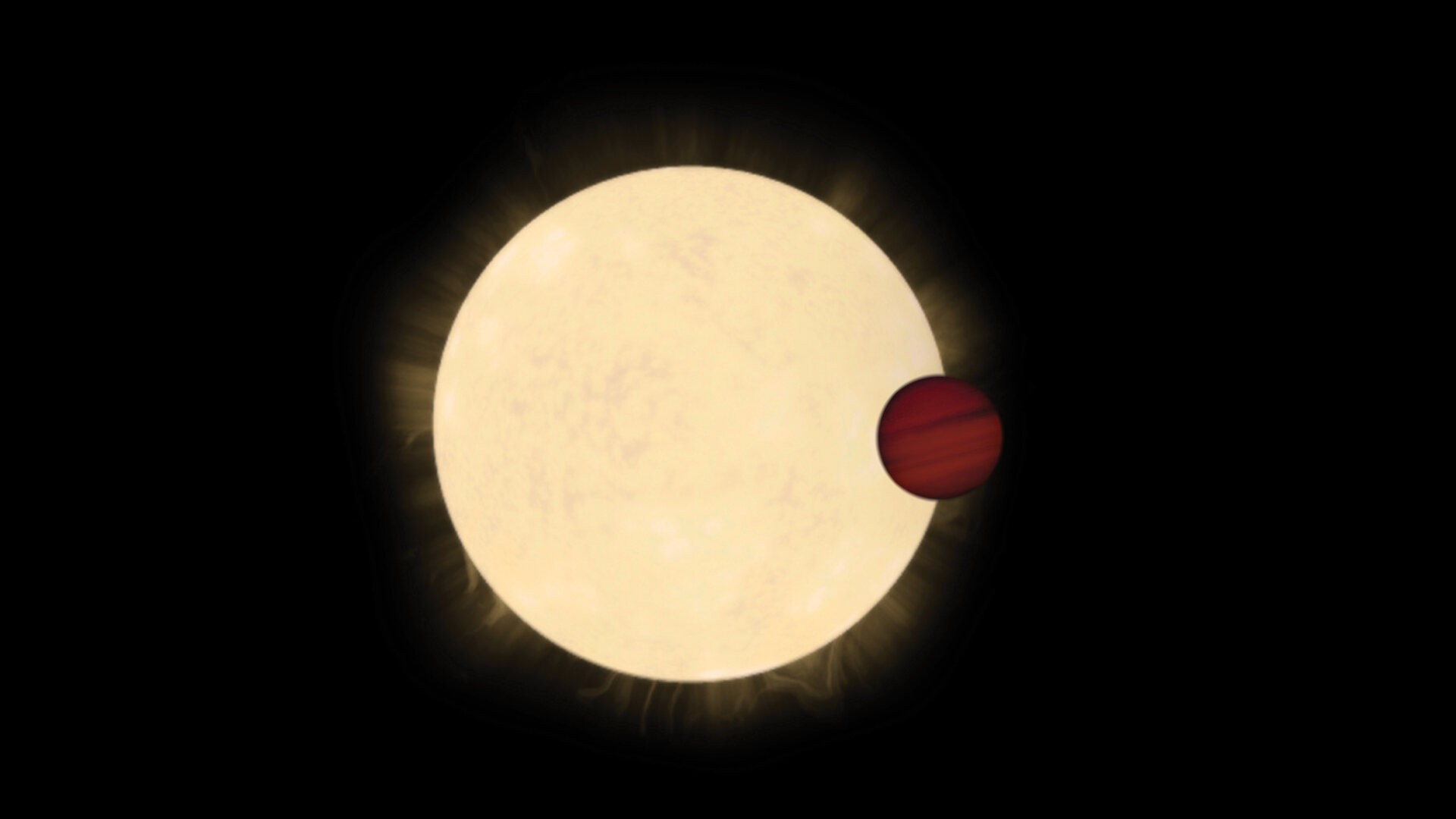 © ESA
© ESA
The light curve of this star shows a clearthe dip caused by the eight-hour passage of KELT-11b. Based on these data, scientists very accurately determined the diameter of the planet: 181,600 km - with an error of slightly less than 4300 km.
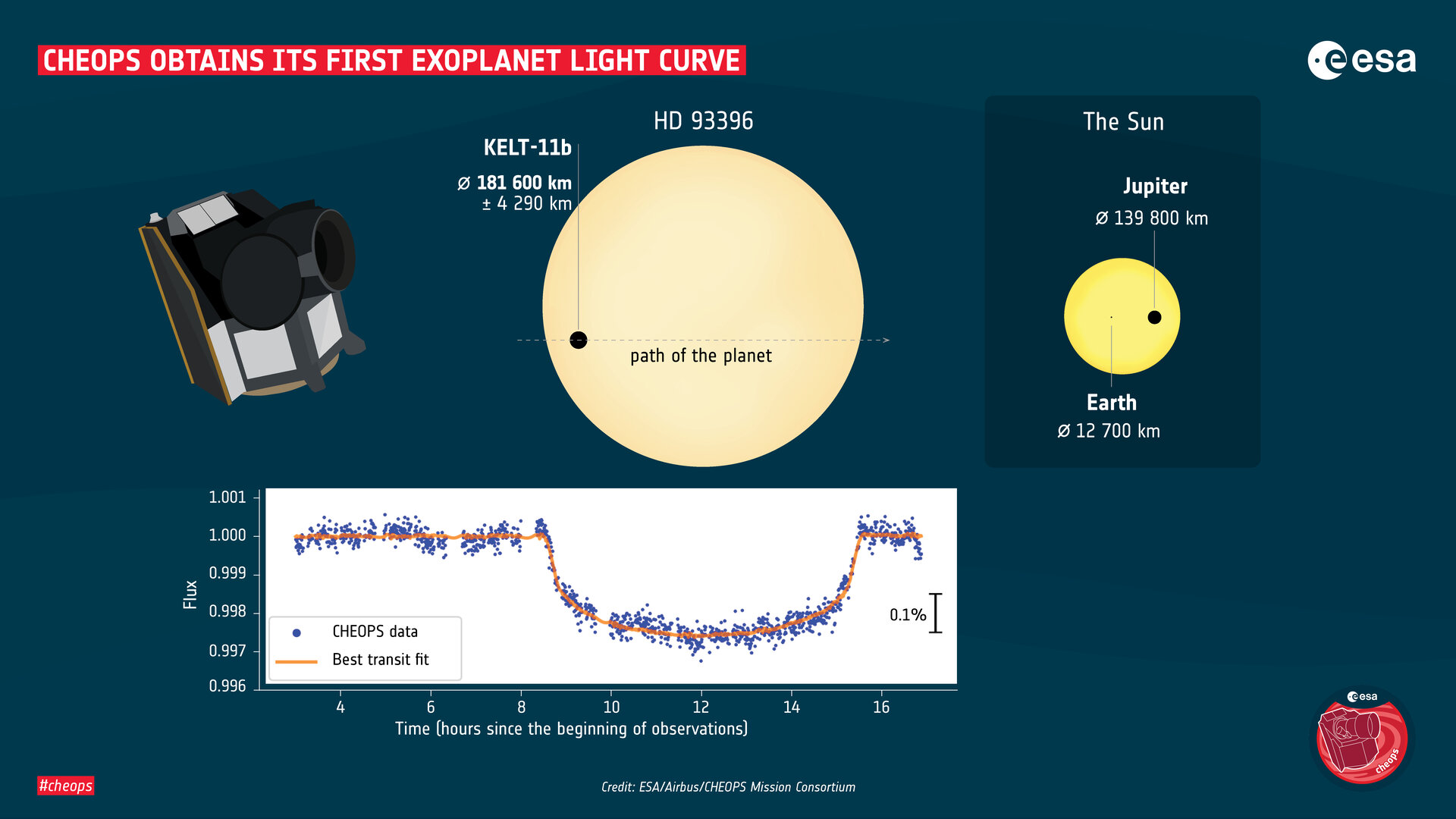 Cheops recognizes the first light curve of an exoplanet. © ESA
The measurements taken by CHEOPS turned out to be five timesmore accurate than measurements from Earth. Willie Benz, principal investigator for the mission consortium and professor of astrophysics at the University of Bern, said: "This gives us an idea of what we can achieve with CHEOPS in the coming months and years."
The first discovery of "Cheops"
CHEOPS met the expectations of scientists already aftera few months. Recently, observations with this space telescope revealed details of the exoplanet WASP-189b, one of the most extreme planets known.
Eight months after the launch of the spaceThe CHEOPS telescope produced the first scientific publication using CHEOPS data. Using CHEOPS data, scientists recently conducted a detailed study of the exoplanet WASP-189b. The research results have been accepted for publication in the journalAstronomy & Astrophysics. “These observations demonstrate that CHEOPS fully lives up to its high performance expectations,” Benz said.
One of the most extreme planets in the universe
WASP-189b, CHEOPS Observation Target, presentsis an exoplanet orbiting HD 133112, one of the hottest stars ever to have a planetary system. "The WASP-189 system is 322 light-years away in the constellation Libra," explains Monica Lendl, lead study author at the University of Geneva and a member of the PlanetS National Competence Center.
Why is WASP-189b so interesting?
Object WASP-189b is especially interesting because ita gas giant that orbits very close to its parent star. It takes less than three days to fly around its star, and is 20 times closer to the star than the Earth is to the Sun. The planet is more than 1.5 times the size of Jupiter, the largest planet in the solar system.
Planetary objects such as WASP-189b are veryexotic. They have a constant day side, which is always illuminated by the light of a star, and, accordingly, a constant night side. This means that the climate on such a planet is completely different from the climate of the gas giants - Jupiter and Saturn - in our solar system. Scientists also estimated WASP-189b's temperature to be 3,200 degrees Celsius. Such planets are called “super-hot Jupiters.” At such a high temperature, iron melts and even becomes gaseous.
“This object — one of the most extreme planets we know,” Lendl emphasizes.
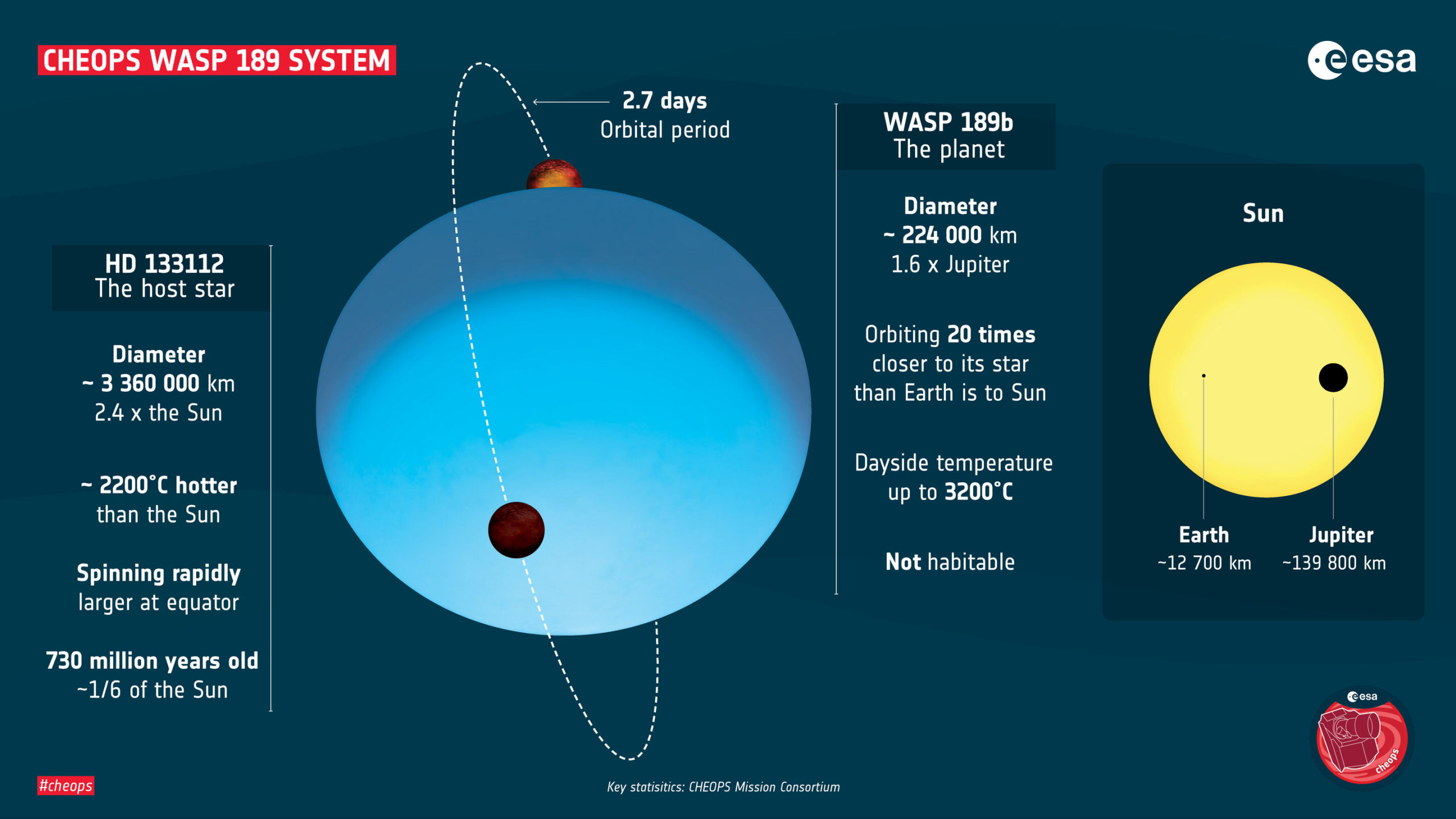 WASP 189 Information Graphics. © ESA
What measurements were taken to study the planet?
The problem is that scientists cannot see itselfplanet because it is too far from Earth and too close to its parent star. As a consequence, astronomers have to rely on indirect methods.
To do this, CHEOPS uses high-precisionbrightness measurements: when a planet passes in front of its star, that is, makes a transit, the star appears fainter for a short time. Of course, when viewed from Earth.
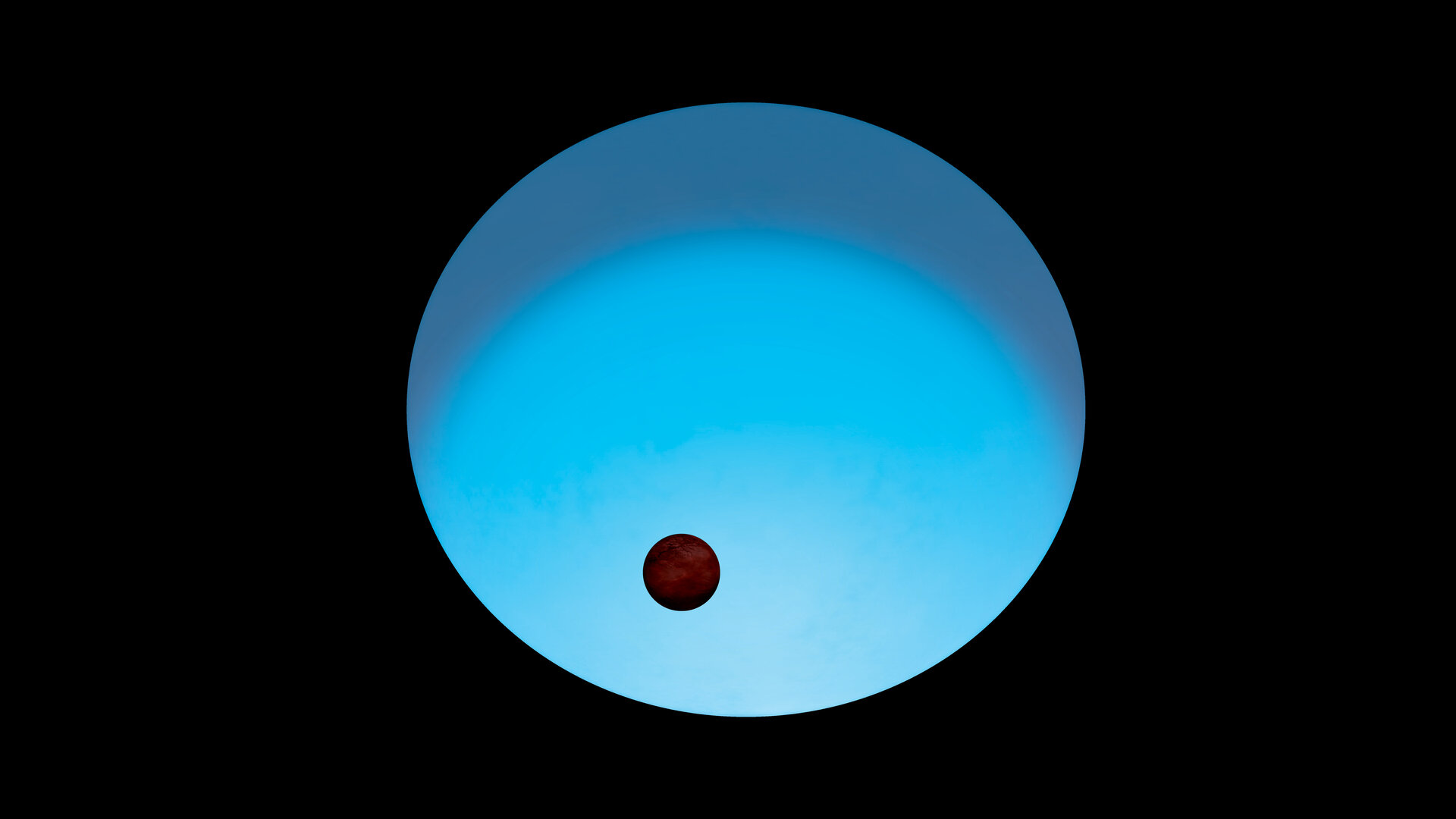 Artist's impression of WASP-189 © ESA
Since exoplanet WASP-189b is closeto its star and its daytime side is so bright that scientists have measured even the "absent" light when the planet passes behind its star - that is, during an eclipse. The research team observed several of these WASP-189b eclipses using CHEOPS. The planet does not appear to reflect much starlight. Instead, most of the starlight is absorbed by the planet, heating it up and making it shine.
However, scientists believe that the planet is notvery reflective as there are no clouds on its daytime side. And this is not surprising - theoretical models state that clouds cannot form at such high temperatures.
In addition, scientists have found that the passagegas giant in front of its star asymmetrically. This happens when a star has brighter and darker areas on its surface. Thanks to the CHEOPS data, scientists can conclude that the star itself rotates so quickly that its shape is rather ellipsoidal rather than spherical. The star is stretched out at the equator.
What's the bottom line?
The star around which WASP-189b revolves,very different from the sun. It is considerably larger and more than 2000 degrees Celsius hotter. Because it is so hot, the star appears blue instead of yellow-white like the sun.
Only a few planets are known to orbitaround such hot stars, and this system is by far the brightest. As a result, it also serves as a guide for further research. “We expect further exciting exoplanet discoveries from CHEOPS observations. The following articles are already in preparation,” concludes the chief researcher of the mission consortium.
Read also
The Doomsday glacier turned out to be more dangerous than scientists thought. We tell the main thing
Study: cats can imitate humans
On day 3 of illness, most COVID-19 patients lose their sense of smell and often suffer from a runny nose