In classical models of stellar evolution, little importance was attached to the early stage of their development. Thomas Steindl from
The “childhood age” of stars is characterized by a stagewhen the reaction of converting hydrogen into helium has not yet occurred in their cores. This stage is also known as the pre-main sequence. After “ignition,” they become adults and become main sequence stars.
“Until now, studies of stars have been concentratedmostly on mature luminaries like the Sun,” explains Thomas Steindl, lead author of the study. “Even if it sounds illogical at first glance, so far little attention has been paid to the evolution of the pre-main sequence, because this phase is very turbulent and difficult to model. Only technological advances in recent years make it possible to study the infancy of stars - and thus understand when a star begins to turn hydrogen into helium.
In a new study, scientists present a modelwhich can be used to realistically depict the earliest phases of a star's life, long before they become adults. It is based on the open source stellar evolution program MESA (Modules for Experiments in Stellar Astrophysics).
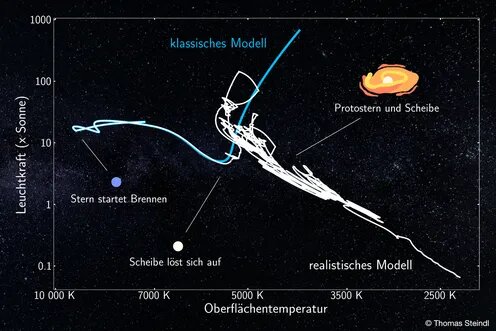 The blue line shows the evolution of the starbefore the transition to the main sequence (blue dot) according to the classical models used since the 1950s. The white line represents the realistic image resulting from Thomas Steindl's new model. Credit: University of Innsbruck.
Inspired by the report of the astronomer EdwardVorobyov of the University of Vienna at a 2019 meeting, Thomas Steindl spent several months perfecting a method for using this stellar evolution code to recreate the chaotic phase of early star formation and then predict their specific oscillations.
At this stage, scientists have found that children'sThe “very stormy” phase of stellar development influences the star’s pulsation in the future. “It sounds very simple, but we couldn’t prove it,” the scientists write. According to the classical theory, the time before the stars “ignite” simply does not matter and is much quieter. It turned out that this is not true.
Read more:
Look at a phenomenon that is simply impossible on Mars
A huge satellite can outshine all the stars and planets in the night sky
China says they will have fusion power in 6 years