For the first time, scientists have imaged electrons in QSL decaying into spin-like particles, or
This achievement will help in the development of ultrafast quantum computers and energy efficient superconductors.
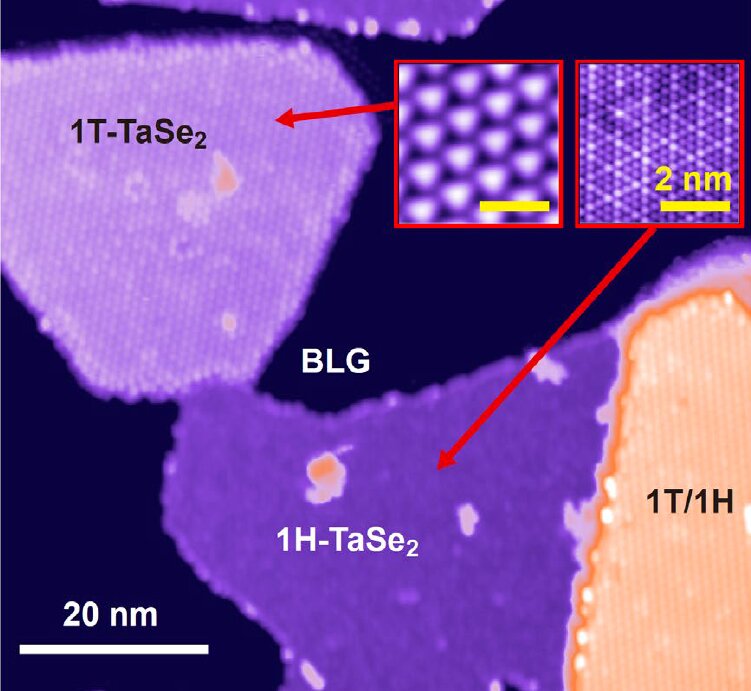
Other researchers have seen various traces of this phenomenon, but we have a real picture of the state in which the spinon is. This is something new.
Mike Crommy, Professor of Physics and Senior Research Scientist at Lawrence Berkeley National Laboratory
Spinons can be called ghost particles, soas they can occasionally be observed, but it is difficult to prove the very fact of existence. Using a new method, scientists have provided one of the best evidence for the existence of spinons to date.
In a quantum spin liquid or QSL, spinons move freely, transferring heat and rotation, but without electric charge. Scientists have previously looked for them relying on thermal signature-based methods.
In the new work, the authors grew single-layer samples of tantalum diselenide (1T-TaSe2) just three atoms thick from Berkeley Lab's Advanced Light Source (ALS).This material belongs to a class of materials called transition metal dichalcogenides (TMDCs).
The team then characterized the thin films using angular-resolution photoemission spectroscopy, a technique that typically uses X-rays.Next, using scanning tunneling microscopy (STM), the researchers injected electrons from a metal needle into a TMDC sample made of tantalum diselenide.
After that, the authors found that when an electron is injected into the QSL from the tip of the STM, it decays into two different particles within the QSL:
- spinons,
- Charges.
Spinon particles ultimately carry spin separately, while charges separately carry an electric charge.
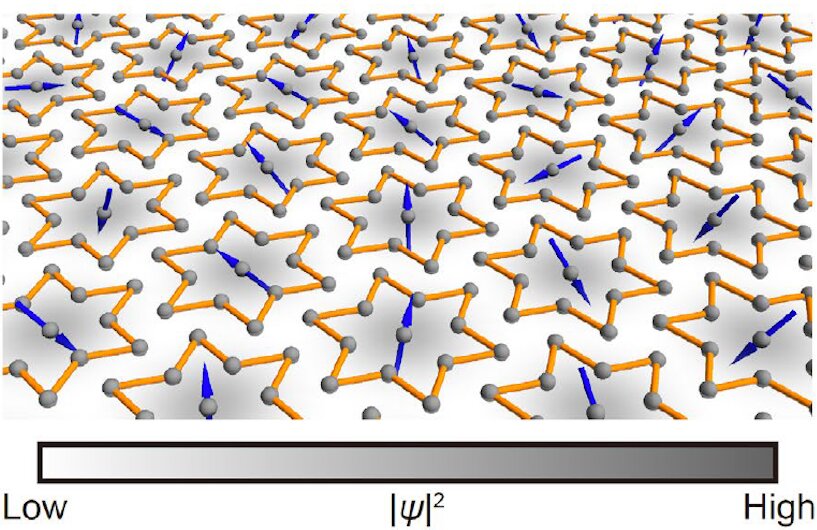
As a result, the STM / STS image shows thatthe charges freeze in place, forming what scientists call the charge density wave of the Star of David. Meanwhile, the spinons are separated from the immobilized charges and move freely through the material.
Read more:
Giant iceberg A74 collides with the coast of Antarctica
Two new dinosaur species discovered in China
What is the Kessler effect, and also when and what will the collision of satellites in orbit lead to?