Milky Way and Andromeda Galaxy
The merger of galaxies is a key mechanism of their evolution. Astronomers regularly
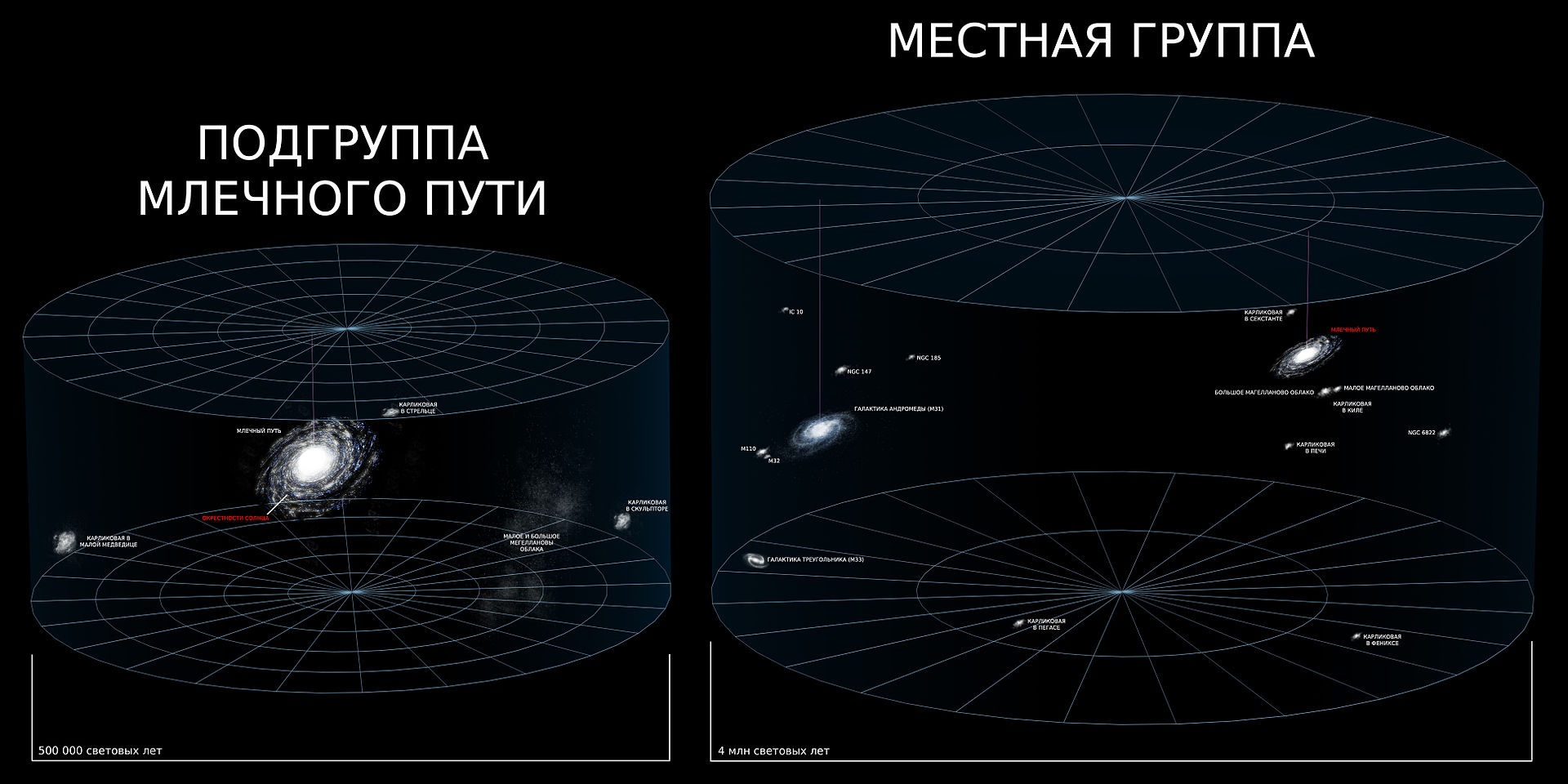
The Milky Way and the Andromeda Nebula are the largestobjects of the Local Group, which includes fifty smaller galaxies. They are 2.5 million light years apart. Despite such a great distance, both galaxies are gravitationally connected to each other.
Collision model
- Milky Way
The Milky Way is the galaxy that contains the Earth, the Solar System, and all the individual stars visible to the naked eye. Refers to barred spiral galaxies.
The Milky Way along with the Andromeda galaxy (M31),Galaxy of the Triangle (M33) and more than 40 dwarf satellite galaxies - their own and Andromeda - form the Local Group of Galaxies, which is part of the Local Supercluster (Virgo Supercluster).
The Galaxy belongs to the class of spiral galaxies, which means that the Galaxy has spiralsleeves, located in the plane of the disk. The disk is immersed inhalospherical in shape, and around it is a sphericalcrown.
The solar system is at a distance of 8.5thousand parsecs from the galactic center, near the plane of the Galaxy (the displacement to the North Pole of the Galaxy is only 10 parsecs), on the inner edge of the arm calledOrion arm.
This arrangement makes it impossible to observethe shape of the sleeves visually. New data from observations of molecular gas (CO) suggest that our Galaxy has two arms, starting at a bar in the inner part of the Galaxy.
In addition, there are a couple of sleeves on the inside. Then these arms transform into a four-arm structure observed in the neutral hydrogen line in the outer parts of the Galaxy.
- Andromeda Galaxy
The Andromeda Galaxy is a spiral galaxyobserved in the constellation Andromeda. This galaxy is approximately twice the diameter of our galaxy, contains several times more stars and is located at a distance of about 800 kiloparsecs.
This makes it the closest of the large galaxies, as well as the largest galaxy in the Local Group, however, its mass is less than that of the Milky Way.
The stellar population of this galaxy, on average, is more thanolder than our galaxy, and more metallic. The galaxy has many satellites that affect its structure, in its history there have been many collisions with other galaxies. In the future, the Milky Way will collide and merge with the Andromeda Galaxy.
The earliest surviving mention of the galaxy dates back to 964 AD, and today it is one of the most studied galaxies.
Galaxy collision model
As with all such collisions, it is unlikelythat objects like stars contained in each galaxy will actually collide with each other due to the low concentration of matter in the galaxies and the extreme distance of the objects from each other.
For example, the closest star to the Sun, Proxima Centauri, is located at a distance of approximately 4.22 light years from Earth, which is 277 thousand times the distance from Earth to the Sun.
For comparison: if the Sun were the size of a coin 2.5 centimeters in diameter, then the nearest coin / star would be 718 kilometers away.
Based on calculations, the stars and gas of the galaxyAndromeda will be visible to the naked eye in about three billion years. As a result of the collision, the galaxies will merge into one giant galaxy within about one to two billion years. Various names have been proposed for the newly formed galaxy, for example,Milkomed.
Collision probability
At the moment it is not known exactly what will happencollision or not. The Andromeda Galaxy's radial velocity relative to the Milky Way can be measured by studying the Doppler shift of spectral lines from the galaxy's stars, but the transverse velocity (or "proper motion") cannot be measured directly.
Thus, it is known that the Andromeda Galaxy is approaching the Milky Way at a speed of about 120 km/s, but whether a collision will occur or the galaxies will simply separate cannot yet be determined.
At the moment, the most accurate indirectmeasurements of the transverse speed show that it does not exceed 100 km/s. This suggests that at least the dark matter haloes of the two galaxies will collide, even if the disks themselves do not collide.
Launched by the European Space Agency in 2013, the Gaia space telescope refined the locations of the stars in the Andromeda galaxy to refine the transverse velocity.
Frank Summers of the Space Science InstituteThe telescope has created a computer visualization of the upcoming event based on research by Professor Chris Migos of Case Western Reserve University and Lars Hernquist of Harvard University.
As published in September 2014According to one model, in 4 billion years the Milky Way will “absorb” the Large and Small Magellanic Clouds, and after 5 billion years it will merge with the Andromeda Nebula. According to other calculations, the galaxies will collide tangentially in 4.7 billion years.
Such collisions are relatively common: the Andromeda nebula, for example, has collided in the past with at least one dwarf galaxy, just like our own galaxy.
Potential impacts of a collision on the solar system
Manifestations of this collision will occurextremely slowly and may not be visible at all from Earth with the naked eye. The likelihood of any direct impact on the Sun and planets is low.
But on the other hand, it is possible that during the collision the solar system will be completely ejected from the new galaxy by gravitational forces and will become a wandering intergalactic object.
This will not cause negative consequences for oursystem, except for the gradual disappearance of the beautiful starry sky. The solar magnetosphere may be able to protect us from intergalactic radiation.
The probability of being ejected from the disk of the Milky Way during the first stage of the collision is now estimated at 12%, and the probability of being captured by Andromeda is 3%.
By that time, the evolution of the Sun and its subsequent transformation into a red giant in 5-6 billion years will be of much greater importance for life on Earth.
New research on the alleged merger
Scientists from Italy recently conducted a newmodeling the merger of the Milky Way and the Andromeda Nebula, specifying their parameters. As the authors note, the result is highly dependent on the mass of the invisible part of galaxies - the halo.
It is believed to be composed of dark matter,inaccessible to our devices. The dimensions of the halo are unknown, making it difficult to determine the mass of galaxies. The range of values is 21-73 times the size of the galactic disk.
It is not even known where exactly the Milky Way ends.and Andromeda, whether their halos intersect. The result is also influenced by the speed of proper motion of galaxies and the density of the intergalactic medium in which they fly.
According to the authors' forecasts, the galaxies will approach each other in 4.3 billion years and after another ten billion years they will begin to merge. This is longer than previous estimates.
By then the sun will turn redgiant, will incinerate the nearest planets and go out. Earthlings will have to flee to the outlying giant planets, but they will be able to observe the death of their Galaxy.
As for supermassive black holes, they will first spiral in the inner part of Milkomeda, and only after 16.6 billion years will they merge.
Due to the huge mass of objects, a powerful release of gravitational radiation will occur. The waves from this event will be able to detect powerful interferometers such as the ground-based future SKA or the space-based LISA.
Read more
Oxygen will definitely disappear: what will happen to the Earth without the main source of life
Solar energy made liquid fuel in China
Physicists have created an analogue of a black hole and confirmed Hawking's theory. Where it leads?