A group of Japanese researchers led by Tohoku University recreated the conditions in the laboratory
Modern research suggests that the nucleus,located at a depth of about 3 thousand km below the Earth's surface, it consists mainly of iron: an outer core of liquid metal surrounds a solid inner core. However, all modern observations are obtained solely on the basis of the analysis of the propagation of seismic waves, which may be inaccurate, scientists say.
The researchers combined the cell method with diamondanvils and scattering x-rays to recreate the conditions of the inner core and determine its properties. The cell is designed with two cone-shaped diamonds that transmit compressive force to work platforms that are less than a millimeter in diameter. Due to the high hardness of diamond, pressures of several million atmospheres can be achieved with this method.
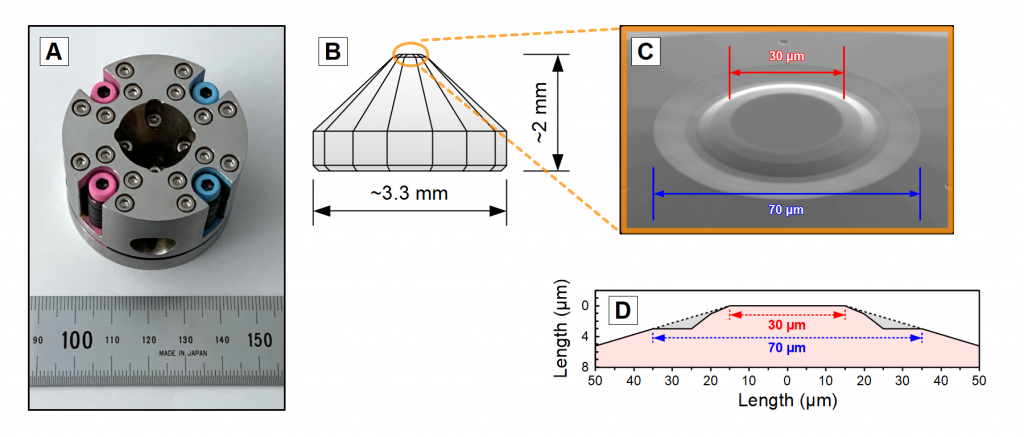 Diamond anvil cell used inthis experiment. (A) Symmetrical diamond anvil, (B) Schematic diagram of a diamond anvil. (C) Image of the top of a diamond anvil (stepped chamfer) designed to measure IXS at ultra-high pressure, (D) Cross section of the diamond anvil. Image: Daijo Ikuta et al., Nature Communications
By connecting cells with scattered x-raysrays, scientists were able to observe the movement of atoms in materials. This is the only way to accurately measure the speed of sound in metals under static compression in a diamond anvil cell, they note.
The study showed that the speed of sound forthe inner core, determined by seismological studies, is 4 ± 2% slower in compression rate and 36 ± 17% slower in shear rate than that of metallic iron.
These results suggest that current ideas about the composition of the Earth's core are incorrect. Researchers believe that, in addition to iron, the Earth's core may be enriched in silicon and sulfur.
Read more:
The creator of the space elevator: "Transit into space will appear within 10 years"
Look at the result of a "head-on collision" of two galaxies: this is a very rare occurrence.
Wolves infected with toxoplasmosis are 46 times more likely to become pack leaders