The tattered shell of the first ever documented supernova was revealed by a dark energy camera
Around the outer edges filled with starsthe image shows thin tendrils that seem to float away from the central point, like the tattered remains of a burst balloon. These cloud-like features are believed to be the luminous remnants of a supernova that Chinese astronomers observed in 185 AD. e. When it appeared, ancient astronomers called this strange phenomenon in the night sky a “guest star,” according to the U.S. National Science Foundation. It remained visible to the naked eye for about eight months before disappearing from sight.
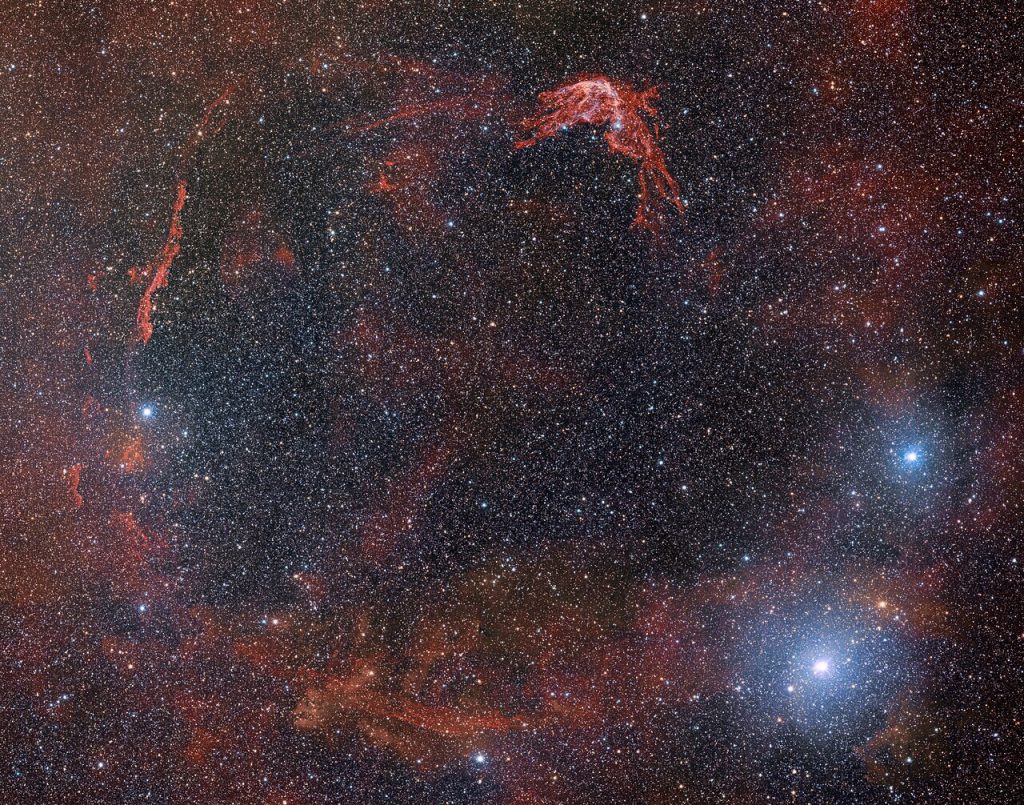 Credit: US National Science Foundation
Now this historical supernova is calledSN 185. It exploded at a distance of more than 8,000 light-years in approximately the direction of Alpha Centauri, between the constellations Circulus and Centaurus. The resulting structure of RCW 86 helps understand how supernova remnants have evolved over the last 1,800 years. DECam's wide-field vision allowed astronomers to create this rare image of the entire supernova remnant as it is seen today.
Now astronomers have a more completea glimpse of how RCW 86 formed. When the binary system's white dwarf consumed material from its companion star, its high-speed winds pushed surrounding gas and dust outward, creating the cavity we see today. Then, when the white dwarf could not withstand any more mass falling on it from its companion star, it exploded. The previously formed cavity provided ample space for high-velocity stellar remnants, which expanded very quickly and created the monumental structures we see today.
Read more:
The mystery of the red stripes on the satellite of Jupiter is revealed
Found "impossible" planet. She defies modern science
Mysterious hexagonal "honeycombs" in salt deserts found an explanation