Scientists have found a medium-mass black hole AT2020neh, which was hiding in the dwarf galaxy SDSS J152120.07+140410.5. It was discovered when it engulfed a star. The resulting tidal disruption event produced a powerful burst of radiation that briefly eclipsed the combined light of the host dwarf galaxy. The discovery will help astronomers better understand the relationship between black holes and galaxies.
Tidal disruption event, also knownlike a flash of tidal disruption, an astronomical phenomenon. It occurs when a star gets too close to the event horizon of a supermassive black hole and is torn apart by the object's tidal forces. This causes spaghettification.
The outbreak was recorded with the help of YoungThe Supernova Experiment (YSE) is a survey designed to detect cosmic explosions and transient astrophysical events. An international team led by scientists from the University of California, Santa Cruz, the Niels Bohr Institute at the University of Copenhagen, and the University of Washington reported the discovery in a paper published in the journal Nature Astronomy.
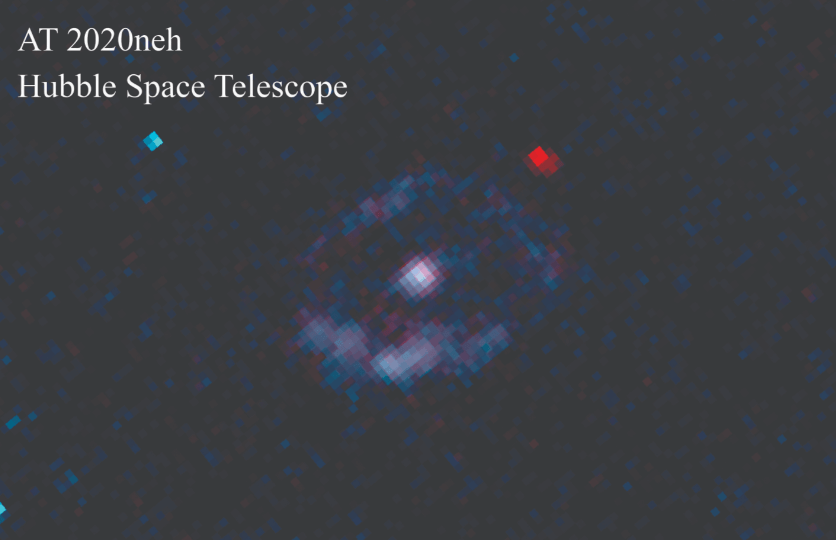 Hubble's ultraviolet camera has seen a ring of stars forming around the core of the galaxy where AT 2020neh resides.
Image Credit & Copyright: NASA, ESA, Ryan Foley/UC Santa Cruz
First author Charlotte Angus of the InstituteNilsa Bohr said the team's findings provide a basis for future research on medium-sized black holes. “We managed to find her when she was devouring a star. Otherwise, we would not have noticed this object,” she explains. “This will help detect other black holes of this type.”
Supermassive black holes are located at the centers ofall massive galaxies, including the Milky Way. Astronomers believe that these massive objects, with millions or billions of times the mass of the Sun, could have grown from intermediate-mass black holes.
Read more:
Named the consequences of the last solar storm that hit the Earth
A massive impact from a space object triggered the Earth's magnetic field
A huge tunnel under the Egyptian temple “hidden” mysterious artifacts
Cover photo: TIC 400799224, The Center for Astrophysics, Harvard & Smithsonian