How was Phobos discovered?
At the beginning of the 17th century, the German astronomer Johannes Kepler suggested that Mars could
So, despite the theory that Mars hasshould have its own moons, like its neighbors, no evidence of their existence could be found. Yet American astronomer Asaf Hall conducted a methodological study at the United States Naval Observatory in Washington, DC. He looked for satellites closer to the planet than previous explorers. However, his search was unsuccessful.
The disappointed Hall was about to give up, but hewife Angelina insisted that she continue the observations. The very next night, August 12, 1877, he discovered the moon that would later be known as Deimos. Six days later he discovered Phobos. The two moons were so close to the planet that they were hidden by the glow of Mars. About the size of an asteroid, they are also the two smallest moons in the solar system. Moreover, the larger Phobos is 7.24 times more massive than Deimos.
What makes him interesting?
In Greek mythology, Phobos was one of the sonsgod of war Ares (Mars - in Roman), his brother's name was Deimos. Twin sons accompanied their father in battles. Deimos means "terror" or "panic" (especially in the context of escape from the battlefield), and Phobos means "fear" (hence the word "phobia").
Phobos has a nearly circular equatorial orbit.It rotates every 7 hours 39 minutes at an altitude of 5,989 km above the surface of Mars. The orbital period of Phobos is three times faster than the rotation of Mars. The satellite is too light for gravity, so its shape is not spherical. It is all covered with bumps and craters.
The dominant feature of Phobos is the large impact crater Stickney, about 9.5 km in diameter. It is named after Asaph Hall's wife's maiden name.
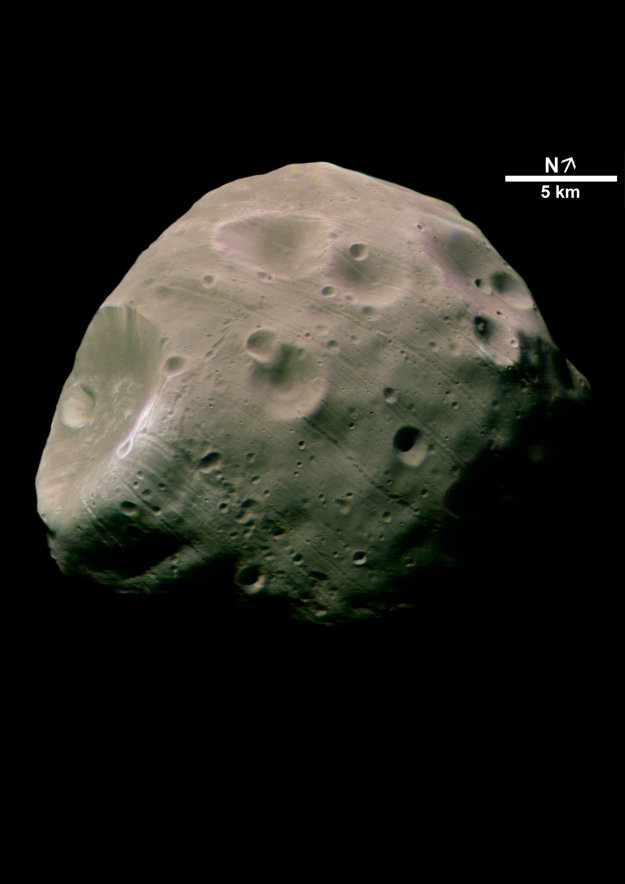 An image of the side of Phobos facing Mars. Credit: ESA / DLR / FU Berlin (G. Neukum), CC BY-SA IGO 3.0.
By the way, several studies of Phobos and its satellite have revealed not only their bizarre non-spherical shapes.
After observing this pair of moons, scientists cameto the conclusion that they are made of material similar to type I or type II carbon chondrites. It is of it that asteroids and dwarf planets are composed. Eventually, some scientists concluded that Phobos and Deimos originated from the asteroid belt when Jupiter's gravity pushed them into Mars orbit billions of years ago.
However, astronomers are not sure exactly from therethe moons of Mars appeared. Both have nearly circular orbits, which is very unusual for objects captured by the planet's gravity. Moreover, these moons are not as dense as objects in the asteroid belt.
Phobos and Deimos may have formed from dust and rocks from the orbit of Mars, joined together by gravity.
The orbit of Phobos decreases by 1.8 cmper year. Within 50 to 100 million years, the moon will either collide with its parent planet or be torn to pieces and scattered into a ring around Mars. The gloomy future of Phobos has earned it the nickname “the doomed moon of Mars.”
How was Phobos previously studied?
With more and more research, scientists were ablelearn more about the moons orbiting Mars. Viking orbiters flew past them in the late 1970s. The Soviet Phobos 2 mission, NASA's Mars Global Surveyor program and Europe's Mars Express have all provided more clues about the two curious moons. The Spirit, Opportunity and Curiosity missions provided images of satellites from the surface of Mars.
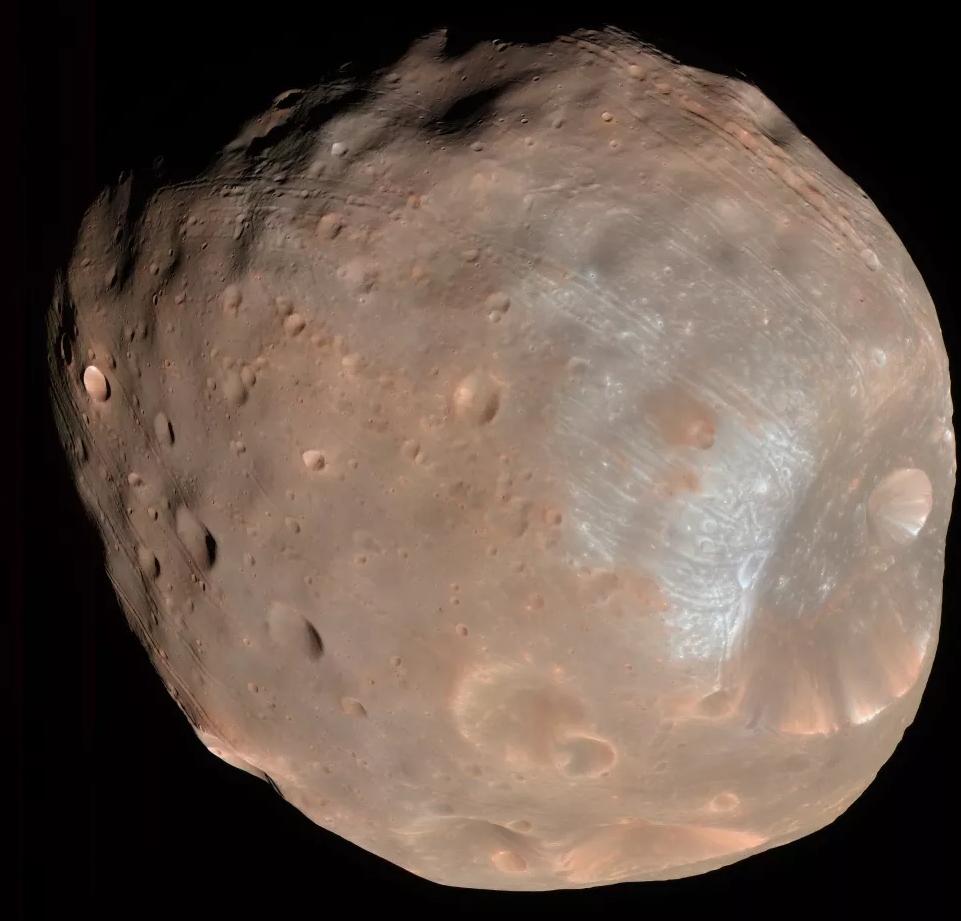 NASA Mars Reconnaissance OrbiterOrbiter captured this image of the larger of Mars' two moons, Phobos, from about 6,800 kilometers away. Image: © NASA / JPL / University of Arizona
In 2011, Russia tried to send a mission toa Martian satellite called Phobos-Grunt that was supposed to return to Earth in 2014 with a small sample of the moon. However, the spacecraft remained in low-earth orbit due to technical problems. As a result, the satellite fell to Earth in early 2012 in the Pacific Ocean.
Why do you need a new mission?
Quentin Nénon from the Laboratoryof Space Sciences at the University of California, Berkeley, and his colleagues believe that the upper layers of the regolith covering the Martian moon Phobos could have accumulated ions of oxygen, argon, carbon and nitrogen, which over the course of billions of years left the Martian atmosphere.
To reach this conclusion, Nenon's teamanalyzed data from NASA's MAVEN (Mars Atmosphere and Volatile EvolutioN) spacecraft. MAVEN has been collecting data from Mars orbit for more than six years to help scientists figure out how the planet lost its atmosphere and provide other important scientific data about the evolution of the planet's climate. Because the spacecraft crossed Phobos' orbit about five times per Earth day as it circled Mars on its primary mission, scientists decided to use MAVEN's measurements to learn something about Phobos. Moreover, this is the goal of the new upcoming mission that is being planned in Japan.
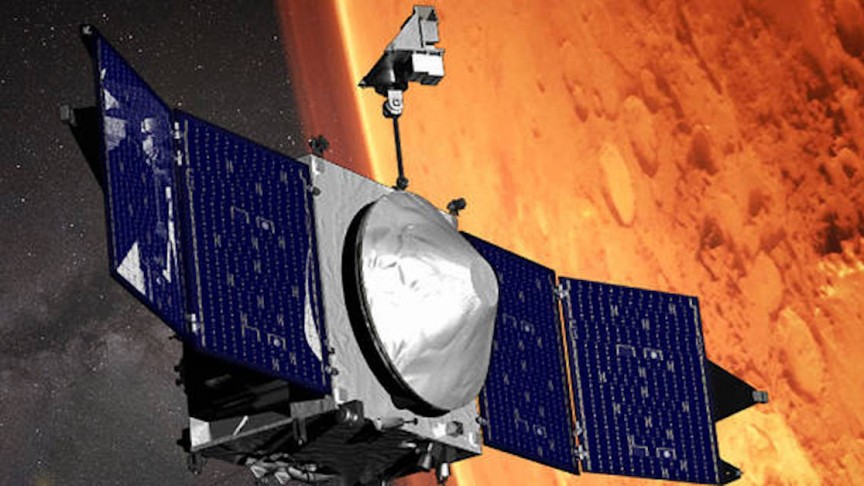
The visualization shows the change in the orbit of the MAVEN spacecraft during its main mission.
Credit: NASA
Japan Aerospace Exploration Agencyis preparing to send the Martian Moons Exploration (MMX) probe to Phobos in 2024 to collect samples from its surface for the first time and deliver them to Earth. Scientists believe these samples will be most informative if MMX lands on the side of Phobos that faces Mars. For at least the last ten million years, Phobos has been in a state of spin-orbital resonance, that is, it is always facing Mars with one of its hemispheres. Therefore, gas ions from the Martian atmosphere all this time fell on the same side of Phobos.

To estimate their possible number,The researchers analyzed data collected by the Super-Hot and Hot Ion Composition Analyzer (STATIC) on board the MAVEN orbiter. They found that the topmost layer of the surface of the side of Phobos closest to Mars is exposed to 20 to 100 times more Martian ions than its opposite side.
The Japan Aerospace Agency (JAXA) is preparingMartian Moons eXploration mission (research of Martian satellites, MMX). Of course, the mission will focus on Martian moons. The spacecraft will perform close-up remote sensing and in-situ observations of both moons, and collect samples from one to return to Earth. The mission is planned to observe two of Mars' moons, Phobos and Deimos, and return to Earth with a sample taken from one of those moons.
MMX mission aims to launch a probe at the start2020s, and research and development is ongoing. The estimated launch date is 2024. The probe will enter quasi-satellite orbit (QSO) of the Martian moons and then observe and collect samples. A possible scenario for the return of the probe to Earth with its samples after the probe completes its observations and collection is now being studied.
It is hoped that this research and developmentwill lead to advances in technology required for future planetary and lunar probes, optimal communication technologies using new ground probe stations, advanced sampling technology from the surface of astronomical objects, and technologies for travel between Mars and Earth.
The mission will also help to figure out the evolutionary process of Mars and get the key to understanding the secrets of planet formation in this region of the solar system.
In addition, NASA is consideringthe Phobos Surveyor mission, in which small probes will be sent to the lunar surface. The mission is funded by NASA's Innovative Advanced Concepts Program, NASA's Institute for Advanced Concepts. It is designed to develop far-reaching, long-term, cutting-edge and completely new aerospace concepts.
Read more
Look at an 8 trillion pixel image of Mars
Scientists have developed a replacement for the theory of relativity. What is the essence of the "theory of everything"?
Abortion and science: what will happen to the children who will give birth