Researchers from China and the United States have proposed a new method for producing perovskite cells. Technology
Perovskites are usually synthesized in wetlaboratories and then apply the material as a film on a glass substrate for a variety of applications, the authors say. To create their solar cells, they replaced glass with a substrate made of a layer of metal or metamaterial, consisting of alternating layers of silver (conductor) and aluminum oxide (dielectric).
In a solar cell, photons of sunlightmust interact with and excite electrons, causing negatively charged particles to move and generate an electric current, the physicists explain. Ideally, a solar cell should use "weak" materials to avoid recombination as excited electrons return to the atomic nuclei.
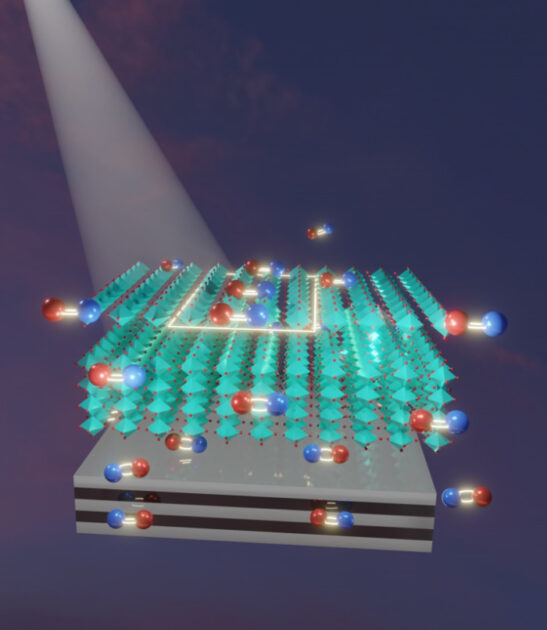 An illustration of the interaction between perovskite andmetal-dielectric substrate. Mirror images reflected from the substrate reduce the ability of the excited electrons in the perovskite to recombine with their atomic nuclei. Image: Chloe Zhang, University of Rochester
Using new technology, scientists have createda material in which the recombination of electrons is weakened by a "many amazing physical phenomena". The metal layer serves as a mirror that creates inverted images of electron-hole pairs, weakening the ability of electrons to recombine with holes.
In a lab experiment, researchersshowed that metal- or metamaterial-supported perovskites convert photons into electricity 250% more efficiently than glass-based perovskites. Physicists will continue to work on improving the material in order to solve the main problem of perovskite elements - rapid degradation.
Read more:
It's not about the Earth: scientists explained why the solar system is the rarest
Dinosaurs in bamboo corsets were found among the artifacts of the expedition of the early twentieth century
Substance from the "grandfather's beard" improves memory and neuronal growth