Using simultaneous observations at different wavelengths, the researchers obtained an image of a distant
Astrophysicists of the Event Horizon Telescope Projectmapped the linearly polarized radiation in the interior of the J1924-2914 quasar. The image is the highest angular resolution image of polarized radiation from a quasar ever taken, the study authors say.
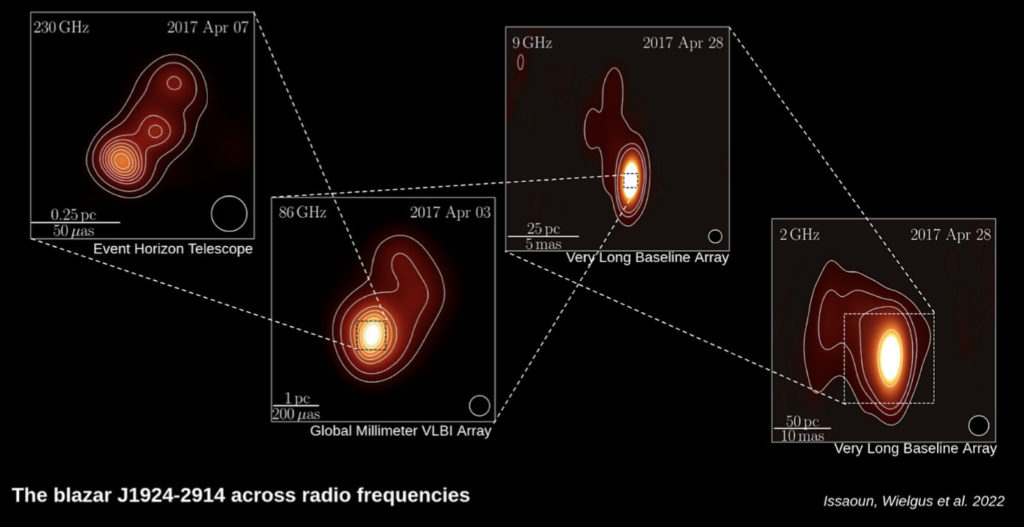 Observations at different frequencies of the blazar J1924-2914. Image: Sara Issaoun et al., The Astrophysical Journal
Scientists note that the image shows newinteresting details in the strongly polarized inner core of the source. For example, the morphology of polarized radiation suggests that it most likely has a twisted structure of the magnetic field.
Blazars are powerful active galactic nucleiin which supermassive black holes eject relativistic jets or jets consisting of plasma. A blazar can shine brighter than its own galaxy and can be seen with radio telescopes from billions of light-years away.
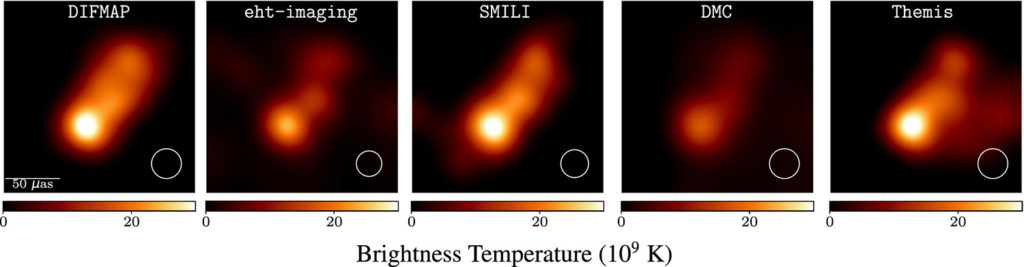 Blazar J1924-2914. Image: Sara Issaoun et al., The Astrophysical Journal
Astrophysicists add that researchJ1924-2914 allow you to tune instruments and better understand the processes that occur in the center of our galaxy. Sagittarius A*, the supermassive galaxy at the center of the Milky Way, is a more difficult object to study. It is more difficult to observe because we are in the same plane, and besides, it actively changes in time.
The Event Horizon Telescope is an internationala project combining a global network of radio telescopes and data from several Very Long Baseline Interferometry (VLBI) stations around the Earth. The creation of a detailed image was made possible thanks to almost simultaneous radio observations of the Event Horizon Telescope at 230 GHz, the global network of VLBI radio telescopes at 86 GHz, and the VLBA radio interferometer at 2.3 and 8.7 GHz.
In the spring of 2022, researchers at the Event Horizon Telescope presented a second image of the Milky Way's black hole.
Read more:
Einstein's prediction may come true: how an experiment with invisible atoms will change physics
On the pyramid in China found a portrait of the "king of ancestors". He ruled over 4,000 years ago
“This is science fiction”: scientists create a fundamentally new type of quantum computers