Astronomers have observed NGC 6302, better known as the Butterfly Nebula, which is located approximately 4,000
In the new image, the star is “hiding” at a pointwhere the two wings “meet”. It used to be active and bright, but is now fading away as a tiny collapsed white dwarf. The “wings” themselves are remnants of this star’s outer layers of gas, which were thrown into space thousands of years ago when it ran out of nuclear fuel to burn and died. According to NASA, today the size of these wings is 3 light years.
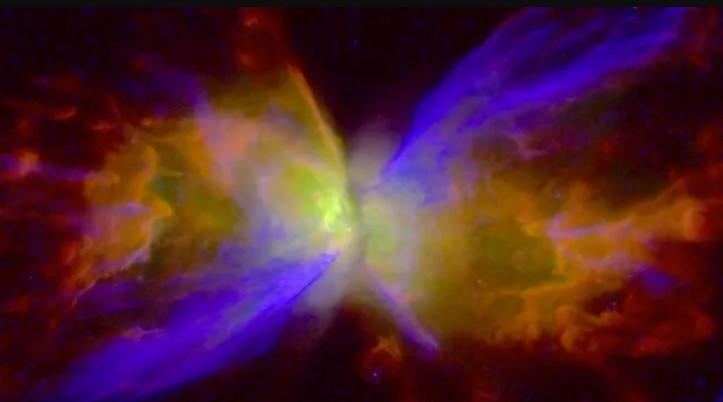 Color image of NGC 6302, the Butterfly Nebula,based on black and white images taken by the Hubble Space Telescope in 2019 and 2020. In the purple regions, strong stellar winds have been actively changing the shape of the nebula's wings over the past 900 years.
Image Credit: Bruce Balick/University of Washington/Joel Kastner/Paula Baez Moraga/Rochester Institute of Technology/Space Telescope Science Institute
For more than a century, astronomers have tried to understand whyThe Butterfly Nebula has taken on this distinct insect shape, while most other objects of its type expand into space in neater, circular patterns. New time-lapse images of the nebula, presented on January 12 at the 241st meeting of the American Astronomical Society in Seattle, hint at what's going on.
Comparing two images of butterfly wings,taken by the Hubble Space Telescope in 2009 and 2020, researchers have discovered strange processes that control the nebula's growth. Scientists have discovered traces of half a dozen "jets" of intense wind emanating from the nebula's central star, which apparently crisscrossed chaotically for thousands of years and erupted from behind the central star 2,300 and 900 years ago.
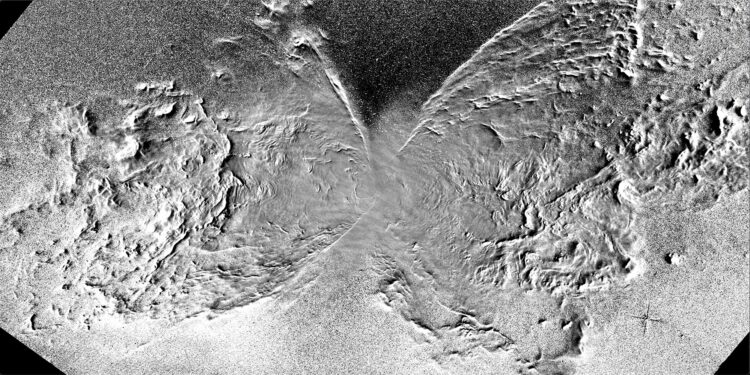 Structural changes in the Butterfly Nebulain the period from 2009 to 2020. Various details moved from black to white areas over an 11-year interval. The image shows the amazingly complex growth patterns caused by the multiple ejections of the nebula's unseen central star over the last two millennia.
Image courtesy of Lars Borchert and Bruce Balik/University of Washington
According to the researchers, they pushed matterto the edges of the nebula at an unusually high speed - up to 800 km/s. Meanwhile, matter located closer to the central star “crept outward” at a speed ten times less. As a result, complex and asymmetrical structures formed on the wings of the nebula.
Read more:
The strongest class X flare occurred on the Sun
Engineers figured out how to keep drones in the air "forever"
The secret of the durability of Roman concrete is revealed: it can be restored