A group of neuroscientists led by the South Korean Institute of Basic Sciences has discovered the main
Empathy is not limited to humansmany mammals exhibit similar behavior. A classic experiment in which empathy is shown in animals is called "fear of the observer." During the experiment, one of the mice is subjected to electric shocks, the second is watching this because of the transparent screen. Previous studies have shown that the "observer" shares a sense of fear with the "victim". This is manifested in the fading of the animal in place.
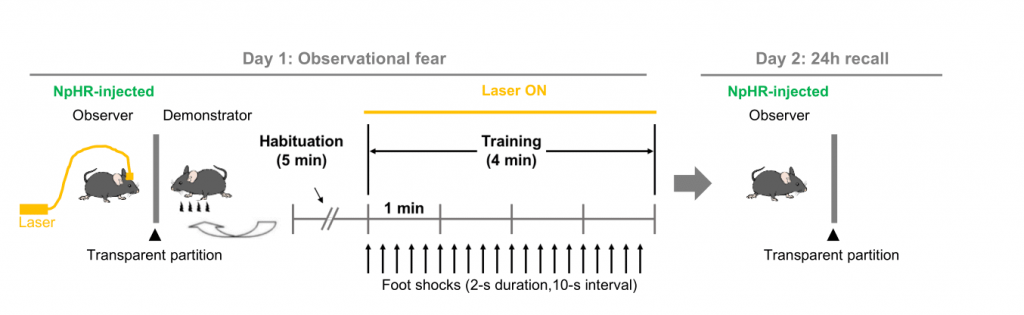 Scheme of the experiment "fear of the observer".The mouse shows freezing not only when observing an electric shock, but also “remembers” the fear experienced 24 hours later when approaching the partition. Image: Seong-Wook Kim et al., Neuron
In the new work, the researchers combined thisclassic experiment with optogenetic studies. The study showed that when the "observer" experiences fear in the anterior cingulate cortex and the basolateral amygdala, synchronized rhythms occur at a frequency of 5-7 Hz. At the same time, in the "victim" an increase is observed only in the lower range of 3-5 Hz and only in the basolateral amygdala.
To confirm the connection between synchronizationrhythms and empathy, the researchers disrupted the synchronization between two areas of the brain in the right hemisphere of the “observer” mouse. This led to a significant reduction in the fading effect that characterizes fear. Similar communication disorders in the left hemisphere did not affect the behavior of the animal.
Given the universality of observed fear inmammals, it is reasonable to speculate that a similar neural signature critical for affective empathy could be found in humans and could be used to detect empathy dysfunction in people with psychiatric disorders, including severe social deficits.
Hi-Sup Shin, Head of Research
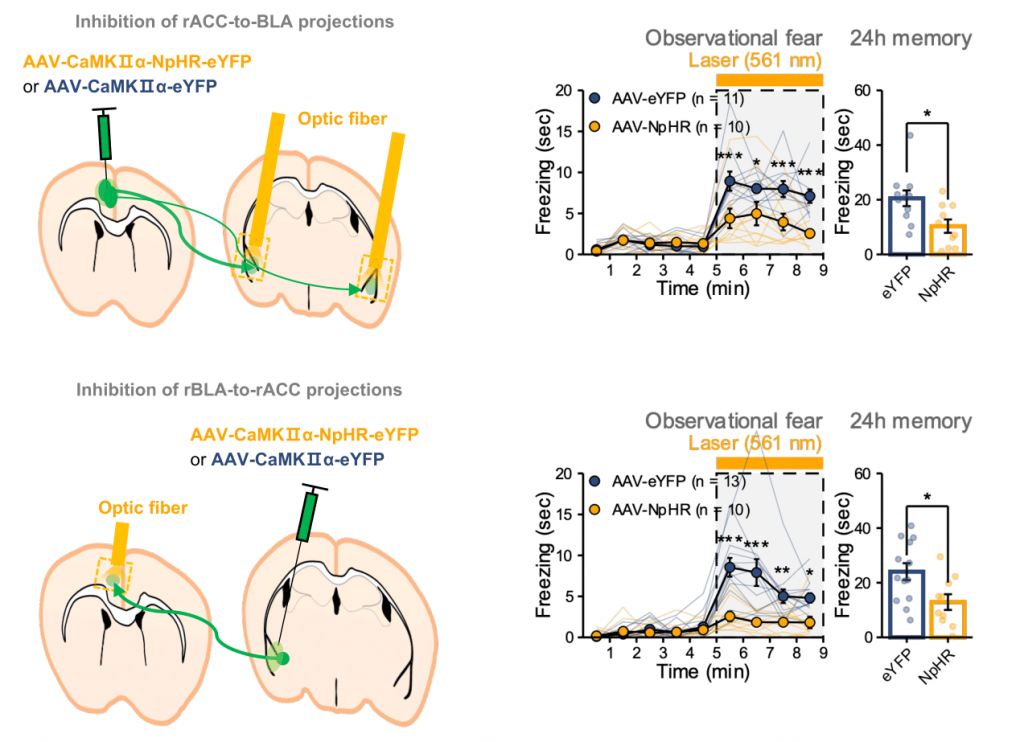 Disruption of communication between the two parts of the brain led to a decrease in fear and memory about it. Image: Seong-Wook Kim et al., Neuron
Empathy is the ability toperceive and understand the emotions of another person, such as joy, sadness or fear. This is an important function of human social life, and its disruption is seen in numerous psychiatric and neurological disorders such as autism, schizophrenia, and Alzheimer's disease. Until now, the exact mechanisms in the brain that underlie empathy have not been identified.
Read more:
The egg was dropped from space: look what happened to it
Brain-eating amoeba is spreading in the US: is there a danger to Russia
See what a woman Thora looks like. She lived 800 years ago