Artemis is a large-scale international program led by NASA that aims to return
The main task of the mission is to test the workof all ship systems to prepare for the first manned flight. This is especially important because most of the components, from the launch vehicle that put Orion into orbit, to the lander and thermal protection, are designed exclusively for the Artemis program and have not been used in any previous flight.
According to NASA preliminary data, all systemsThe ships worked out their tasks almost perfectly. The main issue that space agency specialists are currently working on is a number of failures with the engine power system. She turned off without a command, but the operation of the engines could be restored after a command from the Earth, and these errors did not affect the mission as a whole.
The developers rate the mission's performance so highly that several more tests of engine capabilities were added to the experiments that were initially carried out for the ship.
According to NASA officials, after splashdownmore analysis will be done to see how well the Orion fared. At the moment, the key question remains whether the mechanisms for landing Orion on Earth will work out just as successfully.
 Artistic illustration of Orion's return to Earth. Image: NASA
Return: how will it be?
After traveling beyond the moon for a distanceover 430 thousand km and returning back, the spacecraft will develop a speed reaching 40,000 km / h when approaching the Earth. This is about 25 times the speed of sound in air. After impact with the atmosphere, friction will reduce this speed to 480 km / h in just a few minutes.
The main task of the final stage of the testflight - to verify that the capsule's heat shield will withstand these extreme conditions, and participants in future manned missions will be safe.
The Orion spacecraft is made up ofthe Crew Module space capsule and the European Service Module. The first of these is designed to accommodate a crew of six, and the second includes the main control components outside of low Earth orbit and the ship's engines.
 Structures of the ship "Orion". A protective hull (right) and launch module (left) surround the European Service Module (center left) and crew capsule (center right). Image: NASA
Just 40 minutes before splashdown, deliveringOrion to Earth, the European Service Module will separate from the capsule and go into the upper atmosphere. The landing will be controlled by the crew module's own engines, and the service component will burn up in the atmosphere. At the same time, the trajectory of the final flight of the service module was chosen so that it would not damage the capsule, people and ships and completely burn out in the atmosphere over the Pacific Ocean.
After separation from the service module, the capsulethe crew will start their own engines and begin to descend into the atmosphere using a specially developed entry technique for the ship. It will enter the Earth's upper atmosphere at a gentle angle, and then use it and the capsule's tilt change to pop out and "dive" back into it for a final landing.
This technique, reminiscent of a stone, whichbounces off the water when thrown under the correct trajectory, will help the Orion get to the exact landing site. The alternative is the traditional right-angle entry, which is simpler, but significantly limits the possibilities for further maneuvers. In addition, the new approach will reduce the thermal load on the ship's screens due to smoother braking.
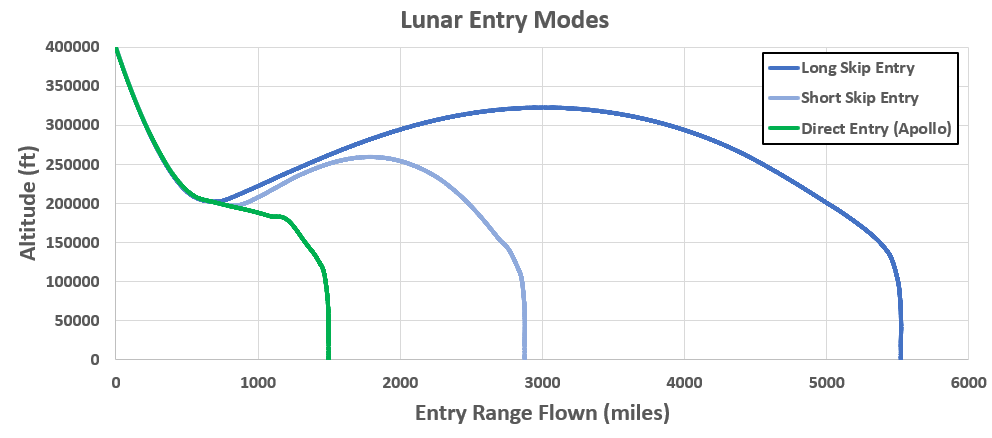 Changing the possible landing distance for direct approach (green line), short (blue) and long re-entry. Image: NASA
Earth's atmosphere will slow down upon re-entryThe speed of the spacecraft is up to 450 km/h, after which it will open its parachutes at an altitude of about 8 km above the ground. The smooth descent will last about 10 minutes and will slow down the speed of the crew capsule to 32 km/h or even less.
NASA chose the Pacific Ocean for landingoff the island of Guadalupe, off the west coast of Mexico. Rescue crews on US Navy ships will be on duty near the landing site and pick up the capsule.
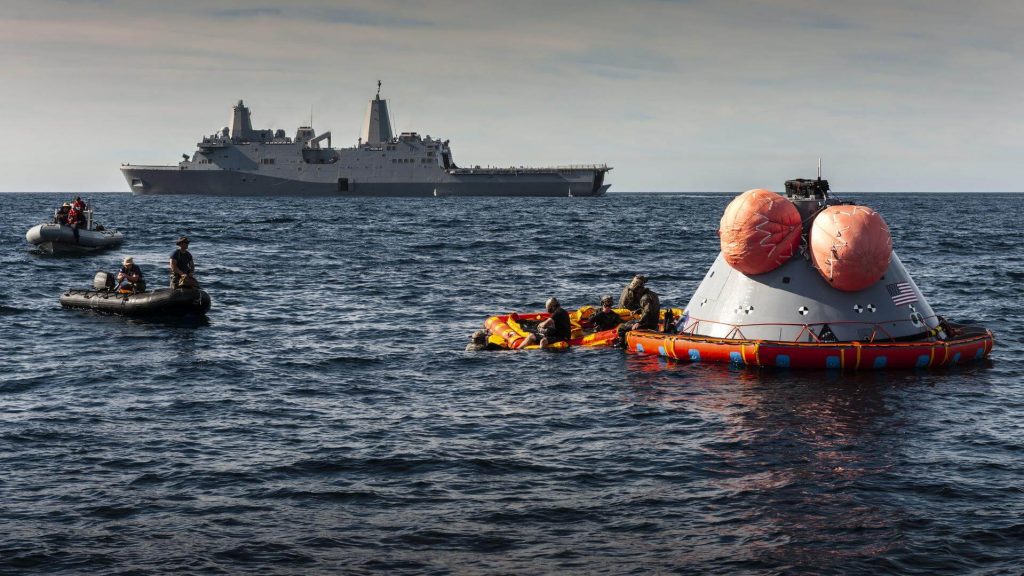 Rehearsal of the rescue operation for the Orion capsule. Image: NASA/Tony Gray
Orion heat shield
The bottom of the crew landing capsule is coveredThe world's largest heat shield, with a diameter of 5 m. It is made of a material called Avcoat. This is an ablator - a material that burns in a controlled manner during reentry, removing heat from the spacecraft.
The outer surface of the heat shield isof 186 blocks of Avcoat material, 3 to 7 cm thick. They are connected to a titanium frame and a composite skin that gives the shield its shape and provides structural support for the crew module during descent and splashdown.
Avcoat was made in large blocks andthen processed in 186 unique shapes before being applied to the heat shield. In the process, the engineers looked for voids in the fastening lines, and also measured the steps and gaps between the blocks. The gaps were filled with a special adhesive material.
After installing and checking the thermalprotection engineers and technicians subjected the heat shield to a thermal cycle test. This ensures that the blocks are properly bonded and will function properly when exposed to extreme temperatures during a mission. The heat shield was then coated with white epoxy paint. To dissipate surface electric charges and maintain an acceptable temperature, an aluminized tape is applied on top.
Such serious preparation is not accidental.During landing, the module will have to withstand temperatures exceeding 2,760°C. This is almost two times less than on the surface of the Sun. At the same time, according to the calculations of engineers, the temperature inside the shield should not exceed 100°C. Before the flight, NASA specialists conducted more than a thousand tests in a special installation that simulates atmospheric entry, but it will be possible to accurately determine whether the shield will work correctly only during and after landing.
 Orion heat shield. Image: NASA/Isaac Watson
Where and when to watch?
Crew lander landingThe Orion spacecraft will be broadcast live on NASA and European Space Agency channels. The commentary broadcast will begin at 19:00 Moscow time. According to the plan, at 20:00 the European service module will separate from the landing capsule. The craft is supposed to enter the atmosphere at 20:20 and land around 20:40.
What will happen next?
After the capsule splashes down, itwill remain in the water for two hours to perform a "re-impregnation" test. This will help to understand how the spacecraft copes with the thermal impulse during re-entry. A rescue team, supported by small boats and helicopters, will then tow the capsule to the ship's deck and dry it.
Then the apparatus, as well as parts of the preservedOrion's heat shield - charred Avcoat tiles - will be sent for detailed examination to the NASA Space Center. Scientists plan to conduct additional tests and analyzes, as well as process data that will be received from sensors during and after landing.
Engineers expect landing flight datathe Orion capsules will help confirm the accuracy of the simulation and the safety of the ship. This is important because the next stage - "Artemis-2" - should be a manned mission that will repeat the route of the first ship. NASA plans to send this mission in 2024 if the results of the first flight show that everything went well. Artemis-3 with a crew landing on the moon is tentatively scheduled for 2025.
Read more:
Does science exist in extreme conditions? We answer in numbers
"The Walking Dead" existed millions of years ago: scientists told how they appeared
A hyperactive sunspot will lead to a geomagnetic storm on Earth
Cover: Artistic illustration of the Orion spacecraft entering Earth's atmosphere. Image: NASA