A team of researchers led by BGI-Research investigated the development and regeneration of the brain in
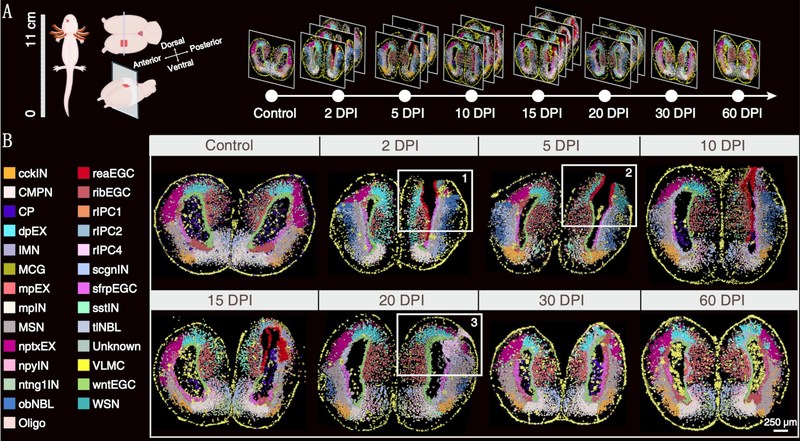 A one-cell expansion map of the recovering brain. Image: YUNZHI YANG, BGI
Biologists have analyzed the development and regenerationambistoma brain. They also identified key subsets of neural stem cells that are used in the animal's brain regeneration process. The researchers were able to describe in detail the process of reconstructing damaged neurons using stem cells.
Unlike mammals, some vertebrateshave the ability to regenerate several organs, including parts of the central nervous system. Ambistomes are one of the most successful on this path. They can restore not only the limbs or the tail, but even the brain. At the same time, the evolutionary structure of the brain in these amphibians is close to the brain of mammals.
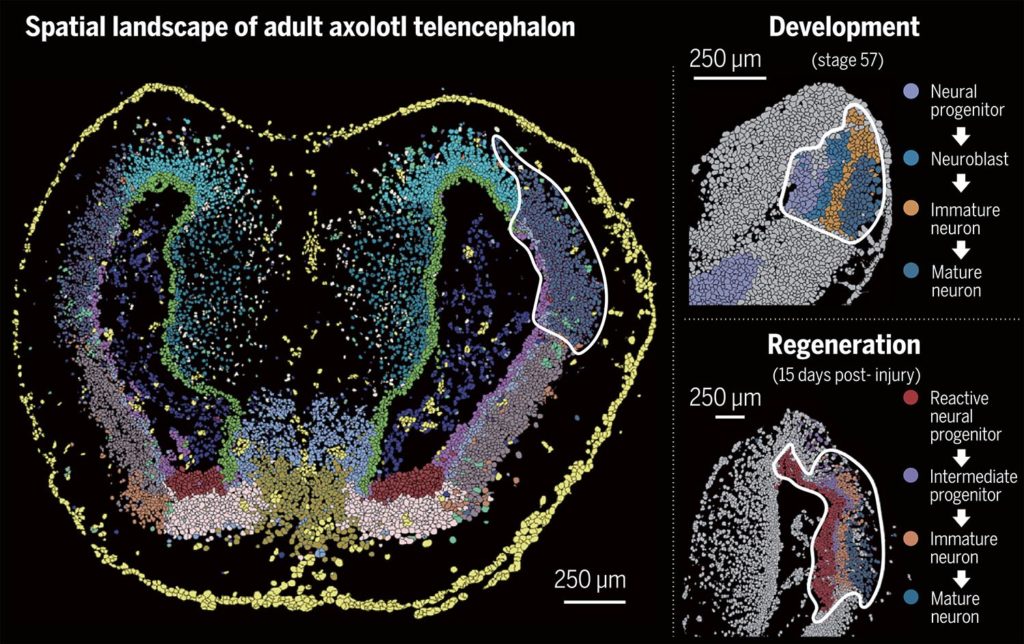 Image of the regenerating brain of an axolotl. The process of regeneration (lower right) resembles the development of the brain in the process of formation (upper right). Image: YUNZHI YANG, BGI
Taking brain samples at seven time points (via2, 5, 10, 15, 20, 30 and 60 days) after damage to the amphibian cerebral cortex, biologists were able to analyze cell regeneration. It turned out that at an early stage, new subtypes of neural stem cells began to appear in the wound area. After 20 days, the injury site was filled with new tissues that differed in structure from the intact brain, but by the 60th day, this anomaly completely disappeared and all tissues became homogeneous.
Using the ambistome as a modelorganism, we have identified key cell types in the process of brain regeneration. This discovery will provide new insights and guidance for regenerative medicine in the mammalian nervous system.
Yin Gu, co-author of the study and deputy director of BGI-Research
Read more:
The first images of the underground part of Mars surprised scientists
A galaxy located 12 billion light-years from Earth 'curled up' into an Einstein ring
Plant on Mars produces oxygen at the rate of an average tree