The Xiongnu Empire was the first documented nomadic empire of Eurasia, which arose in the steppes on
Their influence at its peak ranged fromEgypt and Rome in the west to imperial China in the east, and trade links played an important role in the economy of the Silk Road. It is believed that the Great Wall of China was built to protect against Xiongnu attacks.
Despite the power and huge size of the ancientthe states of the Xiongnu did not develop a written language, and therefore the historical records of this empire are almost entirely written and transmitted by their rivals and enemies. Most of the mentions of this people are contained in the Chinese chronicles of the Han Dynasty, which for a long time waged wars with the nomadic empire.
To learn more about the internalsempire and gain an independent perspective on the development of that society, an international team of researchers from the Institutes of Evolutionary Anthropology and Geoanthropology, the Max Planck Society, Seoul National, Michigan and Harvard Universities, conducted a genetic study of two imperial cemeteries of the Xiongnu elite along the western border of the empire.
Who are the Huns?
Xiongnu - a radically new type for that timea political entity that united heterogeneous nomadic and sedentary groups, the study authors write. The state, which initially formed on the Mongolian plateau, gradually captured the eastern steppes and spread all the way to the Altai Mountains.
As the Xiongnu expanded their empire fromcentral and eastern Mongolia, they conquered and integrated numerous neighboring groups. They spread to western Mongolia and the southern regions of Lake Baikal and captured part of the territories of northern China. The empire became not just a nomadic army, but a powerful state that controlled many trade routes and imported Roman glass, Persian textiles, Egyptian faience, Greek silver and Chinese bronze.
The Xiongnu did not leave writing, but on the territoryarchaeologists find ancient burial places in modern Mongolia and part of the territory of Russia. An analysis conducted in 2020 showed an amazing genetic diversity: representatives of various ancient peoples were mixed in the territory of the empire, like in a melting pot. Researchers believe that the Xiongnu arose as a result of mixing populations of several separate nomadic peoples. And such assimilation continued throughout history as new territories were explored.
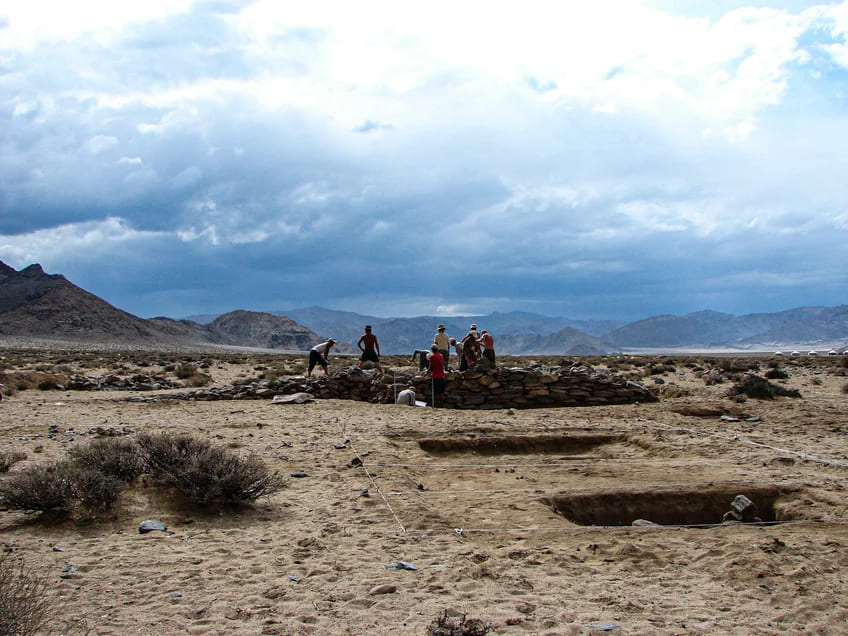 Excavations of the tomb of the Xiongnu elite, in which there was an aristocrat with a high status, in Takhiltyn-Khotgor. Photo: J. Bayarsaikhan, Max Planck Society
Xiongnu burials reflect a toughsocio-political hierarchy: the graves of representatives of different "estates" differ in type and wealth. Most burials of the later period of the empire are mine pits located under thick stone rings on the surface. Researchers believe that they belonged to local elites: simple nomads are buried under stone piles or in nameless pits.
The highest ruling elite of the empire was buried in largesquare stone tombs, next to which were often buried people of lower status. Together they formed a large burial complex. In such "mausoleums", as a rule, many ornaments and foreign luxury items, gold or gilded objects, as well as horses and livestock were left. Although most of them have been looted, the differences in the shape of the graves reflect a clear social gradation.
Multinational Elite
The researchers analyzed two burials,found in the west of modern Mongolia in the Altai region. The first of them, Takhiltyn-Khotgor, is a burial complex surrounding the square tombs of the aristocratic elite of the empire. Second, Shombuuzin-Belchir, mine pits of the regional and local elite.
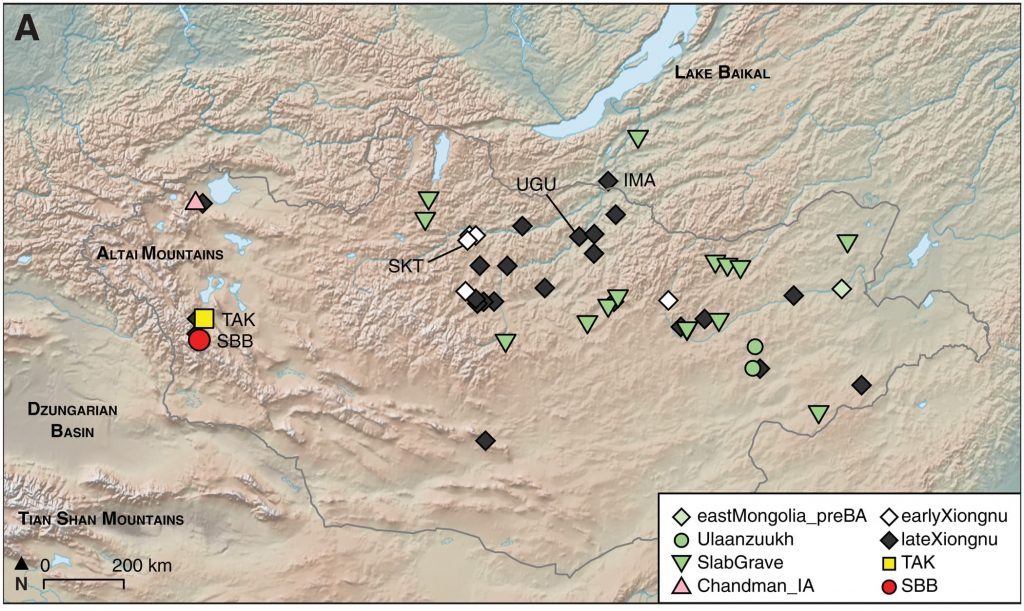 The location of ancient burials: Takhiltyn-Khotgor is marked with a yellow square, Shombuuzin-Belchir - with a red circle. Image: Juhyeon Lee et al., Science Advances
The researchers found that people on twocemeteries showed extremely high genetic diversity, comparable to what was observed across the empire in previous studies. This confirms the hypothesis that the Xiongnu were not just united by several separate territories with their own "peoples", but in the full sense it was a multinational state with active internal migration.
At the same time, this genetic diversitymanifested differently in different social groups. The lowest-status individuals—probably servants who were buried around the elite—showed the highest genetic diversity and heterogeneity. They probably came from remote parts of the Xiongnu Empire or beyond.
The local and aristocratic elite, on the other hand,showed lower overall genetic diversity. It is likely that elite status and power were concentrated among certain genetic subsets. Nevertheless, even in these families there were genetic traces of diverse peoples. Researchers believe that the Xiongnu used marriages between the elite of the empire and the power of local tribes to finally secure new territories.
Nomadic matriarchy?
The second important discovery showed that mostburials corresponding to the highest social status and filled with precious gifts belonged to women. At the cemetery of the aristocratic elite Takhiltyn-Khotgor, the researchers found that the elite monumental tombs were built for women. Each of them was surrounded by modest burials of many male commoners.
The researchers found that women were buried incarefully designed coffins with golden symbols of the sun and moon - signs of Xiongnu imperial power. In addition, in one tomb there was a team of six horses and part of a chariot.
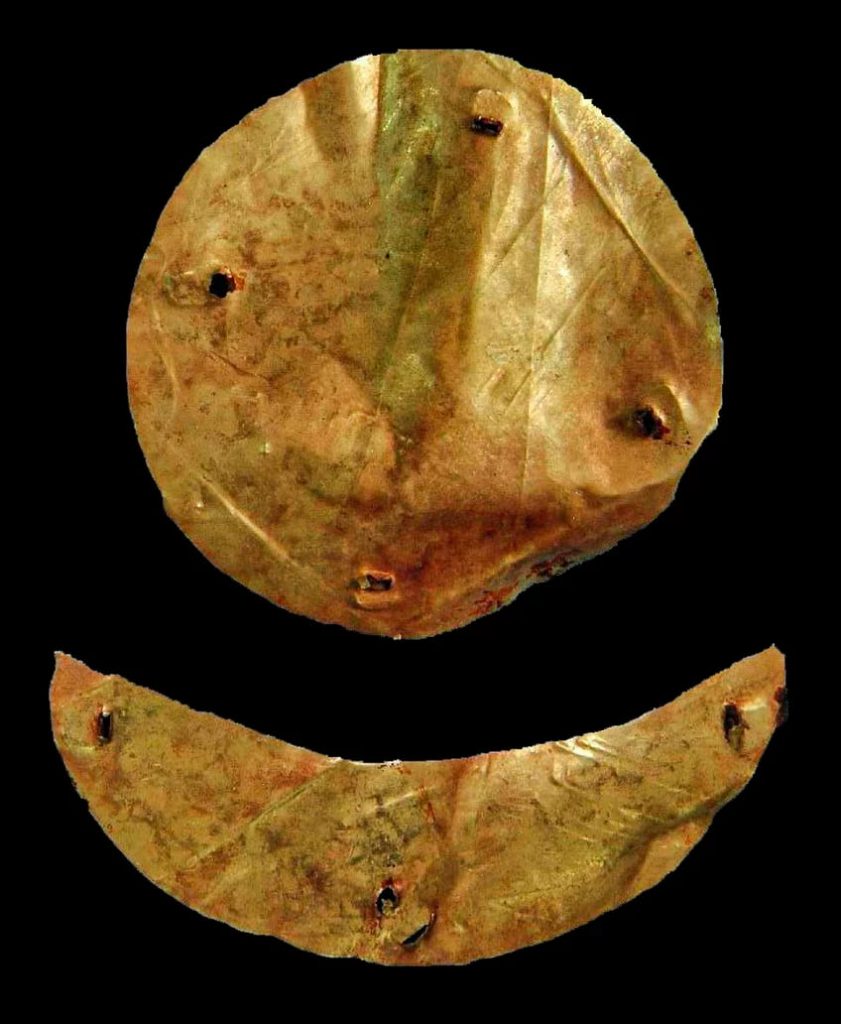 Obarzes of the Sun and Moon are symbols of power in the Xiongnu empire, found in elt burials. Image: J. Bayarsaikhan, Max Planck Society
Similar discoveries were made in the cemeterylocal elite: women occupied the richest and most exquisite graves. Such burials were filled with grave goods, consisting of wooden coffins, golden coats of arms and gilded objects, glass and faience beads, Chinese mirrors, a bronze cauldron, silk clothes. Some of the graves contained items conventionally associated with male riders: a Chinese lacquer bowl, a gilded iron belt clasp, and horse harness.
Women wielded enormous power asagents of the Xiongnu Empire on the border. They often held exclusive ranks of nobility, maintained Xiongnu traditions, and participated in both military politics and Silk Road "networks of exchange".
Brian Miller, professor of archeology at the University of Michigan and study co-author
The results of the study confirm the indirectideas about the high role of "princesses from the elite" in the life of nomadic tribes, scientists conclude. It was they who, apparently, played a decisive role in the political and economic life of empires, especially in peripheral regions. Although the Xiongnu collapsed at the end of the first century AD, this tradition survived the empire and was very common in the Mongol Empire that emerged in Central Asia in the Middle Ages.
Read more:
No longer a toy. What will the evolution of GPT and Midjourney lead to?
In space, no one will hear your cry: 7 action-packed books about the secrets of the universe
"Sea" of quarks inside one proton: what does an elementary particle consist of
On the cover: artistic illustration of the multinational elite of the Xiongnu empire. Image: Galmandakh Amarsanaa, Max Planck Society