For the first time, scientists have photographed all of Uranus in the infrared part of the light spectrum - so they want to study the mysterious
As on Earth, Aurors on Uranus arise inas a result of the interaction of the solar wind, the flow of charged particles emanating from the Sun, with the planet's magnetic field. But because Uranus is so different from our planet, these Aurors behave very differently from the northern and southern auroras on Earth.
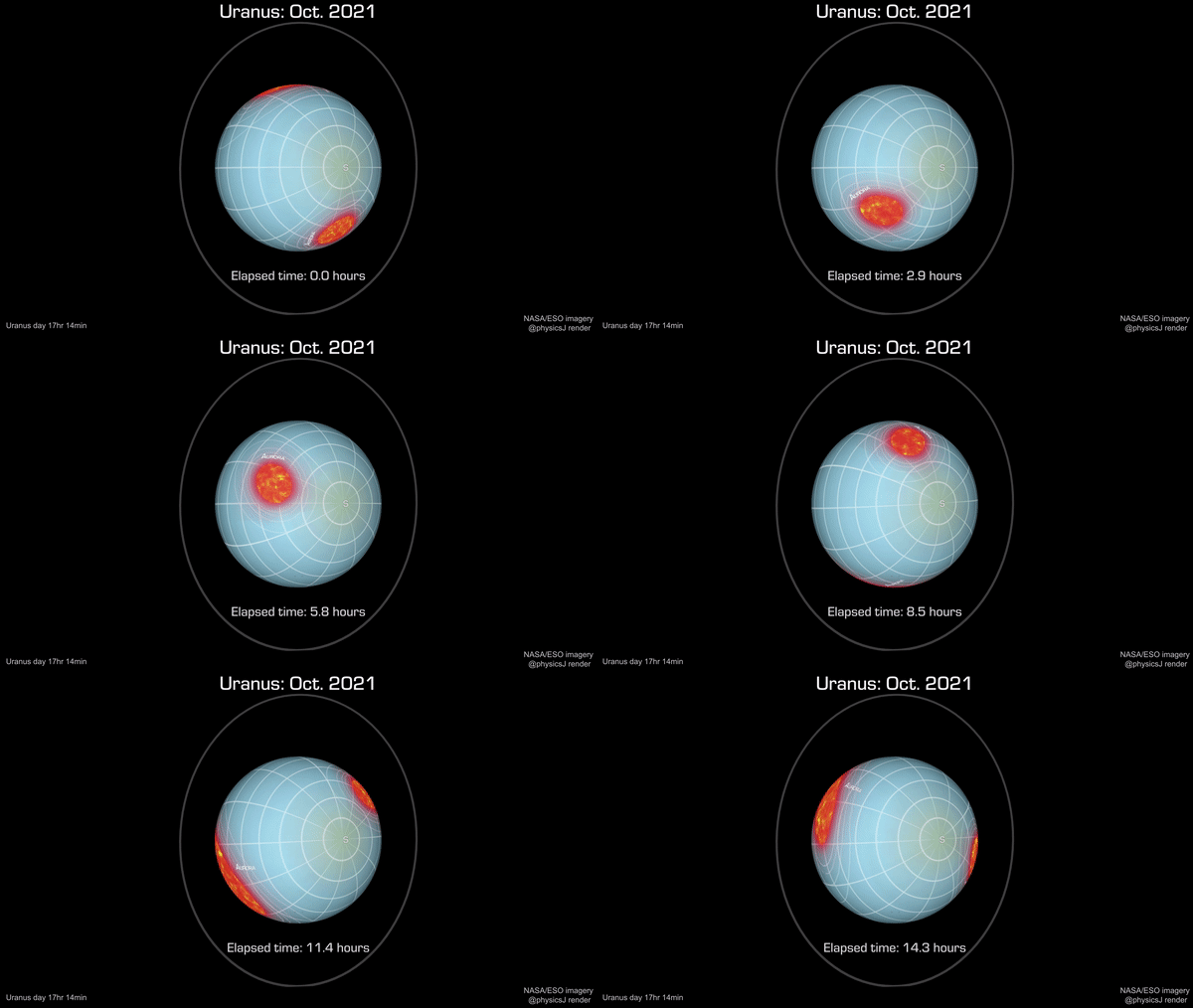
To obtain an image of the entire surfaceUranus, scientists divided the surface of the planet into several areas - they could be observed for eight hours over three days. Now they want to combine the results and make the most detailed map of the distant planet in the infrared part of the spectrum.
“We want to understand where on Uranus are the brightplots. Uranus itself will be illuminated by daylight. Anything above this level is caused either by internal thermal processes or by luminescence. By measuring the density of particles over Uranus, we will be able to determine what we see in front of us, ”the researchers noted.
Previously, the surface of Uranus was filmed only inultraviolet part of the spectrum. NASA's Voyager 2 mission flew past the planet in 1986, taking the first and so far only set of close-up images of the planet's surface and environment. In 2011, the Hubble Space Telescope first detected auroras shimmering over the surface of Uranus, each covering an area larger than that of Earth.
Read more
Hawking was right, but sometimes wrong: the scientist's most daring ideas
Astronomers have figured out that the Earth and solar system are in a giant magnetic tunnel
A Chinese hypersonic missile orbited the entire globe. How is this possible and what is known about her