Researchers from MIPT and MISiS have demonstrated the successful implementation of a CZ quantum gate (operation) on
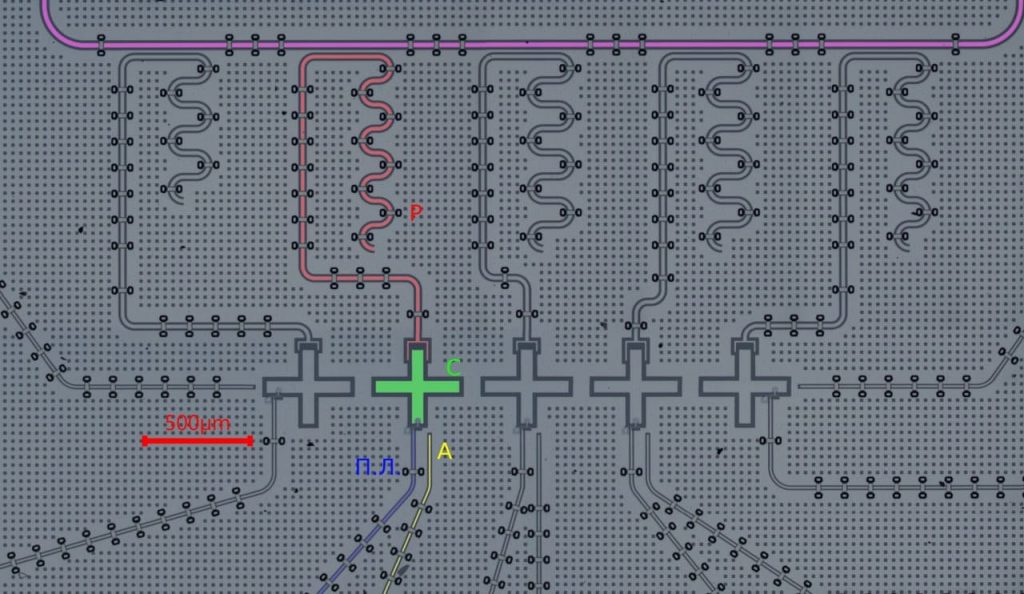 Photograph of a microcircuit from an optical microscope (infalse color). The microcircuit implements 5 qubits (the capacitance of one of them is marked in green) associated with resonators (red) for individual reading. Each qubit is provided with a control flow line and an antenna for performing single-qubit operations (blue and yellow, respectively). Image: MISiS
An electronic microchip designed by scientistsconsists of five capacitively shunted charge qubits. During the experiment, the researchers used only four of them. Qubits are electrically connected to each other and can both exchange energy and controllably change each other's phase of superpositions of states |0⟩ and |1⟩.
During a demonstration on November 8, scientists showedthe possibility of performing a CZ quantum gate using the created integrated circuit. CZ is a logical operation in which one qubit performs a controlled rotation of another. It is necessary to create quantum entanglement.


Laboratory of High Load Physics. Image: MISiS
The results of the experiment showed that timeexecution of an individual logical operation is about 25 ns. This makes it possible to implement more than 3,200 operations during the lifetime of the quantum state of the processor, scientists note.
For the first time inIn Russia, algorithms for cross-entropy testing and quantum tomography of the process were experimentally implemented, which now allow us to estimate the accuracy in principle of any one- and two-qubit gate operations on systems of superconducting qubits.
Ilya Moskalenko, researcher at the Laboratory of Superconducting Metamaterials, NUST MISIS
Previously, Hi-Tech talked about how superconducting qubits work.
Read more:
The main theory of the origin of man was refuted: where did we come from
Results of first cancer drug trial published
8 billion people now live on Earth: is overpopulation threatening the planet?