The compact muon solenoid (CMS) collaboration recently presented the first physical
The Standard Model is a theoretical construct inparticle physics, describing the electromagnetic, weak and strong interactions of all elementary particles. The modern formulation was completed in the 2000s after experimental confirmation of the existence of quarks.
The Large Hadron Collider came to life after three yearscontinuous improvements to the machine, as well as detectors for experiments and data analysis tools. Almost immediately it reached a record energy of 13.6 TeV. Just three weeks later, the compact muon solenoid was ready for the physics data collection period. Previously, Hi-Tech spoke in detail about its preparations for the third launch of the CMS.
This is just the beginning: how and why the detector that helped find the Higgs boson is being updated
Before the third launch, scientists hoped (and nowthis has been confirmed) that the updated collider can collect such a huge amount of data in a very short time. After all, it took physicists two years to collect the data used to discover the Higgs boson in 2012. But now, thanks to the development of data collection and selection systems, as well as the unprecedented speed of analysis, Run 3 data can now be processed in almost real time.
Due to the large number of top quark pairs,created at the LHC, physical analysis can begin even with a small amount of data. The rate of production of this heavy particle system increased by about 10% due to an increase in collision energy from 13 TeV during the second run to 13.6 TeV in the third.
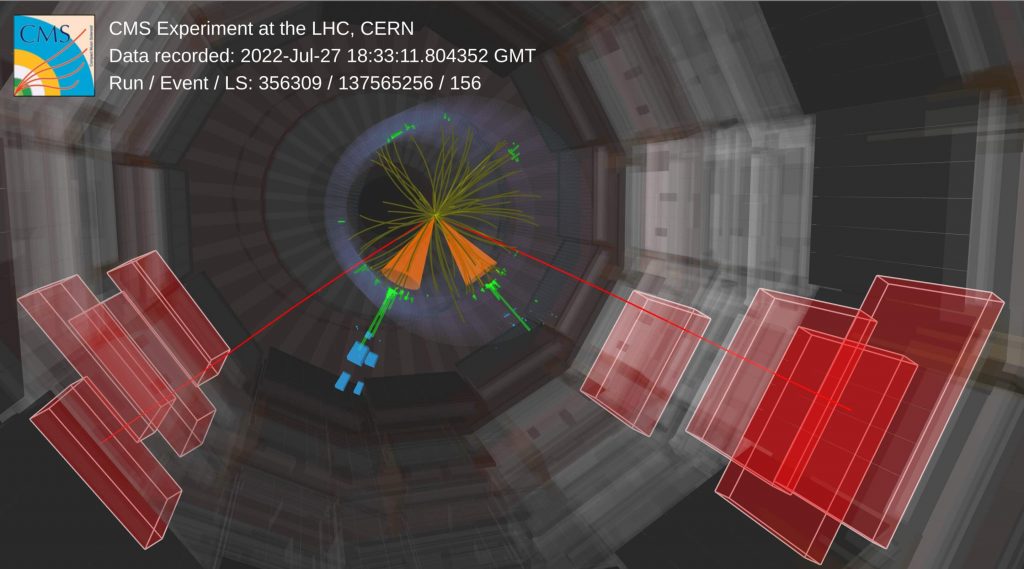 Illustration of the events of the third run using CMS, showing the decay of a pair of top quarks. Photo: CERN
CMS results that are consistentwith the prediction of the Standard Model. Accurate measurements of the properties of the top quark provide, among other things, scientists with information to search for new phenomena as part of the third run of the LHC. Due to its large mass, the top quark immediately splits into an ab quark and a W boson. As these decay products pass through the detector, they leave traces. This way, physicists can observe them and check the detector's performance.
Read more:
Scientists Confirm Alternative Gravity Theory: Why It Changes Physics
A massive impact from a space object triggered the Earth's magnetic field
Pig heart beats slower after transplant to human