UPD: Due to the repeated detection of a hydrogen leak, the rocket launch scheduled for 09/03/2022 was cancelled. New date
The next window for sending a rocket to the moon will be open: from September 19 to October 4 or from October 17 to October 31.
The Artemis space programbecome the first space mission since Apollo 17 in 1972 to put a man on the moon. Despite the fact that many countries over the past 50 years have actively explored the Earth's satellite, other planets and the Sun, and even went beyond the heliosphere, not a single manned mission has left low Earth orbit in all this time.
The Artemis program was officially approved in2017, but many of its components were prepared years before. For example, the Orion spacecraft, which carries out the main mission, transferred to the program from another mission, Constellation. It was initially assumed that the spacecraft would go to the Moon back in 2016, but for various reasons the flight date was constantly postponed.
Finally, in 2022, NASA, along with project partners - the Canadian, European and Japanese space agencies - announced readiness for launch.
First step - "Artemis-1"
The program consists of a series of three missions,which will increase in complexity. The launch of Artemis-1 is the first step and comprehensive testing of all elements. The mission consists of the Space Launch System (SLS) launch vehicle, the Orion spacecraft and ground control systems. None of this has ever been used before.
The uniqueness of the mission lies in the fact that it mustlaunch a potentially manned spacecraft into the farthest orbit for all manned flights. After launch, the most powerful SLS launch vehicle will have to send Orion on a flight to the far side of the moon. During the mission, the spacecraft will fly 450,000 km from the Earth. Recall that the distance from the Earth to the Moon is at different times from 360 to 400 thousand km, another 64 thousand km the ship will do beyond the far side of the Moon.
As a result of such a complex flight, the ship,designed for human flight, will be in space without docking with the station for almost 38 days. This is longer than any of the previously built manned vehicles. And during the return flight, it will accelerate to a record 40,000 km/h and reach higher temperatures than its counterparts.
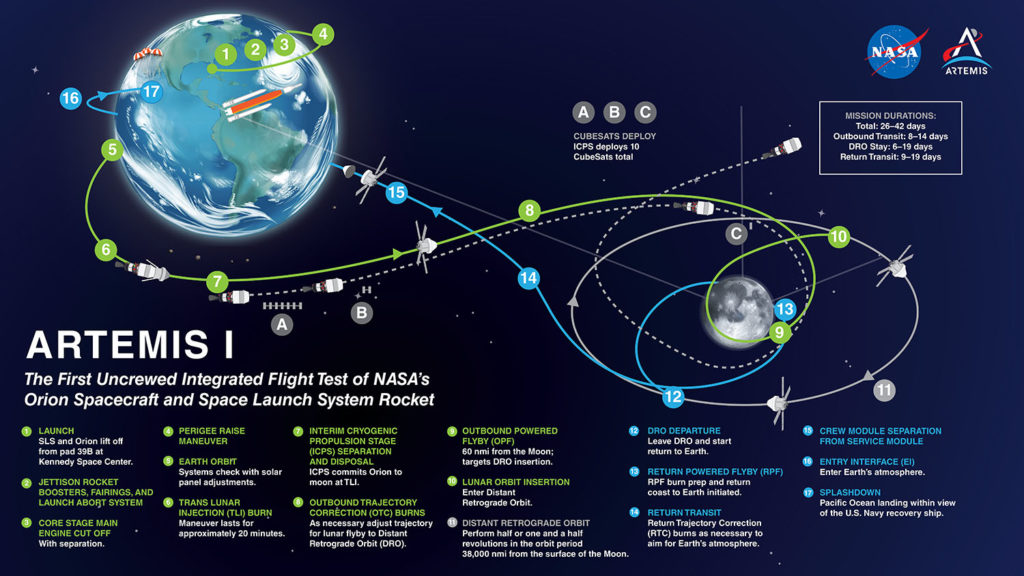 Scheme of the mission "Artemis-1". Image: NASA
How will the mission go?
launch
The SLS launch vehicle is specially designed forsending large cargoes to the moon. The configuration of the first version of SLS - Block 1, which will be used in the current mission, can lift into orbit and launch up to 38 thousand metric tons of cargo to the Moon. At the same time, it can accelerate a heavy spacecraft to a speed of about 36 thousand km / h, which is necessary to enter the Moon's orbit.
The launch vehicle is propelled by a pairfive-section boosters and four RS-25 engines. The solid boosters will burn their fuel and separate in about two minutes, while the main stage and the RS-25 will run out of fuel in about eight minutes. After the boosters, service module panels, and launch abort system are reset, the main stage engines will shut down and the main stage will separate from the spacecraft, leaving the Orion attached to the Intermediate Cryogenic Propulsion Stage (ICPS).
The cryogenic stage is a propulsion system13 meters high and 5 meters in diameter, which consists of a single engine running on liquid hydrogen and oxygen. After the core stage separates, the spacecraft will orbit the Earth and deploy its solar panels, and the cryogenic installation will give it enough of a boost to leave Earth's orbit and head towards the Moon.
At the same time, this maneuver is aimed in such a way that the ship moves in the direction in which it can be picked up by the attraction of a natural satellite.
 Launch vehicle diagram and launch timeresearch cubesets. Four satellites are for lunar exploration (gray), three are for radiation, and three are for technology demonstrations. Image: NASA, Kevin O'Brien
In space
Orion will separate from the cryogenic stage approximatelytwo hours after launch. At the same time, together with the module, the booster module should launch ten cubesets, tiny satellites, into orbit to explore the moon. As it moves away from Earth orbit, the service module will monitor and correct course.
A trip to the moon will take several days, induring which engineers will evaluate the spacecraft's systems. At the point of closest approach, Orion will fly over the surface of the satellite at a distance of about 97 km. It then uses gravity to enter a retrograde orbit beyond the far side of the moon. According to calculations, it should move away from the satellite by 64 thousand km. The previous record set by the Apollo 13 mission was only 26,000 km.
On the way back to Earth, Orion will receive anothergravitational aid from the moon. To do this, it will make a second close flyby, firing its engines at exactly the right time to harness the satellite's gravity and accelerate towards Earth. The service modules will have to choose a re-fly trajectory that will allow them to safely re-enter our planet's atmosphere.
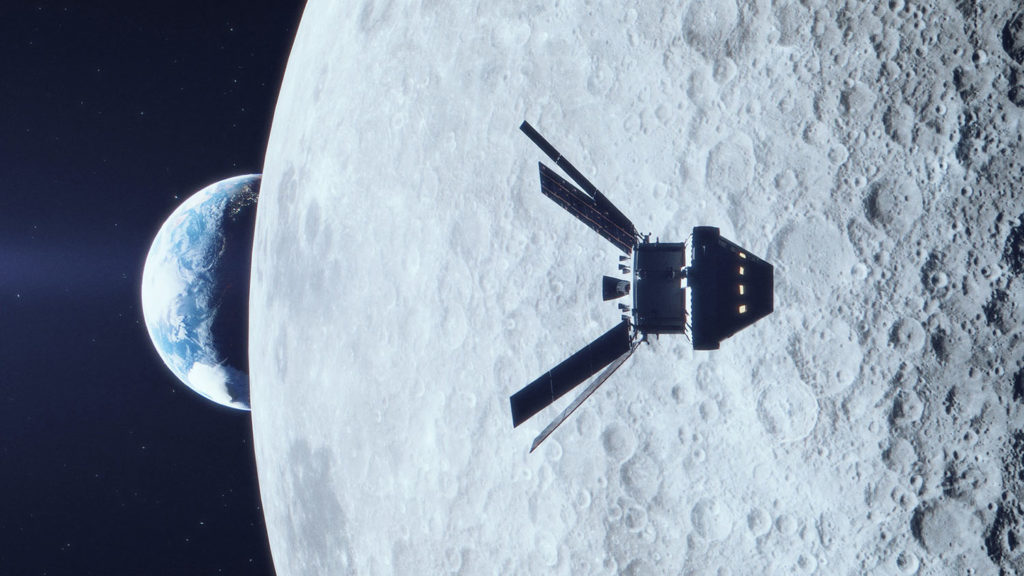 Artistic illustration of the Orion spacecraft with the moon in the background. Image: NASA
Landing
The mission will end with a test of Orion's capabilities.return safely to Earth. After all gravity maneuvers, the spacecraft will accelerate to a speed of about 40 thousand km/h. After entering the atmosphere, it will have to slow down to 480 km/h. In this case, the temperature of the outer skin will rise to approximately 2,800°C.
Once the spacecraft has passed this phaseflying with extreme heat, the forward compartment cover protecting his parachutes would be thrown off. The first two brake parachutes of the Orion will open at an altitude of 7.6 km and within a minute will reduce the speed to 160 km/h. After that, they must unfasten to allow the ship to release three main parachutes, which should allow for a precise landing within sight of the rescue ship off the coast of San Diego.
 Artistic illustration of the landing of the Orion spacecraft. Image: NASA
Why do we need a test mission
The main purpose of the test flight is to checkthe ability of the Orion heat shield to withstand extreme conditions during the return of the device to the Earth's atmosphere. Although the researchers conducted all possible tests on Earth. Not a single artificial installation can completely recreate all the conditions with which a ship moving at cosmic speed will have to overcome during the process of rapid deceleration.
In addition, the researchers plan to workinteraction at all stages of the flight. Both Orion and SLS have never been used before. Although the rules of the operation are spelled out in detail, before sending a mission involving a person, NASA wants to make sure that nothing will threaten the life of the astronauts.
For example, the Orion spacecraft will usecameras mounted on the four wings of the solar array to monitor the status of the crew module and service module. Two studies will be conducted - the first after the ship leaves the space debris zone, and the second before returning. They will help detect any impacts with micrometeorites or orbital debris.
In addition, the mission will carry a crew fromthree mannequins. Commander Munikin Campos takes the captain's seat inside Orion. He is wearing a new spacesuit and equipped with two radiation sensors. His seat also has sensors to record acceleration and vibration data during a mission.
Together with Campos as part of the radiationExperiment Matroshka AstroRad (MARE) ride two phantom torsos: Helga and Zohar. Zohar wears a radiation protection vest fitted with sensors to determine radiation risk en route to the Moon.
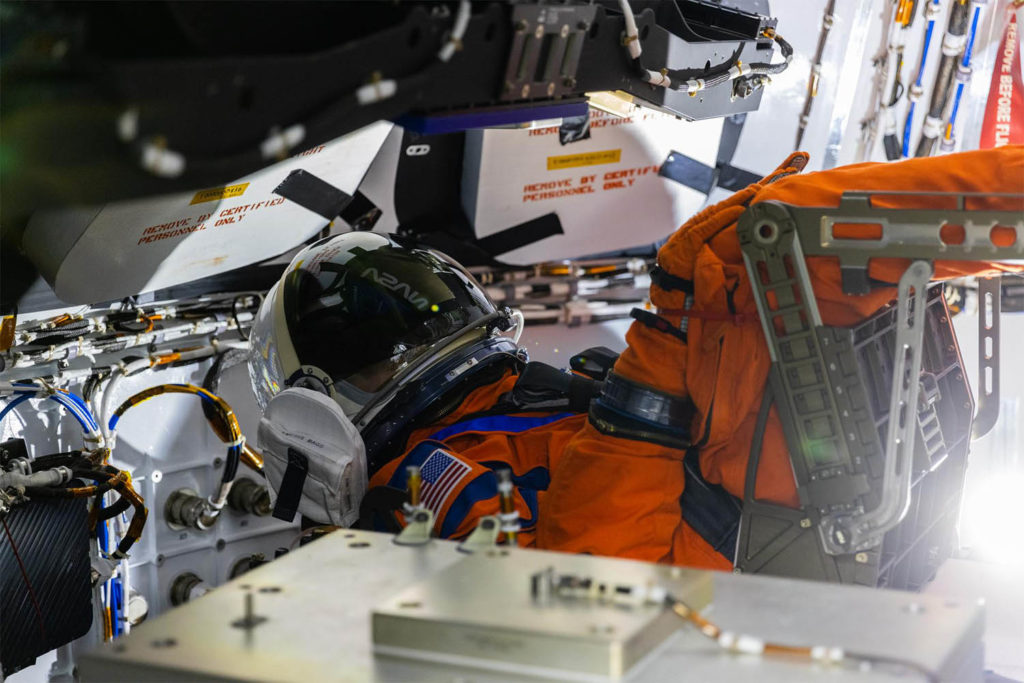

Test ship crew. Image: NASA, Frank Michaux
A number of additional studies are related totesting communication systems with the ship and image capture modules. For example, engineers plan to test the ship's WiFi system, the stabilizer that fixes the direction of the cameras, and the transfer of large files between Earth and Orion.
How to see?
The first attempt to launch the Artemis-1 mission collectedon the coast near the Kennedy Space Center from 100 to 200 thousand people. Recall, NASA was going to launch the spacecraft on Monday, August 29, but the countdown was stopped due to problems with the ship's engine.
Local government officials believe thatSaturday's launch could bring in even more, up to 400,000 people. For all those unable to travel to Cape Canaveral Florida in person, NASA is hosting a livestream.
The live broadcast should begin on September 3 at 19:15 Moscow time from the refueling of the spacecraft. And the launch window will be open from 21:17 to 23:17.
What's next?
If the mission is successful, then in the nextNASA plans to send a manned mission "Artemis-2" with a crew on board. She will have to completely repeat the route of the first mission and conduct additional tests before the most important stage of the program.
And in 2024, according to the plan, it will be sent to the moonthe third mission, which will have to deliver the crew no longer into orbit, but to the surface of the moon using a special descent module. If successful, further development of the program involves annual launches and the creation of a lunar base.
Read more:
The first images of the underground part of Mars surprised scientists
A galaxy located 12 billion light-years from Earth 'curled up' into an Einstein ring
Plant on Mars produces oxygen at the rate of an average tree
On the cover: an artistic illustration of the flight of the Orion spacecraft. Image: Overwatchfan123, CC BY-SA 4.0, via Wikimedia Commons