Astrophysicists from NASA's Goddard Space Flight Center presented the first results of scientific analysis
The results of the study, which weredemonstrated at the annual meeting of the American Astronomical Society in Seattle showed that the distant young galaxies of the early Universe are similar in their properties to the rare but better known green pea galaxies located in the studied part of the Universe.
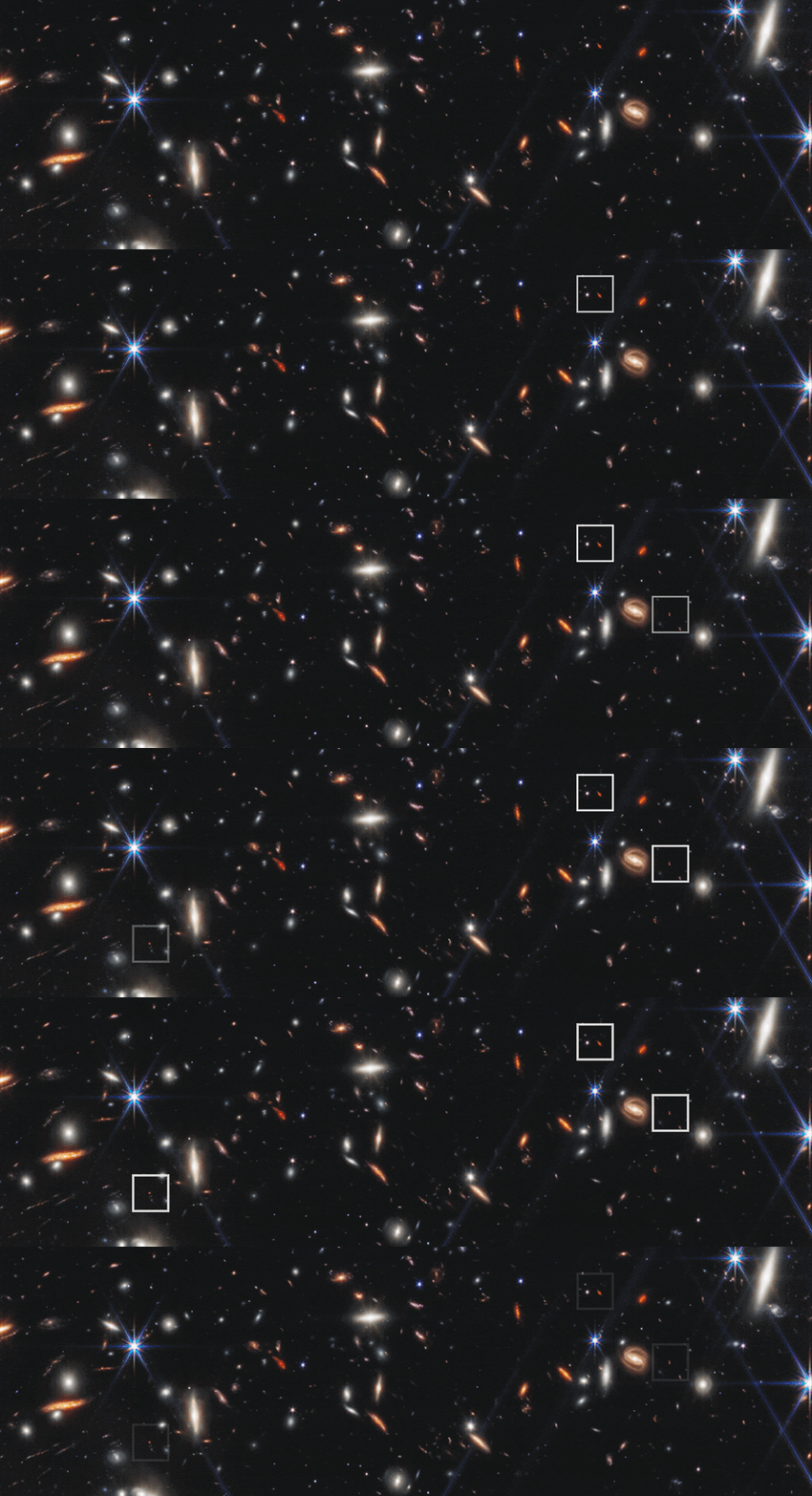 Galaxies of the early Universe in the Webb image. Image: NASA, ESA, CSA, and STScI
What are green pea galaxies?
Pea galaxies or green pea galaxies -this is one of the types of compact galaxies with very active star formation. They were first discovered in 2009 by volunteer astronomers while investigating the results of the Sloan Digital Sky Survey. This is a large-scale astronomical study of the redshift of stars and galaxies, performed using the 2.5-meter wide-angle telescope of the Apache Point Observatory.
The results of observations were analyzed andclassified by volunteer astronomers who participated in the Galaxy Zoo project. The researchers found in the pictures many small galaxies that looked like glowing green dots resembling peas. Such galaxies are located relatively close to the Milky Way: at a distance of only a few hundred million light years (incomparable with 12-13 billion light years for galaxies of the early Universe).
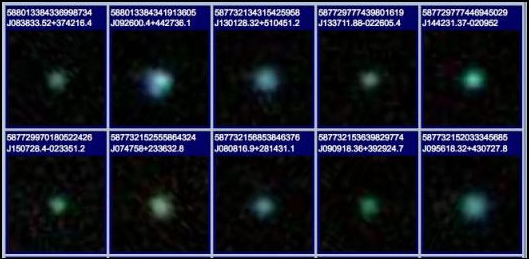 Green pea galaxies. Image: Richard Nowell, CC BY-SA 3.0 via Wikimedia Commons
The colors of pea galaxies are unusual becausea significant part of the radiation in them comes from luminous gas clouds. Gas clouds produce light at a specific wavelength, unlike stars, which emit at different parts of the spectrum. In addition, pea galaxies are very compact, on average their size is about 5 thousand light years or 5% of the size of the Milky Way.
What did "James Webb" investigate?
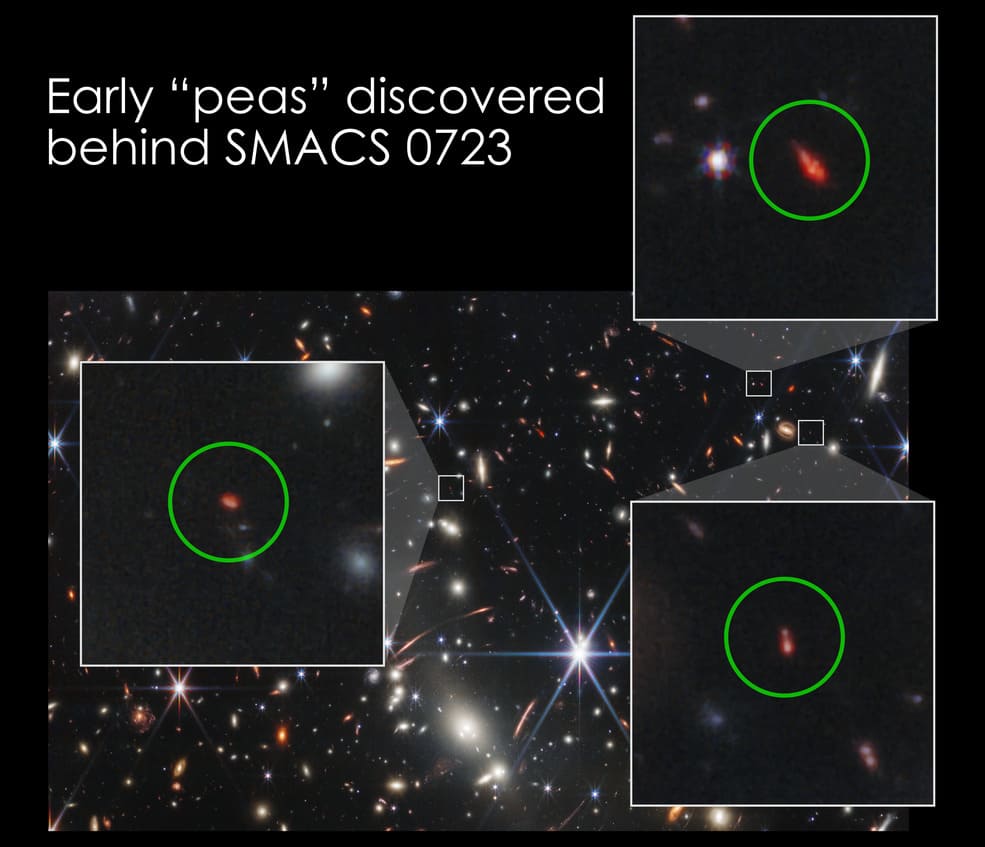 Three galaxies of the early Universe in a deep-sky image around the massive galaxy cluster SMACS 0723. Image: NASA, ESA, CSA, and STScI
In their work, the researchers analyzed the datacollected while exploring the deep sky region around the massive galaxy cluster SMACS 0723. Early results from this study produced the most famous and first image officially published by the James Webb Space Telescope team in the summer of 2022.
The mass of the cluster makes it a gravitational lens,which both magnifies and distorts the appearance of background galaxies. In addition to creating colorful images, James Webb used the Near Infrared Spectrograph (NIRSpec) to analyze the spectra of selected galaxies in the study area.
What did the astrophysicists see?
Among the dimmest galaxies beyond the cluster werethree compact infrared objects were found that look like green peas. At the same time, the most distant of them was magnified by the SMACS 0723 gravitational lens by about 10 times, which made it possible to examine its features in detail. At the same time, the light from it traveled more than 13 billion light years to the Earth, and the galaxy existed when the Universe was about 5% of its current age.
Analysis of emission spectra from these galaxies,corrected for redshift, showed that the emission peaks at different wavelengths from these compact galaxies of the early Universe and from green pea galaxies coincide. The emission lines show radiation characteristic of hydrogen, oxygen, and neon.
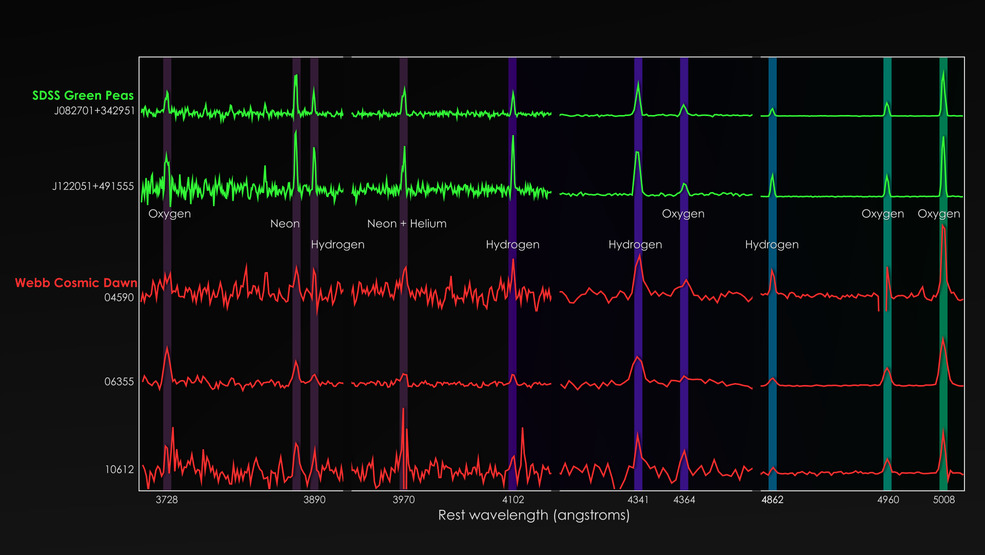 Spectral lines from two green pea galaxies (top) and three new galaxies of the early universe (bottom). Image: NASA's Goddard Space Flight Center/Rhoads et al. 2023
Why is it important?
The two galaxies explored by Webb containoxygen at about 20% of the Milky Way. This is very close to the known green pea galaxies. The third galaxy is even more unusual: it contains about 2% oxygen in proportion to the Milky Way and may be the most chemically primitive galaxy known.
We see these objects as they are.existed until 13.1 billion years ago, when the universe was about 5% older than its current age. And we see that these are young galaxies in every sense - full of young stars and luminous gas that contains little chemical products recycled from earlier stars.
Sangita Malhotra, NASA Goddard Space Flight Center astrophysicist and study co-author
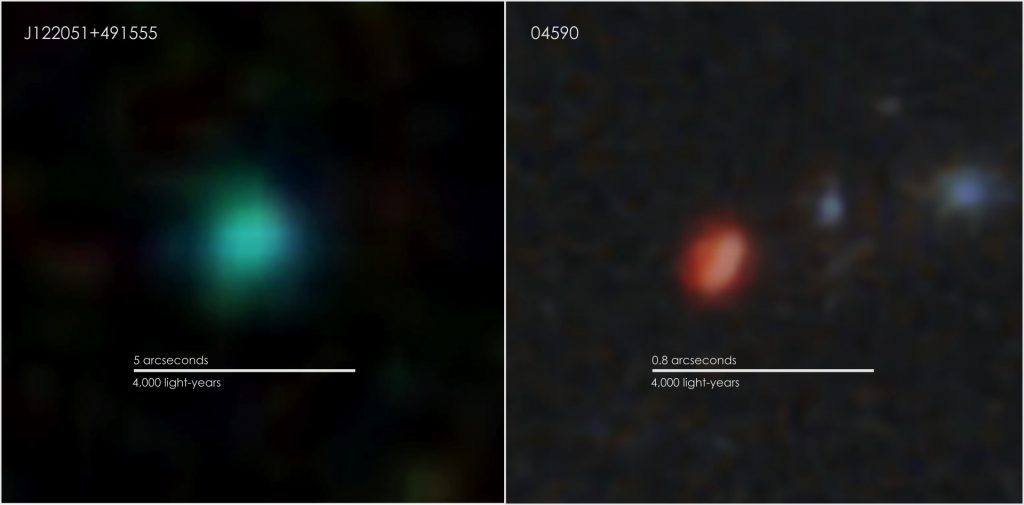 Left:J122051+491255 is a green pea galaxy located about 170 million light-years from Earth. Right: one of the new galaxies 04590, the light from which traveled 13.1 billion light-years to Earth. Image: SDSS and NASA, ESA, CSA, and STScI
Discovery of similarities between the first galaxies andgreen pea systems opens up unique opportunities for a better study of the evolution of the universe. The proximity of these compact galaxies to the Milky Way makes it possible to use a wide range of instruments and observations to study the processes that seem to have led to the formation of the entire diversity of the modern Universe.
Read more:
The most beautiful photos of "Webb" for 2022: see what the $ 10 billion telescope did
The sun opened the year with a flash of the most powerful class
The secret of the durability of Roman concrete is revealed: it can be restored