Future map
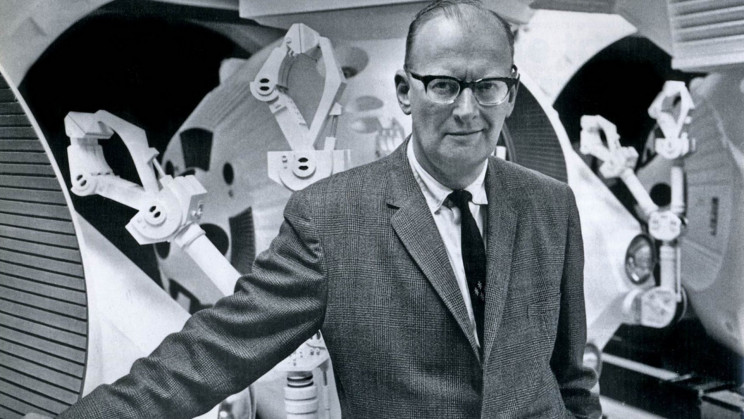
In 1968, Arthur C. Clarke became a household name thanks to the release of the film “2001:
The film also contained many predictionsClark on the future of space travel, which was masterfully executed by the film's illustrators and set designers. And the book includes Clark’s “Map of the Future” - a schedule of his predictions until the year 2100. For example, from a space exploration perspective, Clark predicted spaceships, moon landings, and laboratories in space by the mid-70s. In the 1980s and 1990s, he predicted that humans would land on Mars (and other planets), followed by colonies in the 2000s and interstellar probes by the 2020s.
 Wikimedia Commons
He also predicted the appearance of satellitescommunications by the mid-80s, AI by the 90s and the “Global Library” by 2005. He believed that scientists would develop efficient batteries in the 70s and 80s, fusion energy by the 90s, and wireless energy by 2005. Additionally, by the early 2000s, he foresaw the growth of exobiology (the study of life in space), genetic cataloging, and genomics.
Of course, not all of these predictions came true,at least not within the time frame he proposed. But even where he was wrong, Clark foresaw many trends and events that would eventually become (or are in the process of becoming) reality.
Let's figure out which of Clark's predictions turned out to be accurate.
Satellite communications and Internet
One of the earliest and most accurateClark's predictions were that satellite communications would come from rocket launches. The first recorded mention of this idea was in the article "Extraterrestrial Relays: Can Rocket Stations Provide Worldwide Radio Coverage?" It was published in October 1945 in Wireless World.
In the article, Clarke described a series of artificialsatellites deployed in geostationary orbit (GSO) for relaying radio signals. By 1957, the first artificial Earth satellite (Sputnik-1) with an onboard radio transmitter was launched. The following year, the United States deployed the first dedicated communications satellite as part of the Project Score.

By the 1960s, the firstcommercial communications satellites, and by the 1980s the industry had expanded. Long before that, Clark had predicted the social and economic consequences of the appearance of constellations of communication satellites in orbit. He shared this vision in the 1964 BBC documentary Horizon, where he described what civilization would be like in 2000:
Communication satellites will allow us to be ininstant contact with each other, wherever we are. We will be able to contact our friends anywhere on Earth, even if we don't know their actual physical location.
Arthur Clarke
According to the online index of objects launched inOuter Space, which is maintained by the United Nations Office for Outer Space Affairs (UNOOSA), currently has 7,853 satellites orbiting the Earth. According to the Union of Concerned Scientists (UCS), which actively counts operational satellites, 3,372 of these were active as of January 1, 2021.
It is expected that in the coming years this number will begrow exponentially due to the growth of the satellite Internet market, technology CubeSat and cheaper launch services. Arthur C. Clarke is often credited with the invention of communications satellites. For example, the “Clark Belt” is the name given to the large belt of satellites in GEO.
Arthur Clarke's description of telecommunications is veryresembled the Internet, although he had predicted it decades earlier, in 1974. Then, during an interview with ABC News, the writer spoke to an Australian reporter (and his son) about the future of computing.
Among the giant computers, Clarke explained what computers would look like when the reporter's son became an adult:
We don't have to wait until 2001.Even before, there would be a computer in his house, but not that big. At least he will have a console that he can use to communicate, talk to his friendly local computer and get all the information he needs in his daily life.
Information about bank statements, tickets intheater, all of it will be at home in a compact form. Such a computer will have a screen like a TV and a keyboard. In the future, he will talk to a computer and receive information from it. He'll take it for granted, just like we do with the phone.
Arthur Clarke
Thanks to personal computers (PCs),With Internet connections, cloud computing, and search engines, people today live in a world almost exactly like the one Clarke described. “Home computers” store all the personal information we need, there is a global library of data, and we take these things for granted.
Space planes and commercial airliners
In the movie "A Space Odyssey 2001"about the use of a commercial space plane with the name of a real Pan American airline. Although the real company ceased operations in 1991, the writer's message was clear. Clarke predicted that space planes and commercial space travel would become a reality at the turn of the century.
In the early 1970s, even before completionthe Apollo program, NASA contemplated its next course of action. To reduce the cost of space travel, they decided to develop a new launch system, partially reusable. This is how the space shuttle program was born, which operated until the last of them was decommissioned in 2011.
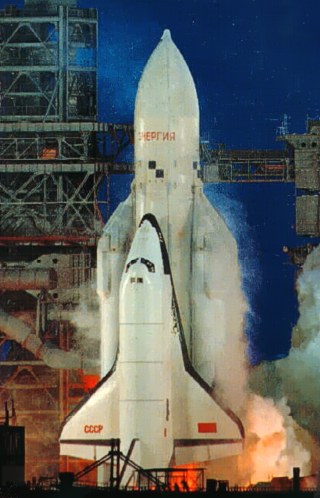
The USSR also developed a reusableorbital ship-rocket plane, but it was never put into permanent operation. Later, scientists began developing spaceplanes such as the Boeing X-37, the Chongfu Shiyong Shiyan Hangtian Qi from China ("experimental reusable spaceplane") and the Dream Chaser from the Sierra Nevada.
Of course, such services were not available in the 2000s,but even then there were rumors that they might someday appear. Between 2000 and 2004, three giants of the modern commercial space industry emerged - Blue Origin, SpaceX and Virgin Galactic. All of them were created with the aim of expanding access to space through the commercialization of launch services.
While SpaceX and its founder Elon Musk are atprimarily engaged in the development of reusable launch systems to transform humanity into an "interplanetary species", Bezos and Branson created the "space tourism" industry.
In July 2021 Virgin Galactic held its firstfully manned flight. And then, on July 20th, 2021, Jeff Bezos flew into space on the first manned mission using the New Shepard spacecraft.
As Elon Musk assures, SpaceX will hold the firstmanned flight on its reusable Starship launch vehicle by 2023. On it, Japanese entrepreneur and collector Yusaku Maezawa and seven other people will fly around the moon.
Thus, these specific predictions are notcame true neither in 1999 nor in 2001. But Clarke predicted trends that materialized around that time. Today, commercial space travel is more reality than fantasy.
Intelligent machines
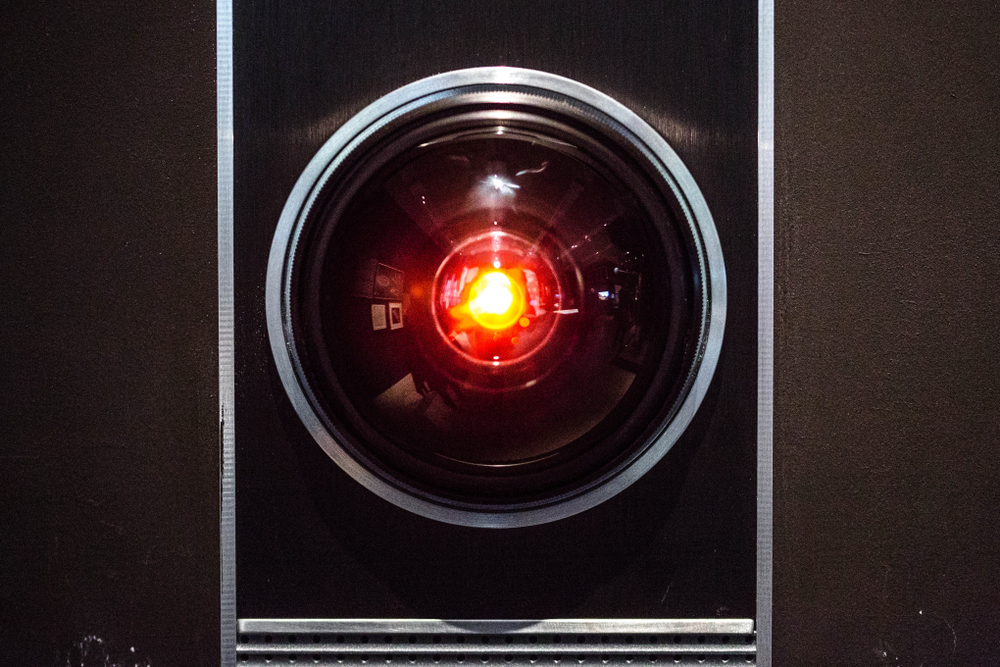
The most important element of 2001: A Space Odyssey was the emergence of artificial intelligence HAL 9000 in the 21st century. In the film, he became an important part of scientific research and space exploration.
The nature and fate of the AI of the future has leftan indelible mark on popular culture. An eerily soothing voice, an iconic red eye, and how HAL 9000 killed expedition members by shutting down life support systems - the image of the AI going crazy has remained unchanged in the public imagination. Even now, in 2021, Clark's prediction that computers will surpass humans at the turn of the century worries some experts.
Talking about the emergence of AI that copeswith complex problems, Clark predicted the development of machine learning. This area of study emerged just a few years before the release of the film and novel A Space Odyssey.
By 2021, supercomputers have already appeared,which, like the HAL, are now capable of simulating human speech and even interactions (like IBM Watson). However, modern supercomputers are still incapable of abstract thinking or reasoning.
Clarke and Kubrick also speculated that HAL 9000will be similar in profile to computers of the time, which occupied entire rooms and had memory cores the size of a wall. Between the 1960s and the 1980s, computers will become smaller and smaller. In the second half of the twentieth century, integrated circuits appeared, which led to the development of personal computers (PCs).
So, while by the 2000s there were computers that surpass everything that existed in the 1960s, humanity has yet to create an AI that will surpass humans in every way.
Strange future
Before his death, Arthur C. Clarke left to the worlda huge amount of literature devoted to the future of humanity. Over time, he revised some of his famous works, mainly as priorities and budgets changed in the post-Apollo era, and also due to technological revolutions.
But, as Clarke himself said in the prologue to 2001 A Space Odyssey: “Remember, this is just fiction. The truth, as always, will be much stranger. "
And this statement of the writer turned out to be 100% accurate.
To read Further
A spaceship several kilometers away: everything that is known about China's new project
COVID-19 mutates, and vaccines are modernized: how to deal with new strains
A supercapacitor the size of a speck of dust has appeared: it is 3 thousand times smaller than its analogues