An international team of researchers presented images of the Orion Nebula obtained by space
Massive young stars radiate a largethe amount of ultraviolet radiation directly into the natural gas and dust cloud that still surrounds them. This changes the physical form and chemical composition of the environment, the scientists explain. Detailed ones will allow you to better understand how massive stars transform the gas and dust cloud in which they are born.
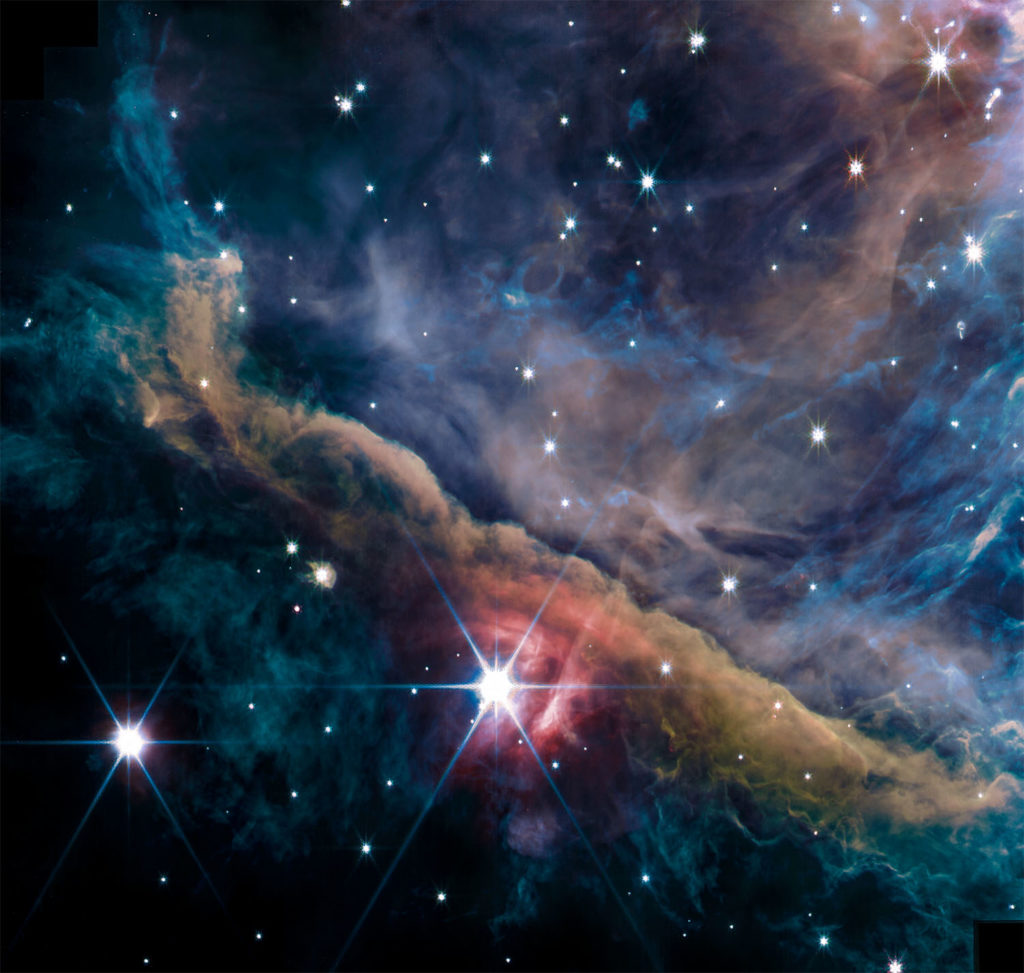 The Orion Nebula. Image: NASA, ESA, CSA, PDRs4All ERS Team; S. Fuenmayor
Regions of the Orion Nebula are similar to the "cradleSolar System, from which our star and its planets were formed about 4.5 billion years ago, the authors of the study add. Observations of such an environment will allow us to understand, by analogy, how the planetary evolution took place in our system.
Regions of star formation in similar nebulaeit is difficult to observe in visible light, since all the details are hidden in a large amount of stardust. But the James Webb telescope can see infrared radiation, which reveals the dust curtain. By studying these images, one can understand what processes are taking place inside the nebula.
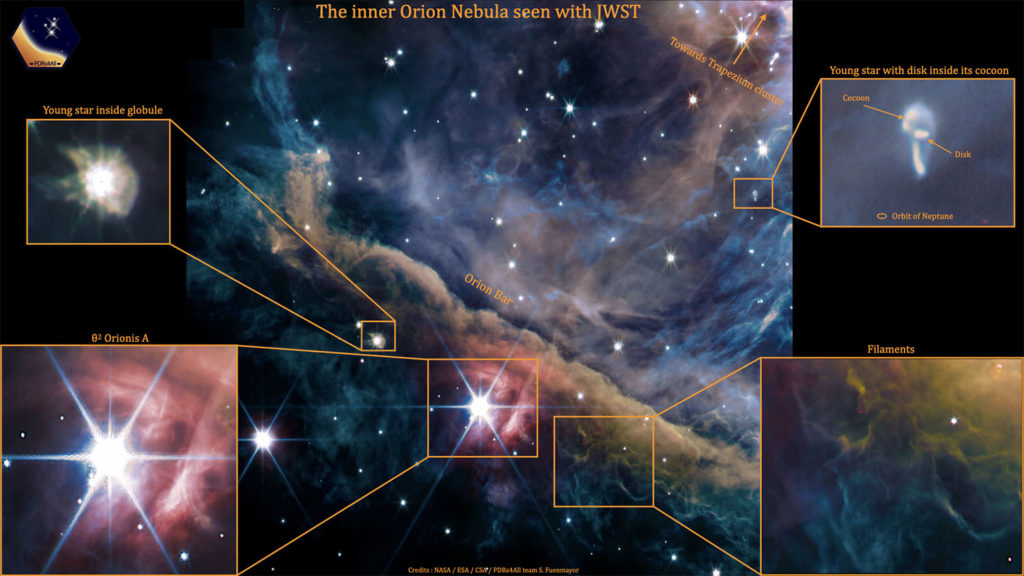 Detailed areas of the image.A young star inside a globule (top left), bright star Orion A (bottom left), a star with a protoplanetary disk inside a cocoon (top right), filaments of molecular gas (bottom right). Image: NASA, ESA, CSA, PDRs4All ERS Team; S. Fuenmayor & O.Berne
Scientists have yet to analyze in detailcollected data, but it is already clear that the telescope has made many interesting observations. For example, in the images you can distinguish a star with a protoplanetary disk inside a cocoon of dust and gas, a young star inside a globule that has just finished collapsing and is starting to glow, and filaments of molecular gas that can form future stars.
Read more:
The space plane will deliver cargo to the ISS and land at a regular "airport"
The star approached the black hole and it was torn apart: scientists observed this from three telescopes
Physicists explain Hawking's 'cosmic mismatch': how it will change science
Cover image: NASA, ESA, CSA