DECaPS2 project researchers presented the results of an analysis of the galactic plane of the Milky Way.
The data included in the catalog is obtained usingDark Energy Camera (DECam) installed on the 4-meter Victor M. Blanco Telescope at the Cerro Tololo Inter-American Observatory. It is located in Chile at an altitude of 2200 meters and provides a good view of the night sky of the southern hemisphere.
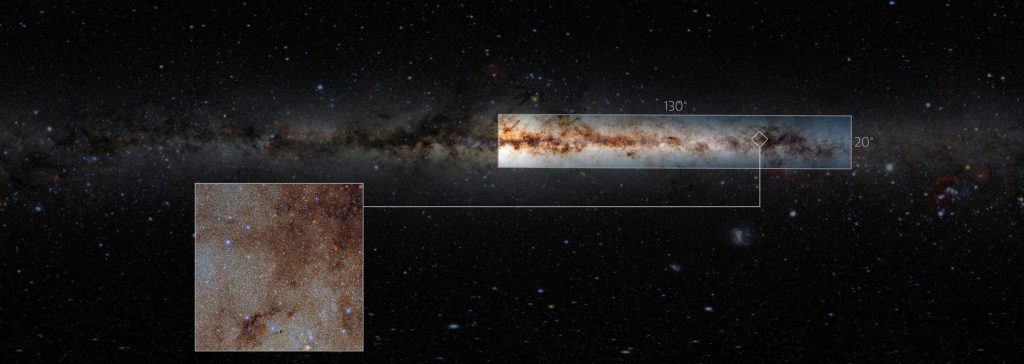 The area being explored during a survey with high detail against the background of the night sky. Image: DECaPS2 / DOE / FNAL / DECam / CTIO / NOIRLab / NSF / AURA / E. Slawik
For his research, which lasted almosttwo years, astronomers processed 21,400 individual night sky exposures taken with the camera. Despite the record number of objects identified during the study, the catalog covers only 6.5% of the night sky and will be supplemented.
The Milky Way contains hundreds of billions of stars,twinkling star-forming regions and dark clouds of dust and gas. Most of these objects lie in the disk plane—a bright band stretching across the night sky—in which the spiral arms of the Galaxy lie. While this abundance of stars and dust makes for beautiful images, it also makes observing the galactic plane difficult.
 Exposure of part of the galactic plane of the Milky Way. Image: DECaPS2 / DOE / FNAL / DECam / CTIO / NOIRLab NSF / AURA
To highlight individual objects hidden inclouds of stardust, the researchers used observations in the near infrared range. In addition, specifically for the DECaPS2 study, scientists have developed a new data processing approach that predicts the background behind each star. This helped mitigate the effects of nebulae and crowded star fields, making the final data catalog more accurate.
Read more:
A giant sunspot is turning towards the Earth. It is visible to the naked eye
Scientists have figured out how to restore the heart after an attack
TESS discovered a "new Earth": a stone planet with water is in the habitable zone
On the cover: The Milky Way with the Cerro Tololo Inter-American Observatory in the background. Image: CTIO/NSF's NOIRLab/AURA/H. stockbrand