Technologies are evolving to improve human life. But sometimes overestimating one’s own strengths is a problem with
Mud volcano Sidoarjo
Sidoarjo, Indonesia has the largestworld mud volcano. It appeared as a result of the explosion of a gas well drilled by an energy company. At the same time, officials from the local oil company claim that the problem was provoked by an earthquake.
In total, there are more than 1,000 mudvolcanoes, but this one seems to be the only one caused by human activity. It all started on May 28, 2006, when oil workers drilled a well to a depth of 3,000 m. This caused an eruption of water, steam and gas from under the earth's surface with great force. This has been going on for over 10 years now. The official name of the volcano is Lumpur Lapindo, but it is commonly referred to as Lucy Volcano.
According to the BBC, the volcano initially ejected180,000 m³ of mud per day. 11 people died during the explosion of the pipeline, another 30,000 people were evacuated from the area. Also, according to the news site Boston.com, dozens of villages and more than 10,000 homes were destroyed, and debris from the mudflow polluted nearby rivers.
Dioxin disaster in Seveso
In the twentieth century in Italy at a chemical plant to the northfrom Milan there was a major industrial accident. It produced 2,4,5-trichlorophenol. According to Chemosphere magazine, the substance has been used as a pesticide and used as a chemical weapon.
On July 10, 1976, a chain reaction destroyedreactor, which, in turn, led to the release of 6 tons of toxic chemicals into the sky. The cloud spread over 18 km² and covered the large city of Seveso. Due to exposure to chemicals, many children were hospitalized. Also, thousands of animals died or were killed to prevent toxins from entering the food chain.
Worst of all, the Seveso disaster hadlong term consequences. Since 1976, more local residents have died from cardiovascular and respiratory diseases, and the incidence of certain types of cancer has increased in the affected areas.
Disaster at Aberfan
Major man-made disasters in Britain happen infrequently. The collapse of the Aberfan mine struck not only the inhabitants of the village of the same name, but the whole country.
The village of Aberfan in the Welsh valleys has grownaround the nearby coal mine, which was opened as early as 1869. After 100 years, the settlement grew, and the village was surrounded by seven huge dumps - waste from mining.
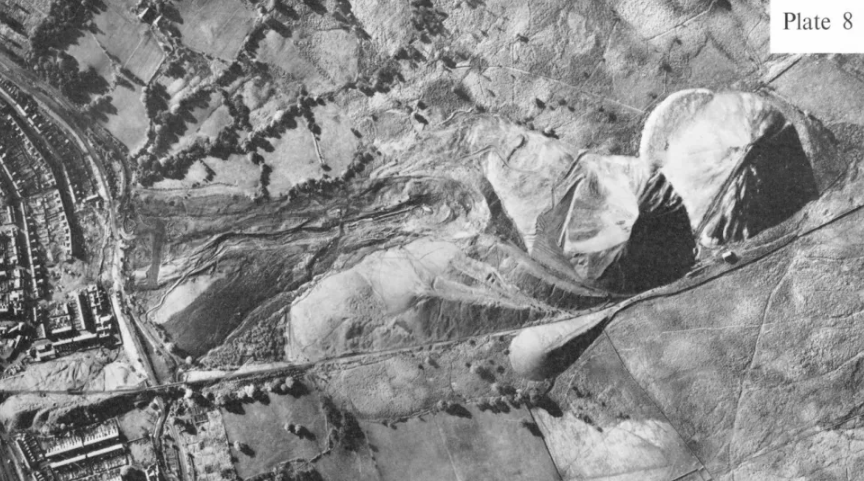 The Aberfan mine disaster destroyed a school, houses and a railway line. Image courtesy of the UK Government
In October 1966, the village of Aberfan fellmore than 15 cm of precipitation, as a result one of the dumps settled. As a result, according to the Smithsonian magazine, a huge amount of rock “demolished” the village at a speed of 17 to 34 km / h. The height of the "waves" reached 9 m in height. The avalanche killed 144 people, including 116 children. The fast moving rock destroyed two schools and 18 nearby houses.
According to the BBC, thousands of volunteers went toregion to help rescuers, and the Prime Minister and Queen Elizabeth visited a few days after the incident. The Aberfan disaster remains one of the most serious mining incidents in the UK.
Bhopal disaster
The Bhopal disaster is considered the worst inmodern history in terms of the number of victims. In early December 1984, a gas leak was detected at a local pesticide plant. This happened due to a malfunction of the security systems. As a result, an uncontrolled increase in pressure led to the leakage of 40 tons of methyl isocyanate. Toxic gas released into the atmosphere. Due to the fact that there were many residential buildings around the plant, more than 600,000 people were exposed to dangerous effects.
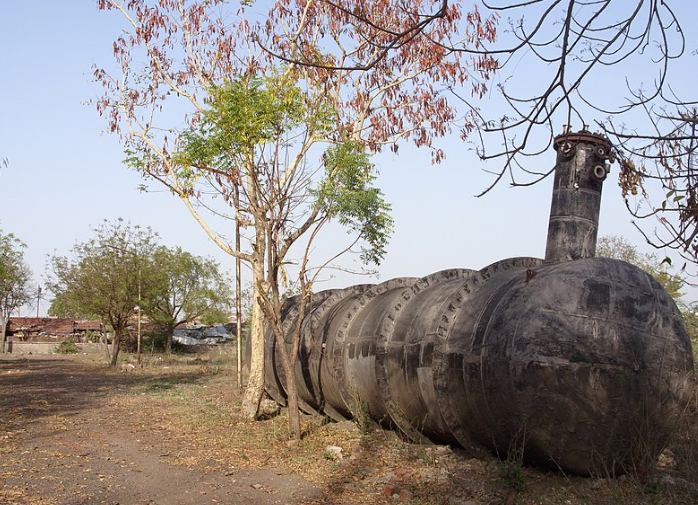 A reservoir from which a deadly gas escaped. Author: Julian Nyča, CC BY-SA 3.0.
According to official government data,On the day of the accident, about 3,000 people died. After the death toll was revised upwards - 5,295 people. According to other sources, the disaster caused the death of at least 18-30 thousand people, of which 7 thousand died on the day of the accident, and about 25 thousand in subsequent years.
The people who lived around the stationinformed, as well as the employees of the nearby hospital. As a result, people suffered from burns and intoxication, and several thousand people died within a few hours after the accident.
Longer term studies doneafter the accident, confirmed that thousands of people are still suffering from physical and psychological illnesses. Experts find it difficult to say exactly how many people were affected.
How to prevent disaster?
Even though in Englishman-made disasters, together with wars and terrorist attacks, are combined into one concept of “man-made disasters”, they cannot be completely prevented. That is why experts recommend focusing on modern notification of the population, the development of evacuation plans and the provision of assistance to the victims.
Read more
"James Webb" took the clearest photo of a star in history
Developments of Moscow radiologists on AI became the basis of federal standards
Quantum charging will allow record-breaking fast charging of electric vehicles