Solar storms occur more frequently and become more powerful as the star approaches its peak
pink auroras
A very rare pink aurora illuminatednight sky over Norway. This happened after a solar storm hit the Earth. The G1 storm caused a small, temporary "crack" in the magnetosphere—the invisible magnetic field surrounding Earth that is generated by the planet's liquid metal core. As a result, charged solar particles penetrated deeper into the Earth's atmosphere than usual.
 Polar Lights.
Photo: Markus Varick
 Polar Lights.
Photo: Markus Varick
Typically, solar wind particles reactwith oxygen atoms high in the atmosphere, which gives them a bright green hue. But this time they encountered nitrogen atoms closer to the ground, which turned the sky pink.
Later, on December 10, eyewitnesses again observed the pink aurora, again in Norway. At times it turned an even rarer orange color.

 Polar Lights.
Photos: Markus Varick

It is noteworthy that the light show was noticed againtourist guide Marcus Varick from the Greenlander company. It is based near the city of Tromso in Norway. Bright auroras appeared around 18:00 local time and lasted about 2 minutes.
Massive plasma plume
Astrophotographer Andrew McCarthy made a beautifulimage of a massive plume of plasma escaping from the Sun after a coronal mass ejection—a large plasma cloud from the solar corona (outer atmosphere of the Sun) or the explosion into space of billions of tons of particles moving at speeds of millions of kilometers per hour. The length of the fiery filament was about 1.6 million km.
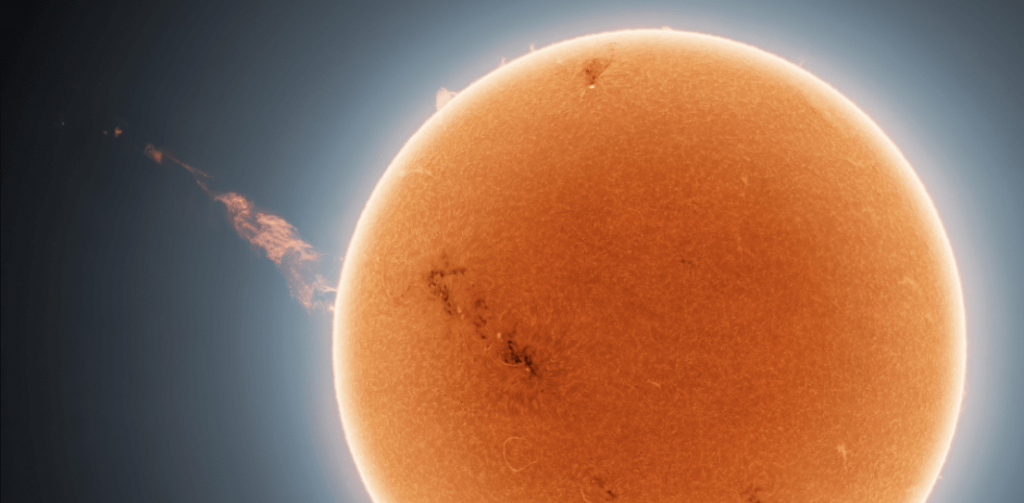 Image courtesy of Andrew McCarthy/@cosmic_background
Initially, the plasma was in a largeloop connected to the surface of the Sun—this phenomenon is known as a prominence. Then it broke off and rushed into space at a speed of about 161,000 km/h.
The photograph itself is a composite imagein artificial colors from hundreds of thousands of images. The photographer took them for six hours. The release was "the largest CME I've ever seen," the image's author said. The full image can be viewed at the link.
Blackout in the Southern Hemisphere
An unexpected solar flare has caused a temporary blackout of radio communications in parts of Australia and all of New Zealand.
It was caused by a coronal ejectiondirected away from the Earth. X-rays and ultraviolet radiation emitted by the flare ionized atoms in the planet's upper atmosphere. They were unable to reflect high-frequency radio waves, which led to a “radio blackout.”
At any point on the planet facingto the Sun, there may be radio communications blackouts due to such flares. Shutdowns are classified from R1 to R5 depending on their danger. This flare caused a moderate dimming of the R2 level. Blackout R5 is capable of disrupting the work of half the planet for several hours.
Giant sunspot doubled in size
Massive sunspot AR3038, sizeroughly the size of Earth, doubled in 24 hours earlier this year. Now its diameter is 31 900 km. A photo of this spot is on the cover of the article.
Scientists warned that a giant spotlocated near the Sun's equator, could lead to several strong M-class flares (medium-intensity flares that can cause large regional power outages). But, although the sunspot was directed at the Earth for about two weeks, the inhabitants of the planet managed to avoid problems.
Apparently, next year we will have more events of this kind. Hi-tech will keep you up to date with events.
Read more:
The tomb of the “midwife of Jesus” was unearthed: scientists told what they found there
Einstein is wrong again and his main theory was rewritten: how it changes the world
Published test video of the world's first propeller with 11 blades