The authors are going to use this model to predict how the star will die.
Technically she
The question of how red hypergiants die is a matter of controversy. Previously, astronomers thought they were simply exploding in a supernova, as most other stars do.
But new data show that supernovae are notas many as exploding stars, but less. By far the most widely accepted theory is that they are most likely collapsing into a black hole. Such an object is much more difficult to observe than a supernova.
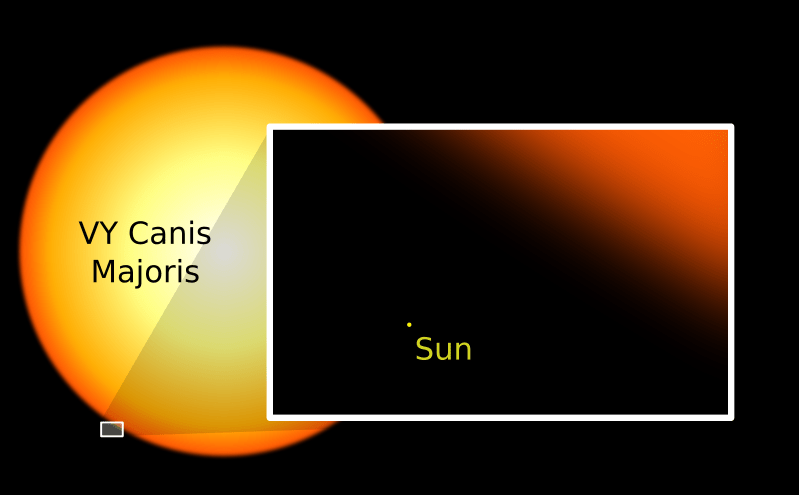
However, it is still unknown what characteristicsmust possess a star to become a black hole. To understand this, the authors chose VY Canis Major. The star has a huge size, and it is also close to our solar system, so it is very convenient to observe it.
One of the main indicators that a star is dying,is the loss of mass. As a rule, this happens when gas and dust simultaneously begin to disappear from the star's photosphere. But VY Canis Majoris has massive objects similar to Earth's coronal arcs, though they are a billion times larger.
UA researchers used data from ALMA to detect radio signals that indicate these eruptions. Sulfur dioxide, silicon dioxide and sodium chloride are erupted.
It is rare for astronomers to collect such a data object from just one object. Now, the data from the math model will continue to be updated so that the model will show when VY Canis Major will finally officially die.
Read more:
The space probe flew 200 km from Mercury. Look what he saw
Scientists uncover how vitamins affect the incidence of cancer
Chinese mind-reading helmet sounds the alarm when a person sees porn content