Scientists from the NOIRLab research institute used a new imaging technique to create the image
R136a1 is considered the most massive knownstars. This colossal star is a member of the R136 star cluster, which lies about 160,000 light-years from Earth at the center of the Tarantula Nebula in the Large Magellanic Cloud.
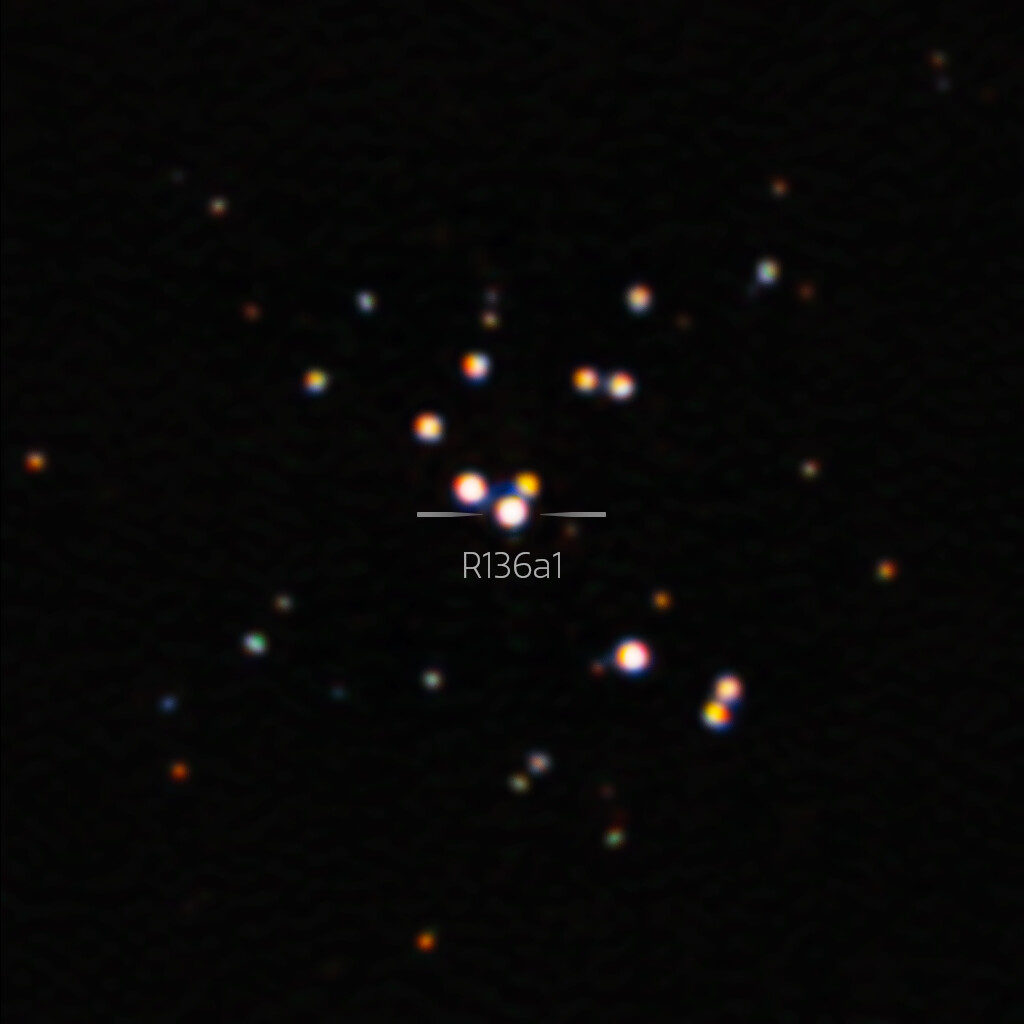 An image of the star R136a1 taken with the Gemini South telescope. Image: International Gemini Observatory, NOIRLab, NSF, AURA
Previous estimates showed that the mass of R136a1250–320 times more than the mass of the Sun. Scientists used the new Zorro instrument on the 8.1-meter Gemini South telescope at the observatory in Chile to take the image.
This device uses technologyspeckle imaging, which allows ground-based telescopes to overcome much of the blurring effect created by the Earth's atmosphere. The telescope takes many thousands of pictures of a bright object with a short shutter speed of only 60 ms, scientists explain. This data is then processed to remove the blur.
In their study, the researchers used 40,000images of the R136 cluster, which were taken within 40 minutes. Each of these shots is so short that the atmosphere didn't have time to blur individual frames, and by carefully combining all 40,000 shots, the team was able to create a sharp image of the cluster.
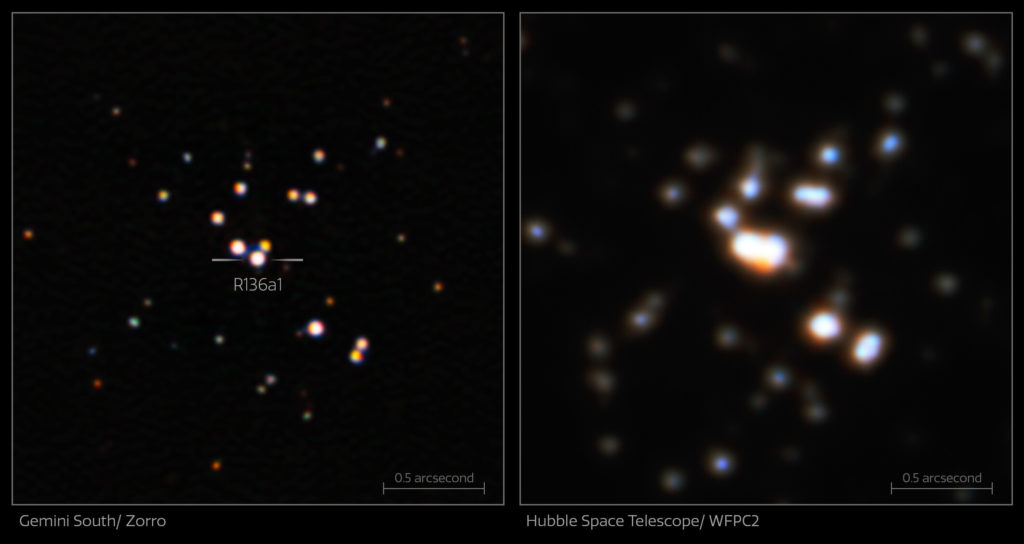 R136a1 as seen by Gemini South (left) and Hubble Space Telescope (right). Image: International Gemini Observatory, NOIRLab, NSF, AURA
Astrophysicists estimate the mass of a star by comparing itobserved brightness and temperature with theoretical predictions. Based on clearer images, they refined the size of R136a1. It turned out that it is only 170-230 times more massive than the Sun, but even this estimate leaves it the largest known star.
On the cover: an artistic image of the largest star. Image: NOIRLab, NSF, AURA, J. da Silva, Spaceengine
Read more:
Record coronal mass ejection at Betelgeuse is 400 billion times larger than the sun
Megalodon ate an animal the size of a killer whale at a time
Everest found traces of DNA that should not be there