Biologists from the German Leibniz Institute for Biodiversity Change Analysis and the Czech Academy of Sciences
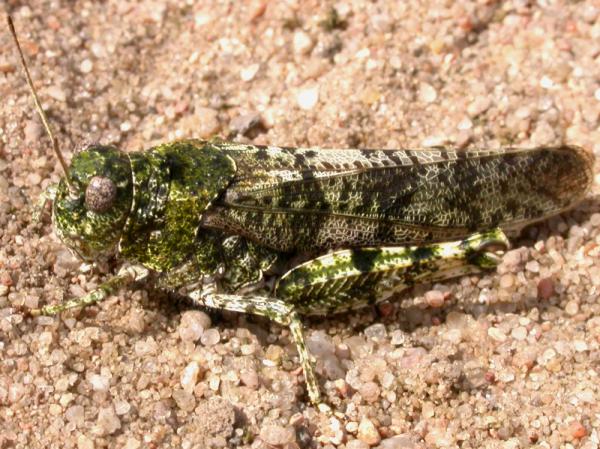 The ratchet is wide-winged. Photo: doc. dr. Eduardas Budrys, Public domain, via Wikimedia Commons
Ratchet broad-winged - one of the most "bright"relatives of grasshoppers living in Central Europe. At the same time, it is one of the rarest, almost extinct species, only a few surviving populations are known on the banks of rivers in the Alps. These endangered habitats have been shaped by thousands of years of constant changes in the natural dynamics of rivers.
The size of the genomes varies greatly among differentgroups of animals, sometimes even within groups. Since the complete genome must be duplicated with each cell division, scientists are looking for reasons for this variability. While scientists have analyzed only a few thousand insect genomes so far, the largest examples have all been found in grasshoppers, locusts and crickets.
Possibly adaptation to changing conditionsenvironment has contributed to genetic diversity and led to exceptional genome sizes. At the same time, when compared with humans, we see that the size of the genome is not necessarily related to the level of complexity of the organism.
Oliver Havlicek, study co-author
The researchers believe that further analysis of genetic differences between species will allow us to learn more about evolutionary mechanisms and adaptation.
Read more:
The secret of longevity is revealed: scientists have figured out how to start the necessary mechanism in the human body
Named a new cause of autism
Notre Dame fire helps scientists unravel the secret of the cathedral's construction
Cover image: Jakob Andreä, Leibniz Institute for the Analysis of Biodiversity Change