The IXPE space observatory has studied a nebula formed as a result of one of the most famous
Images received by IXPE satellite instruments,reveal new details about the magnetic fields inside the Crab Nebula. It refers to plerions: nebulae that are fed by a stream of charged particles accelerated to relativistic speeds by the rapid rotation of the pulsar's magnetic field.
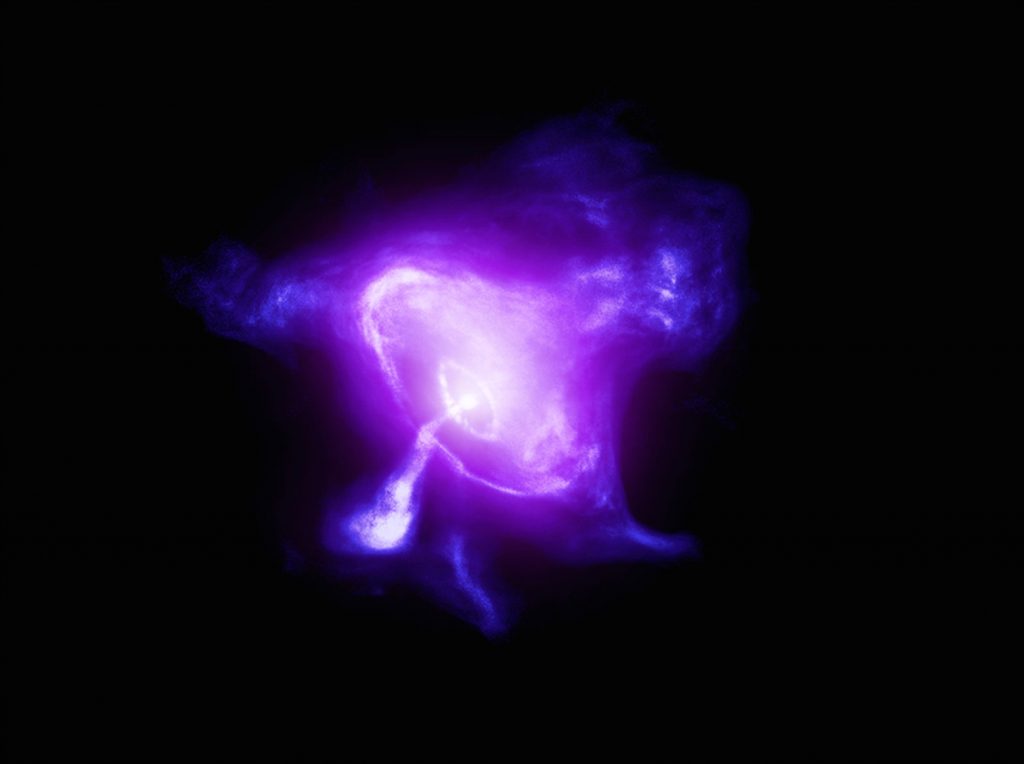 Combined image of the Crab Nebula based on X-ray data fromthe IXPE Observatory in purple and the Chandra Observatory in dark purple.Image: NASA, CXC, SAO, K.Arcand & L.Frattare
The IXPE data show that the magnetic fieldThe Crab Nebula resembles the field of the Pulsar Nebula in Sails, which is also donut-shaped. But in the Crab Nebula, regions of magnetic field turbulence were more patchy and asymmetric than expected.
Polarization of X-rays gives scientists a clueto unraveling the direction of the magnetic field in different parts of a space object, as well as how well the magnetic field is ordered. The geometry and turbulence of the magnetic field determines how particles are catapulted at the speed of light.
 The orange lines show the shape of the magnetic field,defined by IXPE. The observations are superimposed on a composite image made using data from the Chandra X-ray Observatory (blue and white), the Hubble Space Telescope (purple), and the Spitzer Space Telescope (pink). Image: NASA/Bucciantini et al (magnetic field); NASA/CXC/SAO (X-ray); NASA/STScI (visible light); NASA-JPL-Caltech (infrared)
The IXPE observatory measured the polarization angle andstudied the differences in polarization throughout the object. Scientists have discovered regions of strong polarization in the outer regions of the nebula, light years away from the pulsar, where the polarization is lower. This allowed astrophysicists to study not only the X-ray emission of the Crab Nebula, but also the emission of the pulsar itself or the sphere of magnetic fields around it.
The data obtained indicate thatX-rays come from a region of an external magnetic field called the "wind" region. In a magnetic field, the shocks created by the "wind" of the pulsar accelerate the particles to a speed close to the speed of light.
Read more:
Special diet triggers self-destruction of brain cancer cells in mice
Scientists have deciphered the mysterious manuscript of Ptolemy. It was hidden under other text
New image of Hubble puzzled scientists
Cover: The Crab Nebula as seen by the Hubble Space Telescope. Image: NASA, ESA and Allison Loll/Jeff Hester (Arizona State University)