According to Harvard University, there are only three main types of cellular organisms that
Bacteria and archaea may seem to look the same, but the latter are more closely related to eukaryotes.
Basic theory of life
The generally accepted opinion is that the firsteukaryotes are the primitive ancestors of all higher forms of life, including humans. Their appearance was made possible by evolution and symbiogenesis, which forced two single-celled bacteria to merge into a new organism with a nucleus and organelles. This is how most of the living creatures that surround us today emerged.
According to symbiotichypothesis, eukaryotes arose as a result of the union in one cell of different prokaryotes, which first entered into symbiosis, and then, increasingly specializing, became organelles of a single organism-cell.
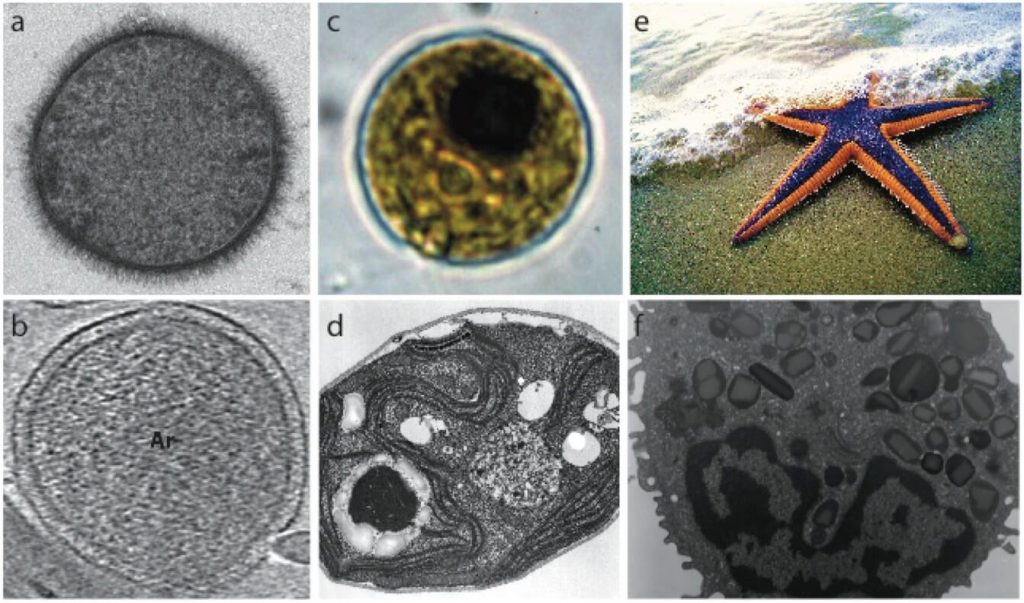 Representatives of the main forms of lifeand their cellular structure. a —bacterium Bacillus subtilis; b —archaea ARMAN; c, d —unicellular eukaryote, microalgae Chlamydomonas sp.; e —multicellular eukaryote, starfish Astropecten articulatus; f —eukaryotic cell (human white blood cell). Collage: sitn.hms.harvard.edu
In other words, evolutionary biologists in generalagree that humans and other living things evolved from bacteria-like ancestors. But about 2 billion years ago, human ancestors separated. This new group, eukaryotes, also gave rise to the development of primitive organisms into animals, plants, fungi and protozoa.
However, new research changes the picture of the world. Scientists have shown that the enzyme in the human cell nucleus comes from one of the earliest forms of life on Earth.
What did the scientists find out?
A group of biologists from the Faculty of ChemistryUmeå University in Sweden has found clear traces of archaea (odinarchaeota) in the human enzyme AK6. It performs many functions, for example, it is responsible for energy metabolism, genome stabilization and programmed cell death.
 The enzyme in the nucleus of a human cell comes from one of the earliest forms of life on Earth.
Author: Johnér Bildbyrå AB, Cultura Creative
Specialists have discovered a molecular mechanism for the recognition of compounds by the odinarchaeota enzyme.
What is the essence of the mechanism?
It turned out that he uses an amino acidglutamine, which has unique chemical properties that allow it to detect a wide range of molecules through a sequence of short loops in the enzyme. This mechanism can now be applied to the production of new enzymes, for example, for the processing of wood raw materials.
Why is it important?
The field of enzyme design aims to develop new designs that can be used, for example, in green chemistry. One example is the environmentally friendly processing of wood raw materials.
What does it change?
As a result, scientists refuted the “eukaryotic theory” and confirmed the origin of humans from archaea.
As the study authors explain, new datawill help us learn more about how human cells evolved from more primitive predecessors. The author of the study, Magnus Wolf-Watz, recalls that the Nobel Prize was just awarded to the “great discovery” that “humans have a lot of Neanderthal DNA.”
At the same time, the age of the earliest remainsNeanderthals (proto-Neanderthals) - is about 500,000 years old; as a species they finally emerged around 130,000–150,000 years ago. And according to the most common hypotheses, eukaryotes appeared 1.6–2.1 billion years ago. As the scientist concludes, it seems that people still have billions of years of human history to unravel.
Read more:
A massive impact from a space object triggered the Earth's magnetic field
Scientists Confirm Alternative Gravity Theory: Why It Changes Physics
Pig heart beats slower after transplant to human
On the cover: needpix.com