The James Webb Space Telescope observed the galaxy Arp 220, formed as a result of the merger of two
The Arp 220 galaxy is located about 250 millionlight years from the Sun in the constellation Serpens. It began to form about 700 million years ago due to the merger of two separate galaxies. This event triggered an explosion of star formation. Scientists have counted about 200 huge star clusters that are located in a dense dusty region with a diameter of about 5,000 light years (5% of the diameter of the Milky Way).
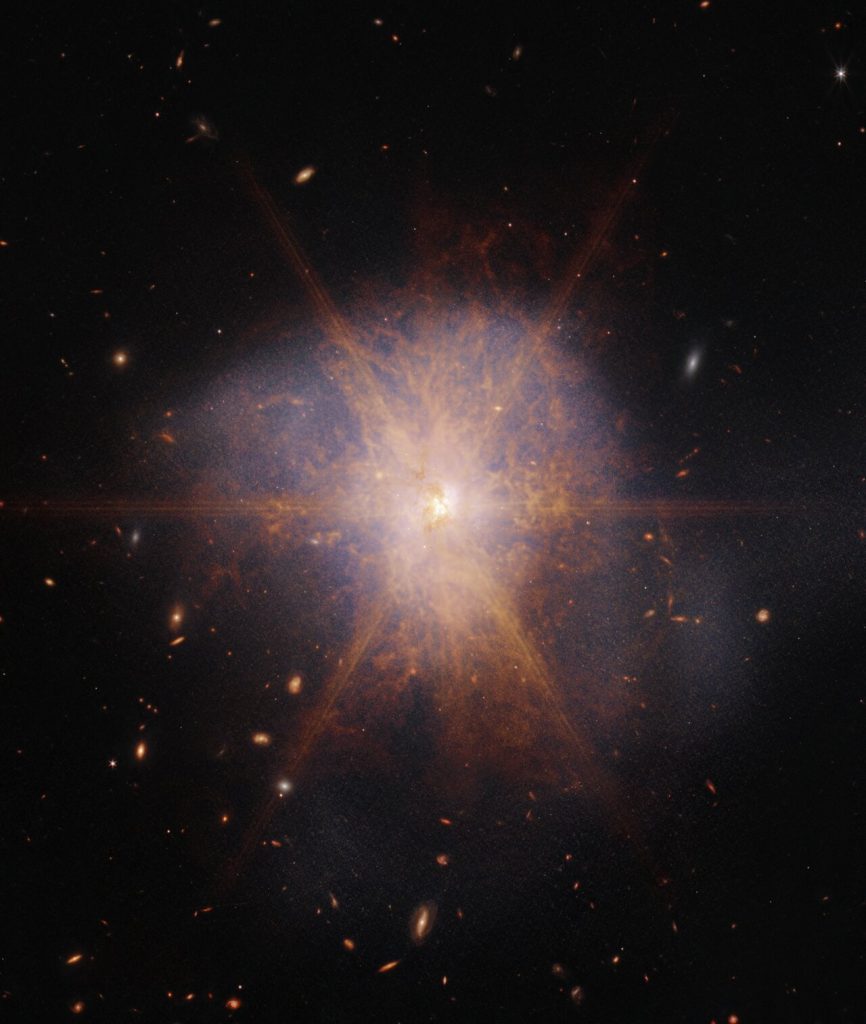 The bright glow of the Arp 220 galaxy. Image: NASA, ESA, CSA, K. Pontoppidan (STScI), A. Pagan (STScI)
This is not the first observation of a bright galaxy.When studying Arp 220 using radio telescopes, scientists found about 100 supernova remnants over an area of less than 500 light years. Ultraviolet-visible analysis of the galaxy using the Hubble Space Telescope showed the cores of the two parent galaxies located 1,200 light-years apart.
Each of the nuclei has a rotating star-forminga ring that emits dazzling infrared light. The scientists used the James Webb telescope's instruments, which are sensitive to this type of radiation, to study these structures. The bright light that dominates this image shows active star formation in these rings.
On the outskirts of this confluence, a space telescopedetects faint tidal tails, or material pulled out of galaxies by gravity. They are shown in blue in the image. The reddish-orange objects that appear in the streams and filaments in the galaxy image show organic elements. The researchers will continue to analyze the collected data to learn more about the merger of large-scale structures in the universe.
Read more:
No longer a toy. What will the evolution of GPT and Midjourney lead to?
In space, no one will hear your cry: 7 action-packed books about the secrets of the universe
"Sea" of quarks inside one proton: what does an elementary particle consist of