Physicists working on the Borexino experiment, a particle detector in the Gran Sasso underground laboratory,
The results of observations showed that the metallicitysolar core is higher than the standard solar model predicts. Recall that in astrophysics, metallicity is the content of any chemical elements heavier than hydrogen and helium, and not just metals.
Thermonuclear reactions in the sun
The energy produced by stars is one ofproducts of nucleosynthesis, the formation of various chemical elements in the process of nuclear fusion in the interior of a star. It is believed that stellar nucleosynthesis began with the formation of hydrogen, helium and lithium during the Big Bang. The main chemical process that generates most of the energy in the cores of main sequence stars (the main stage in the evolution of stars) is hydrogen fusion.
During this process, also calledBy burning hydrogen (although it has nothing in common with burning hydrogen gas in the presence of oxygen), four protons combine to form a helium nucleus. There are two predominant processes by which stellar hydrogen is synthesized: the proton-proton chain and the carbon-nitrogen-oxygen (CNO) cycle.
About 99% of solar energy is produced inthe result of proton-proton chain reactions. The cycle includes three stages. First, two protons that have enough energy to overcome the Coulomb barrier fuse to form a deuteron, a positron, and an electron neutrino. In the second stage, a deuteron fuses with a proton to form a helium-3 nucleus. Finally, the two nuclei of a helium-3 atom fuse to form the nucleus of a helium-4 atom. This releases two protons, which trigger new reactions.
The rest of the solar energy is suppliedas a result of the reactions of the CNO cycle. This is a series of thermonuclear reactions (including oxygen and carbon combustion), in which carbon, oxygen and nitrogen act as catalysts, contributing to the conversion of hydrogen atoms (protons) into helium-4 atoms. Both the proton-proton chain and the CNO cycle produce neutrinos as by-products.
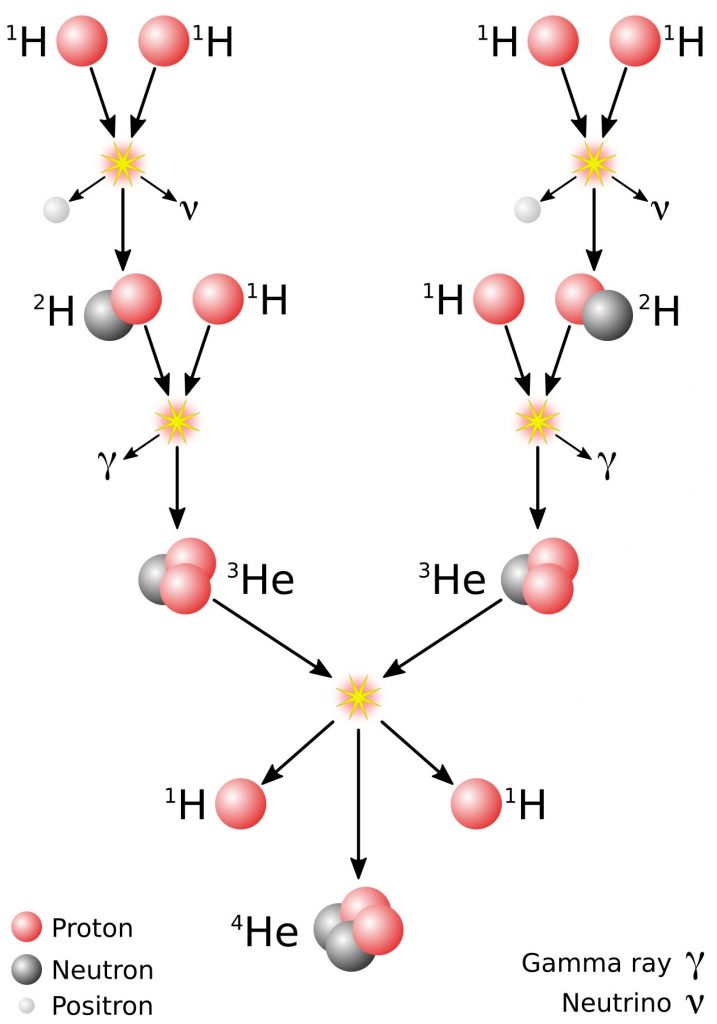 Proton-proton chain. Sarang, Public domain, via Wikimedia Commons
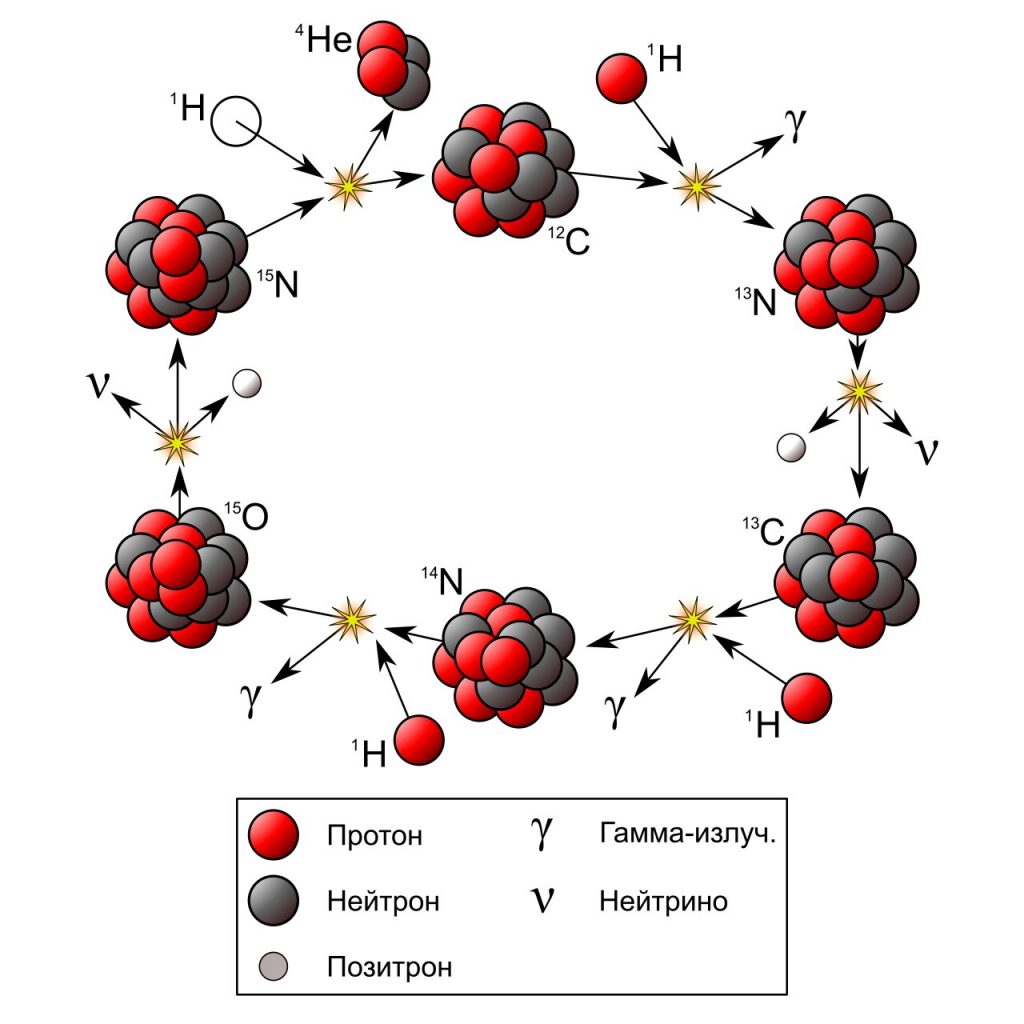 CNO cycle. Image: Kirill Borisenko, CC BY-SA 4.0, via Wikimedia Commons
Measuring the internal composition of the Sun
Until now, astrophysicists have had two ways to investigate the internal composition of a star closest to Earth. These are spectroscopy and helioseismology.
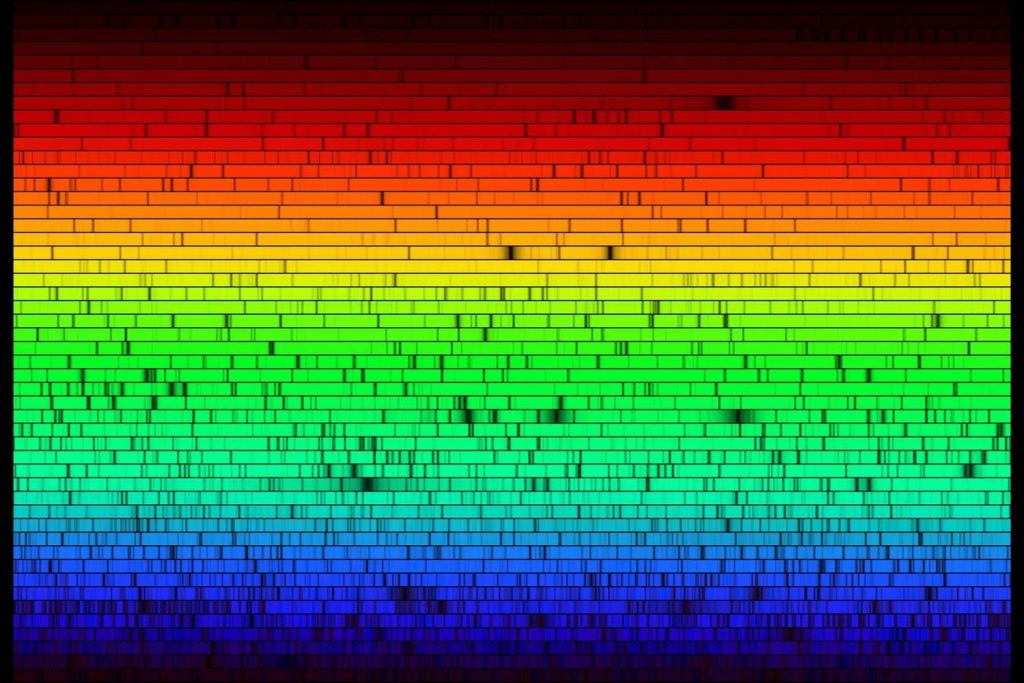 Spectroscopy of the Sun. Image: N.A.Sharp, NOAO/NSO/Kitt Peak FTS/AURA/NSF
When using spectroscopy, scientistsAnalyze the spectrum of sunlight to look for “fingerprints” of various chemical elements. Each of them absorbs light with a certain wavelength, as a result, depending on the composition, dark lines are formed on the spectrum - absorption lines.
By the way, it was thanks to spectroscopy thathelium was first discovered. This element was not discovered on Earth at that time, observing its absorption line on the spectrum of sunlight in the chromosphere of a star during a solar eclipse, the researchers found that there is some additional element that (as it was then believed) does not occur on our planet.
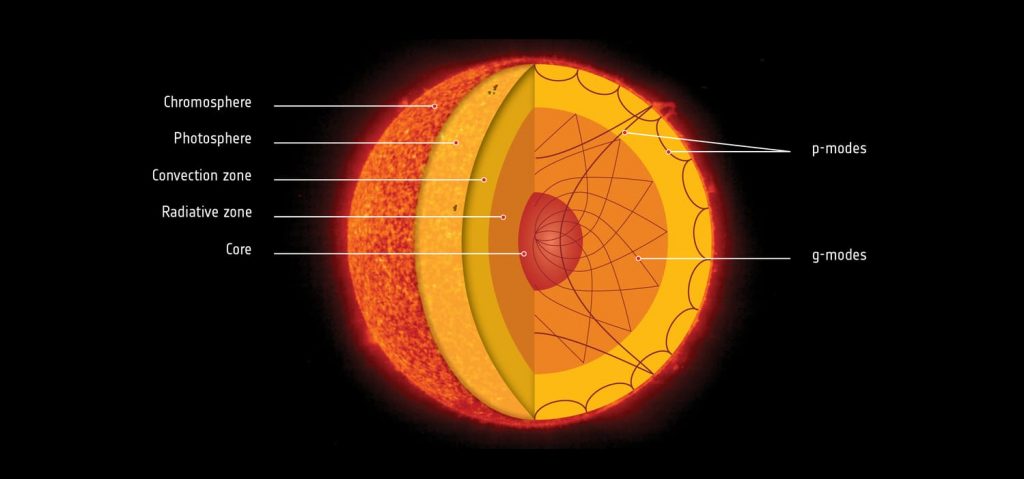 An illustration of the propagation of acoustic waves inside the Sun. Image: ESA, NASA
The second approach to analyzing the composition of a star is calledhelioseismology. Scientists using this method measure the sound waves that reach the surface of the Sun after being reflected inside the star. Moreover, the more heavy elements on the Sun, the more they prevent the penetration of sound waves to the surface, which means the higher the metallicity of the star.
In the past, proposed methods have given comparableestimates, but as the measurement accuracy improved, the data diverged. To reconcile (or quarrel) the two measurement methods, the researchers came up with a new approach.
Back in 2020, physicists announced that for the first time theydiscovered the neutrinos of the CNO solar cycle using the detectors of the Borexino experiment. They collected data between January 2017 and October 2021, observing an average of 4.8 CNO neutrinos per day. In a new paper published in the journal Physical Review Letters, scientists report that they have halved the error of previous measurements and more accurately determine the content of carbon and nitrogen in the core of the Sun.
What is the metallicity of the Sun?
Since the early 2000s, measurements taken withusing spectroscopy and helioseismology began to diverge. The first method of measurement showed a lower content of heavy elements than the analysis of sound waves. The results of neutrino observations confirm the high metallicity theory of helioseismographs: they say that the amount of heavy elements is 9-58% more than the theory based on spectroscopy suggests.
One possible explanation for these differences inmeasurements there may be a difference in the concentration of chemical elements on the surface and inside the star’s core. This hypothesis is proposed by astrophysicists who published the results of their modeling in the journal Astronomy & Astrophysics. They showed that if the Sun collected material from the protosolar disk unevenly during its formation, then the metallicity of its core could be 5% higher than at the surface.
For now this is only a hypothesis that they canconfirm or refute future measurements. But this hypothesis gives hope that researchers using different approaches for their measurements will be able to reach a consensus and create a unified and consistent model of the Sun, and therefore better understand how other stars work, the distance to which does not allow the use of so many alternative instruments.
The fact that there is much more inside the Sunmore carbon, oxygen and nitrogen "changes the understanding of how chemical elements are formed, how stars develop, how they live and die," the scientists note.
Read more:
Named foods that cause cancer. They are served on the New Year's table
Chinese rover discovers traces of never-before-seen basalt on the moon
The most beautiful photos of "Webb" for 2022: see what the $ 10 billion telescope did
Cover image: NASA/GSFC/SDO